

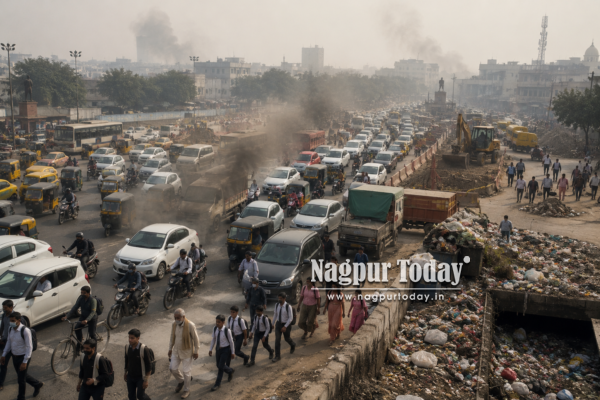
Nagpur: As governments, civic bodies and environmental organisations marked World Environment Day with tree plantation drives, awareness campaigns and lofty promises, the reality on the ground in Nagpur painted a far less encouraging picture. Growing air pollution, unchecked dust emissions, worsening traffic congestion, poor sanitation and deteriorating civic infrastructure continue to threaten the city’s environmental health, leaving residents increasingly concerned about their quality of life.
Across several parts of the city, commuters encounter vehicles belching thick black smoke, construction sites generating massive dust clouds and roads clogged with traffic for hours. Environmentalists and citizens alike argue that while environmental protection is celebrated symbolically once a year, the everyday challenges affecting Nagpur’s environment remain largely unresolved.
One of the most visible concerns is the steady deterioration in air quality. From major intersections to busy arterial roads, numerous vehicles can be seen emitting dense black exhaust fumes, contributing significantly to atmospheric pollution. During peak morning and evening hours, a haze often hangs over several parts of the city, reducing visibility and exposing residents to harmful pollutants.
Doctors have repeatedly warned that prolonged exposure to polluted air can lead to respiratory illnesses, asthma, allergies, eye irritation and cardiovascular complications. Residents living along busy traffic corridors say breathing difficulties and throat irritation have become increasingly common, particularly among children and senior citizens.

Despite periodic enforcement drives, citizens question whether adequate action is being taken against polluting vehicles that continue to operate openly on city roads.
Traffic congestion adding to environmental burden
Nagpur’s rapidly expanding vehicle population has further aggravated the situation. With public transport systems struggling to emerge as a reliable alternative for daily commuters, dependence on private vehicles continues to rise. The result is growing traffic congestion across key junctions and commercial areas.
Ongoing construction of flyovers, road widening projects and infrastructure works at multiple locations has compounded the problem. Long queues of vehicles trapped in traffic jams continue to burn fuel while standing idle, releasing substantial quantities of harmful emissions into the atmosphere.
Environmental experts warn that unless traffic management improves and sustainable transport options are strengthened, pollution levels could rise sharply in the coming years.
While air pollution dominates public attention, conditions in several older and densely populated localities reveal another side of the environmental crisis.
Accumulated garbage, plastic waste, overflowing drains and inadequate sewerage infrastructure continue to plague many residential areas. Residents complain that irregular cleaning schedules and ineffective waste management have resulted in unhygienic conditions and foul odours.
In several neighbourhoods, heaps of discarded plastic and solid waste can still be found along roadsides and open spaces, raising concerns about public health as well as environmental degradation.
Monsoon near, drains still choked
Particularly alarming is the condition of the city’s drainage network ahead of the monsoon season.
Every year, civic authorities announce extensive pre-monsoon desilting and drain-cleaning drives. However, many residents claim that ground realities tell a different story. Numerous drains continue to remain clogged with silt, garbage and plastic waste, increasing the risk of waterlogging and flooding once heavy rains begin.
Citizens and activists argue that the city cannot afford to treat environmental management as a seasonal exercise carried out only during emergencies or annual observances.
Authorities claim improvement
Responding to concerns, Hema Deshpande, Divisional Officer of the Maharashtra Pollution Control Board (MPCB), said efforts are being made to improve air quality under the National Air Quality Monitoring Programme (NAMP).
According to her, pollution levels are being regularly monitored across different parts of the city and awareness campaigns are being conducted to educate citizens. She stated that improvement works are progressing, although challenges remain in densely populated areas where implementation is often slower.
Deshpande said authorities have identified pollution hotspots across the metropolitan region and are undertaking targeted interventions to improve environmental conditions. She expressed confidence that the prescribed pollution-control targets would be achieved gradually.
Citizens seek action, not symbolism
For many residents, however, the growing environmental crisis demands more than assurances. Environmental activists believe that Nagpur requires sustained enforcement against polluting vehicles, scientific waste management, effective public transport, stricter monitoring of construction activities and greater accountability from civic agencies. They argue that without concrete action, World Environment Day risks becoming an annual ritual disconnected from the environmental realities confronting citizens every day.
As Nagpur continues to expand and urbanise, the challenge before authorities is clear: transform environmental commitments from speeches and campaigns into measurable improvements on the ground before pollution, congestion and civic neglect inflict irreversible damage on the city’s future.