

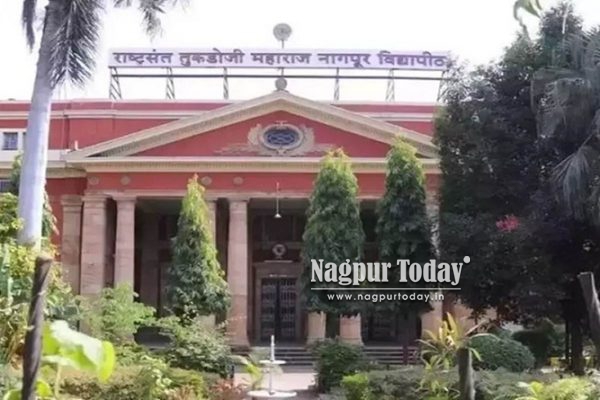
Nagpur: In a major academic transformation aimed at making higher education more skill-oriented and employment-driven, Rashtrasant Tukadoji Maharaj Nagpur University has announced the launch of a wide range of innovative degree programmes, honours courses and industry-integrated academic initiatives from the upcoming academic session.
The move is being viewed as one of the most significant curriculum reforms undertaken by the university in recent years, as it attempts to align itself with rapidly changing global employment trends, emerging technologies and the growing demand for specialised professional skills.
A major highlight of the initiative is the introduction of Apprenticeship Embedded Degree Programmes (AEDP), which aim to bridge the gap between academic education and industry requirements. Under this model, students will receive classroom education along with practical industrial exposure, internships and skill-based training.
University officials believe that the programme will significantly improve employability by ensuring that students graduate with both theoretical knowledge and hands-on experience. The initiative is also expected to encourage entrepreneurship among students by exposing them to real-world industrial practices and professional environments.

For the first time in its history, RTMNU is also introducing diploma courses that students can pursue immediately after completing Class 12. Until now, the university had primarily focused on conventional undergraduate and postgraduate education through affiliated colleges and university teaching departments.
The newly introduced diploma programmes by the Department of Mass Communication include Diploma in Film Production and Diploma in Artificial Intelligence and Digital Media. The courses are aimed at preparing students for rapidly expanding sectors such as digital media, entertainment production, content creation, artificial intelligence-driven communication and emerging technologies.
Vice Chancellor Dr Manali Kshirsagar said the university is attempting to redesign its academic structure in accordance with changing industry expectations and technological advancements.
Apart from the diploma programmes, the university has also announced a series of honours courses in futuristic and high-demand sectors. These include B.Sc. (Hons.) in Data Science and Artificial Intelligence, Financial and Actuarial Mathematics, Cyber Security, Semiconductor Materials and Devices, System Applications and Products in Data Processing (SAP), Cyber Science and Drone Science.
Additionally, RTMNU has introduced B.Com. in Corporate Administration and B.A. (Hons.) in Economics to provide specialised knowledge and industry-oriented exposure in commerce and social sciences.
Education experts believe the university’s decision to focus on areas such as Artificial Intelligence, Cyber Security, Semiconductor Technology, Data Science and Drone Science reflects the changing landscape of higher education, where technology-based skills are increasingly becoming essential for career growth and employment opportunities.
University authorities stated that the programmes have been designed in line with the objectives of the National Education Policy, which promotes multidisciplinary learning, vocational education, internships, research orientation and stronger collaboration between academia and industry.
The reforms are also being seen as an attempt by RTMNU to move beyond its traditional image of being largely dependent on conventional arts, commerce and science streams. Over the years, universities across the country have faced criticism from students, parents and academicians for failing to adapt to rapidly changing job markets and industry expectations.
With the launch of these programmes, RTMNU appears to be positioning itself as a future-focused university seeking to prepare students not only for conventional careers but also for emerging sectors driven by digital transformation, automation and technological innovation.
The admission process for the newly launched programmes is expected to commence in the coming days.