

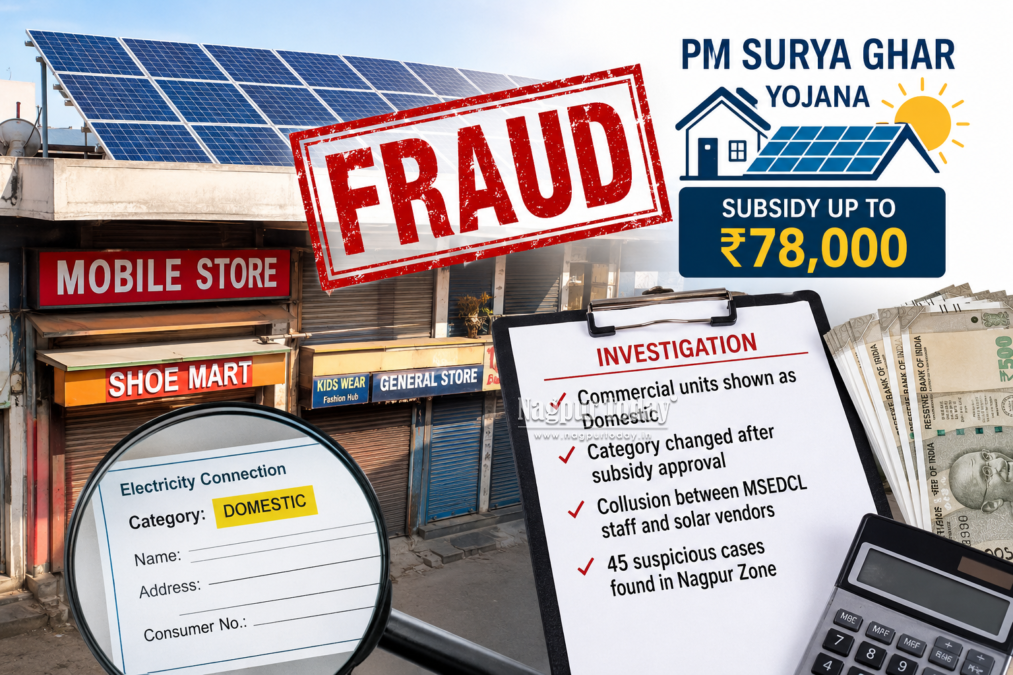
Nagpur: A massive fraud linked to the Central Government’s ambitious PM Surya Ghar Yojana has surfaced in Maharashtra, with Nagpur emerging as one of the key centres of the alleged scam. The shocking revelations have triggered panic within power department circles after investigators uncovered cases where commercial establishments were allegedly disguised as residential properties to illegally obtain hefty Government subsidies meant exclusively for domestic consumers.
The PM Surya Ghar Yojana was launched to promote rooftop solar systems for households by offering subsidies of up to Rs 78,000 along with the promise of reduced or free electricity bills. Maharashtra has been among the top-performing states in implementing the scheme. However, the latest findings have now raised serious questions over large-scale misuse of public funds and possible collusion between officials and private players.
The alleged racket came to light after Maharashtra State Electricity Distribution Company Limited (MSEDCL), also known as Mahavitran, noticed a suspicious pattern involving consumers who suddenly applied for conversion of their electricity category from Commercial to Domestic before installing rooftop solar systems.
According to sources, once the solar panels were installed and the subsidy amount was sanctioned, many of these consumers allegedly reverted their connections back to Commercial status, exposing what officials suspect to be a carefully planned subsidy fraud.

Investigators believe the manipulation could not have happened without internal assistance. Preliminary findings indicate possible collusion between certain MSEDCL employees, consumers and solar vendors, who allegedly exploited loopholes in the system to siphon off Government benefits reserved for ordinary households.
Sources revealed that the fraud pattern was detected after officials noticed an unusual spike in category-change applications linked to rooftop solar installations. This triggered internal scrutiny, leading to the exposure of multiple suspicious cases.
So far, 45 such cases have reportedly been identified in the Nagpur Zone alone. Out of these, six cases are from Wardha district, while the remaining are from Nagpur district. Officials said the number could rise sharply as detailed verification and field inspections continue across the state.
Authorities also found two unusual cases where electricity connections were shifted from Domestic to Public Service category after the subsidy process was completed, while most others were changed back to Commercial.
The emerging scam has now sparked a blame game between MSEDCL and solar industry representatives.
Saket Suri, Director of AIREA, strongly denied the allegations against solar vendors and accused MSEDCL of attempting to shift responsibility onto private companies. He argued that the entire rooftop solar approval process, including inspections and installation of net meters, is handled by MSEDCL officials themselves.
“How can vendors be blamed when the official portal itself shows the consumer as a domestic connection? Vendors work based on the category approved by MSEDCL,” he questioned.
His remarks have further intensified suspicions about possible involvement of insiders within the power utility.
Sources claim that investigators are now examining whether fake inspections, manipulated documents and forged declarations were used to illegally approve subsidy claims under the scheme.
Amid growing controversy, the Executive Director of MSEDCL has reportedly written to all Chief Engineers across Maharashtra, directing them to carry out physical verification of all consumers who installed rooftop solar systems under the scheme.
The development has sent shockwaves through the solar sector and Government departments alike, as authorities fear the scam could run into crores of rupees if similar irregularities are found elsewhere in the state.
The alleged fraud has also raised serious concerns about monitoring mechanisms under flagship subsidy schemes and whether public money meant to support genuine domestic consumers was systematically diverted through a well-organised nexus.