

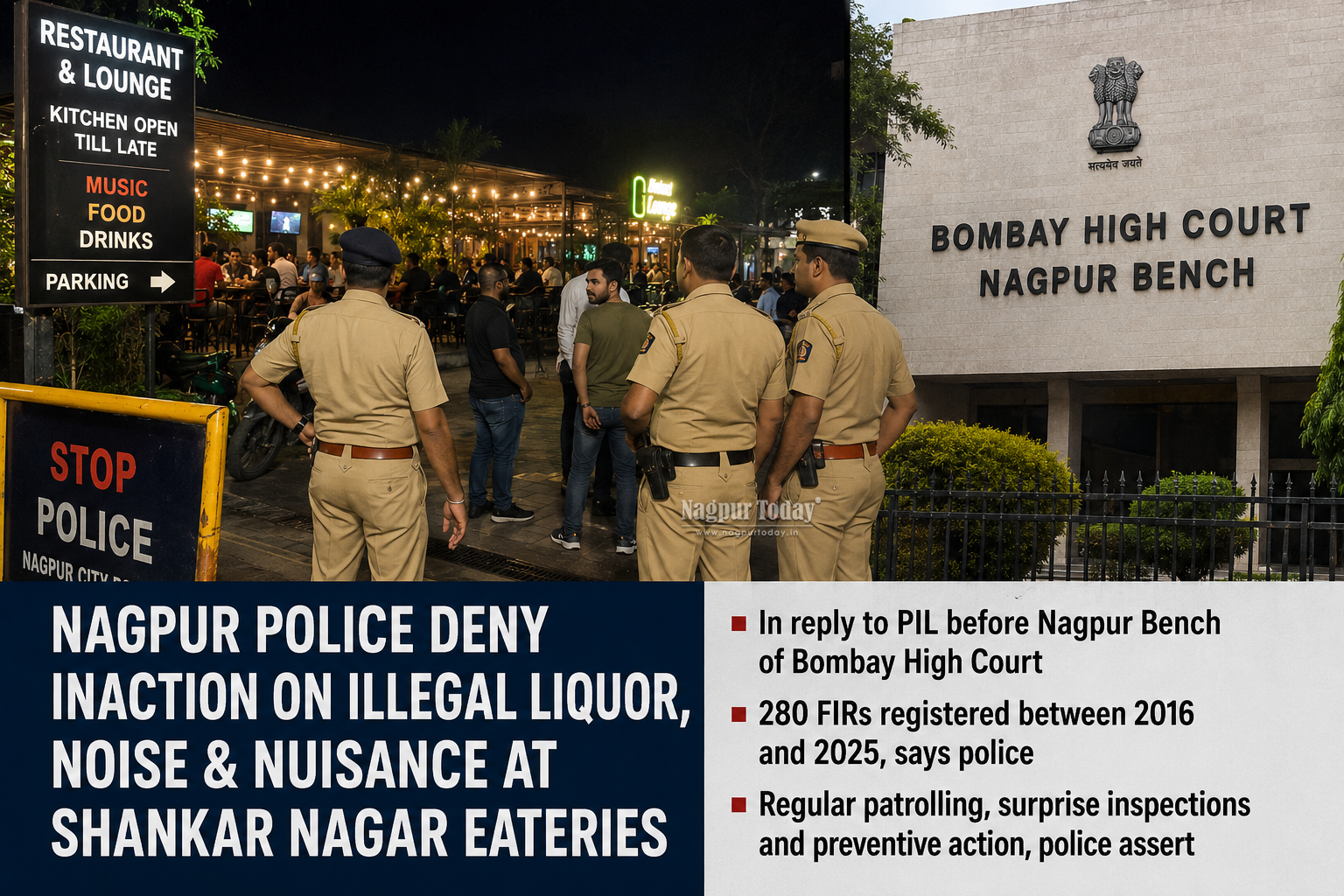
Nagpur: The Nagpur Police have firmly rejected allegations of inaction against illegal liquor consumption, noise pollution and public nuisance at eateries operating on PDKV land in East Shankar Nagar, asserting before the Nagpur Bench of Bombay High Court that sustained enforcement action has been carried out over the years.
In a detailed affidavit filed on Monday, police authorities stated that as many as 280 FIRs were registered between 2016 and 2025 under the Maharashtra Prohibition Act and other relevant laws. The reply came in response to a public interest litigation (PIL) filed by three Shankar Nagar residents through senior counsel Akshay Naik and Parth Malviya.
Refuting claims of administrative apathy, the police emphasised that regular night patrolling, surprise inspections and preventive action have been consistently undertaken to tackle violations such as illegal liquor consumption, late-night operations and loud music. “Registration of FIR itself demonstrates that the police had taken cognisance of complaints and initiated legal action,” the affidavit stated.
The petitioners, however, alleged that authorities failed to effectively curb unlawful activities, including liquor consumption without permits, operations beyond permissible hours and persistent noise pollution. They sought strict directions from the court to shut down errant establishments and enforce provisions of the Maharashtra Police Act and Prohibition laws more rigorously.

The police response, filed by Bajaj Nagar Police Inspector Chetansingh Chauhan through Additional Government Pleader Sangita Jachak, underlined that immediate action is taken whenever violations are detected, including stopping sound systems running beyond allowed hours and initiating legal proceedings against offenders.
At the same time, the police pointed to jurisdictional limitations, stating that licensing, building permissions and regulatory enforcement primarily fall under the Nagpur Municipal Corporation and the State Excise Department. The affidavit urged the court to include the Municipal Commissioner as a party in the matter, noting that the police are not the licensing authority.
Highlighting specific action, officials said several eateries were found allowing customers to bring and consume liquor on their premises, leading to penal action. In one case, a restaurant was sealed for 15 days under Section 142 of the Prohibition Act following repeated violations.
Addressing concerns over public nuisance, the police stated that preventive measures, including issuing notices, rounding up habitual offenders and maintaining continuous surveillance, are in place. Instances of disorderly conduct, rash driving and late-night disturbances are being dealt with through “immediate preventive and legal action,” the affidavit added.
The police also flagged systemic gaps, noting that the removal of mandatory police verification for certain licences since 2015 has weakened regulatory oversight.
Dismissing what it termed as “generalised allegations of inaction,” the police told the court that enforcement is based on specific complaints, evidence and verifiable incidents, while monitoring continues to maintain public order in the area.