

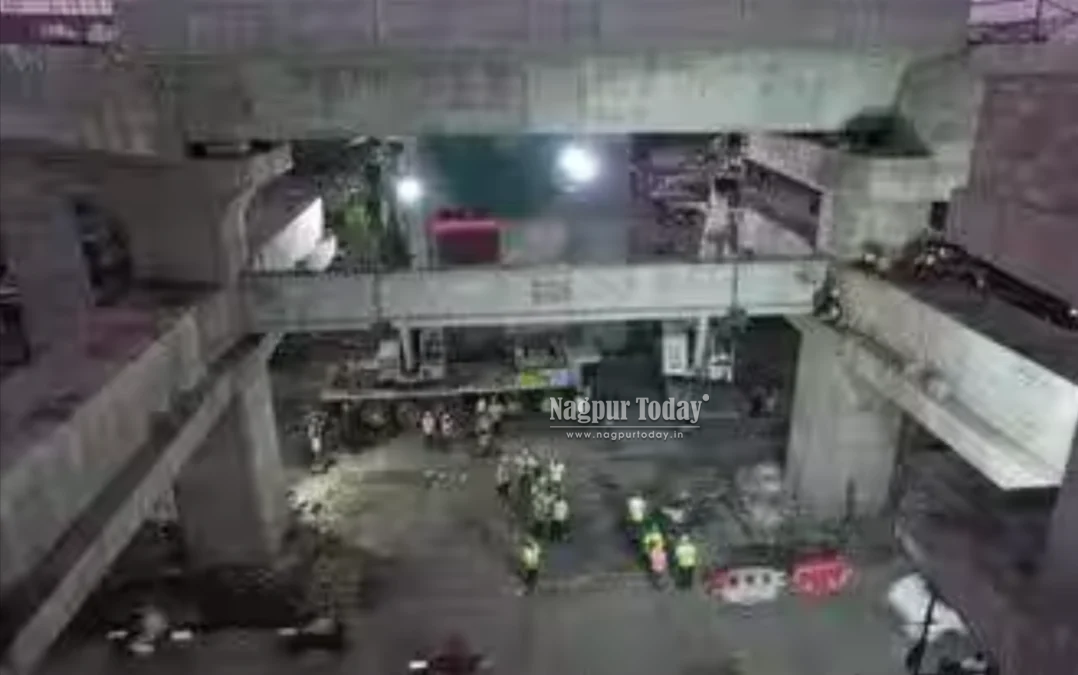
Nagpur: MahaMetro has commenced the erection of the first I-girder at Hingna Mount View station, marking a major step in the construction of Nagpur Metro Phase-II.
The girder erection work has begun on the 6.4-km Lokmanya Nagar-Hingna corridor, also known as Reach-3A, which will feature seven elevated stations. Construction of the stations on the corridor began in March 2025.
Gold Rate
Sept 17,2026 - Time 10.30Hrs

60 I-Girders Required at Each Station
According to metro officials, I-girders are being installed at each station, with every span comprising 15 girders — nine at the concourse level and six at the platform level.

Concourse-level girders weigh between 27 and 45 tonnes, while platform-level girders weigh between 37 and 45 tonnes.
Each station will require a total of 60 I-girders, including 36 at the concourse level and 24 at the platform level.
The completed girders are transported to the erection sites on heavy-duty trailers through designated routes.
Heavy Cranes Used for Erection
For the erection process, the central three concourse-level girders of each span will be positioned using two 80-tonne-capacity cranes.
The remaining girders will be installed using a 500-tonne-capacity crane, allowing the heavy structural components to be safely positioned at the elevated stations.
MahaMetro officials said that girder erection, slab construction and other structural works at both levels are expected to be completed within approximately 45 days at each station.
Work is being undertaken simultaneously at multiple stations to maintain the overall project schedule.
Passenger Facilities at Concourse Level
The concourse level will accommodate several passenger facilities, including ticket counters, lifts, escalators, toilets and infant-care facilities.
It will also function as the transfer level between the entry and exit areas and the platforms.
Construction of entry and exit facilities is currently underway at all seven stations along the corridor.
First 4-km Stretch Targeted for August 2027
The first 4-km stretch of Reach-3A is scheduled to become operational by August 2027, according to the project timeline.