

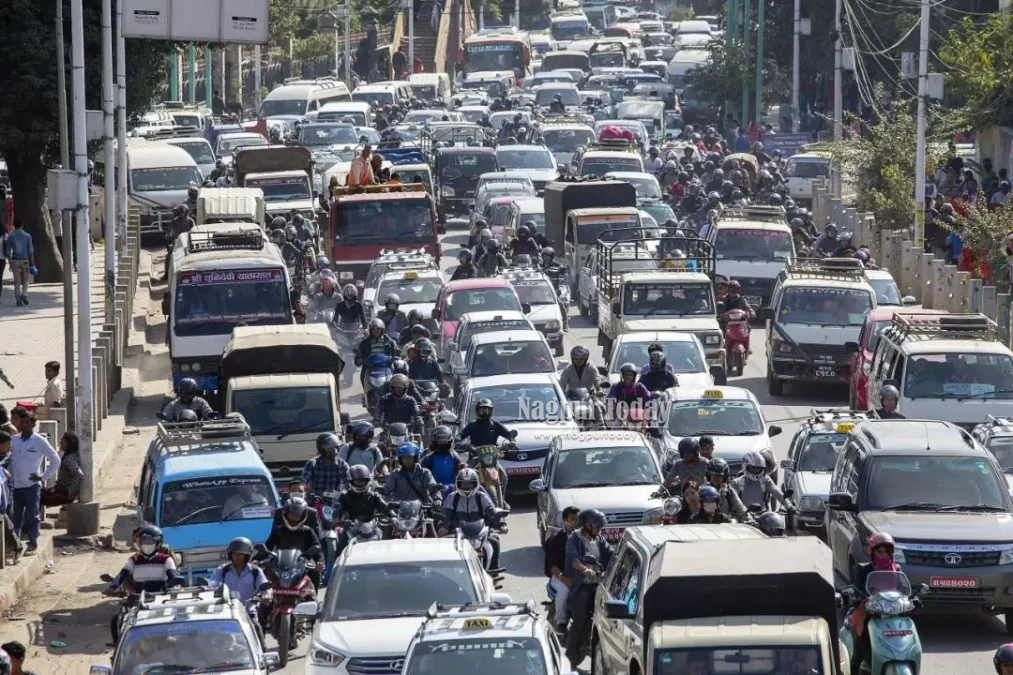
Nagpur: Once admired for its broad roads, relatively smooth traffic and hassle-free driving, Nagpur is increasingly finding itself trapped in traffic congestion. The Orange City’s growing vehicle population, now touching a staggering 32.42 lakh, is putting mounting pressure on its road network, turning traffic jams into an everyday ordeal for motorists.
The scale of the challenge is evident from registration figures compiled by the district’s three Regional Transport Offices (RTOs). The City RTO (MH-31) accounts for the largest share, with 15.08 lakh registered vehicles, followed by the Rural RTO (MH-40) with 9.19 lakh and the East RTO (MH-49) with 7.83 lakh.
More than the cumulative numbers, however, it is the pace at which vehicles are being added to the roads that raises concern. The figures show a sharp increase in annual registrations over the past six years, intensifying the demand for road space, parking facilities and efficient traffic management.
New registrations jump nearly 86% in six years

The three RTOs together registered 1,75,282 vehicles in the financial year 2025-26, compared with 94,286 in 2020-21, an increase of nearly 86%.
The East RTO witnessed one of the sharpest increases, with annual registrations rising from 38,272 in 2020-21 to 70,673 in 2025-26, a jump of nearly 85%.
The City RTO recorded an even more striking proportional rise, with registrations climbing from 16,790 to 35,492 during the same period, more than doubling in six years. At the Rural RTO, annual registrations increased from 39,224 to 69,117.
The momentum has continued into the current financial year. During the first six months of 2026-27 alone, the three RTOs registered 86,648 vehicles. This translates into an average of approximately 475 new registrations every day.
The figures point to a rapidly expanding vehicle base, raising questions about whether the city’s road infrastructure, parking capacity and traffic-control arrangements can keep pace with the growing demand.
Vehicles from outside add to the pressure
The registration figures, however, tell only part of the story. They cover vehicles registered in Nagpur district but do not account for the thousands of vehicles from neighbouring districts and other States that enter the city daily.
Nagpur’s role as a regional centre for employment, education, healthcare, trade and business draws people from across Vidarbha and beyond. Many settle in the city, while others commute regularly for work and other purposes. Their vehicles add to the traffic load on roads already carrying a rapidly growing number of locally registered vehicles.
The result is increasing competition for limited road space, particularly around commercial areas, major junctions, institutional hubs and busy arterial routes.
Migration, parking and infrastructure works compound the problem
DCP (Traffic) Aditya Mirkhelkar acknowledged that the rising vehicle population is among the principal reasons behind traffic congestion, while maintaining that Nagpur’s traffic conditions remain comparatively better than those in other cities of similar size.
“If we compare other cities of similar size, Nagpur’s traffic is still better. Besides increased vehicular population, migration, infrastructure works and lack of proper parking are behind the problem. Apart from proper traffic management, increased use of public transport can ease traffic congestion in city,” Mirkhelkar said.
His remarks underline the multiple factors contributing to the problem. Road construction and infrastructure projects can create temporary bottlenecks, while vehicles parked indiscriminately along busy roads reduce the carriageway available for moving traffic. The arrival of more residents and commuters further increases pressure on the existing network.
Traffic snarls are now frequently reported on major roads, at busy intersections and along commercial stretches. Motorists often encounter slow-moving traffic even outside conventional peak hours, adding to travel time, fuel consumption and frustration.
Although flyovers, road-widening projects and other infrastructure improvements have enhanced connectivity at several locations, their benefits risk being offset by the continuous addition of vehicles.
More roads alone may not be the answer
Traffic experts believe Nagpur needs to look beyond expanding its road network and adopt a more comprehensive approach to urban mobility.
Improved public transport could reduce dependence on private cars and two-wheelers, while better coordination of traffic signals and stricter enforcement against illegal parking could help existing roads carry traffic more efficiently.
Authorities also need to identify persistent bottlenecks, review traffic movement at major junctions and ensure that infrastructure projects are planned alongside parking facilities and public transport connectivity.
The growing vehicle population makes these interventions increasingly urgent. Without measures to manage demand, even new roads and flyovers could struggle to deliver lasting relief.
For a city that once took pride in its smooth traffic flow, the challenge is now to prevent congestion from becoming an unavoidable feature of daily life. With nearly 475 new vehicles being registered every day during the first half of 2026-27, Nagpur’s traffic-management strategy will need to evolve as quickly as its vehicle population.