

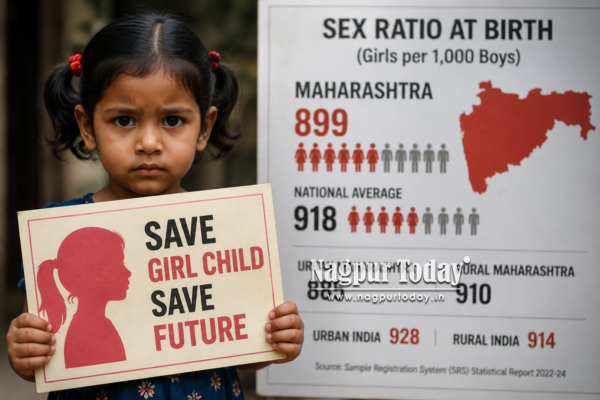
Nagpur/New Delhi: Despite being one of India’s most industrialised and economically advanced states, Maharashtra continues to struggle with a disturbing demographic reality. The latest Sample Registration System (SRS) Statistical Report has revealed that the State’s sex ratio at birth remains among the lowest in the country, raising fresh concerns about deep-rooted gender bias and the continued preference for male children.
According to the report, Maharashtra recorded just 899 girls for every 1,000 boys born during the 2022-24 period, placing it significantly below the national average of 918 girls per 1,000 boys. While the figure marks an improvement from 876 girls per 1,000 boys recorded during 2018-20, experts say the state’s performance remains alarming for a region known for its urbanisation, educational infrastructure and economic progress.
The latest figures place Maharashtra in the bottom five among major states and Union Territories, ranking only marginally ahead of Bihar (896), Haryana (885), Delhi (876) and Uttarakhand (872). In contrast, states such as Chhattisgarh (967), Kerala (974) and Himachal Pradesh (956) have demonstrated far healthier gender balances at birth.
Urban Maharashtra raises bigger concerns

Perhaps the most striking revelation is the sharp rural-urban divide.
While rural Maharashtra recorded 910 girls per 1,000 boys, urban Maharashtra reported a far lower ratio of just 885 girls per 1,000 boys. Ironically, the state’s urban centres, expected to be more progressive due to better education, healthcare access and economic opportunities, performed worse than rural areas.
The trend also runs contrary to the national pattern. Across India, urban areas recorded a healthier sex ratio at birth of 928 girls per 1,000 boys, compared to 914 in rural areas.
The figures suggest that economic prosperity and urban lifestyles alone have not succeeded in eliminating traditional gender preferences. Instead, experts believe easier access to medical technology, coupled with persistent social attitudes favouring sons, may be contributing factors behind the skewed urban numbers.
Falling fertility, persistent son preference
The findings become even more significant when viewed alongside Maharashtra’s declining fertility rates.
The state has already achieved a Total Fertility Rate (TFR) of just 1.4 children per woman, considerably lower than the national average of 1.9 and well below the replacement level of 2.1.
Demographers point out that when families choose to have fewer children, the pressure to ensure at least one male child often increases. Such circumstances can intensify gender selection tendencies despite legal safeguards.
Nationally, Bihar recorded the highest fertility rate at 2.9 children per woman, while Delhi registered the lowest at 1.2.
The low sex ratio appears particularly puzzling because Maharashtra performs relatively well on several social indicators linked to women’s empowerment.
The state’s mean age of marriage for women stands at 23.4 years, slightly above the national average of 23.1 years. Child marriage is also comparatively rare, with only one per cent of women marrying before the age of 18, against the national average of 2.1 per cent.
Ordinarily, higher education levels, delayed marriages and lower fertility rates are expected to correlate with better gender outcomes. However, Maharashtra’s continued struggle with a skewed sex ratio suggests that social attitudes toward daughters remain a challenge despite broader developmental gains.
Government claims improvement
The report comes only months after Maharashtra Health Minister Prakash Abitkar claimed that the state’s sex ratio had improved from 907 females per 1,000 males in 2023 to 912 in 2024. He had attributed the improvement to stricter implementation of the Pre-Conception and Pre-Natal Diagnostic Techniques (PCPNDT) Act and announced plans to tighten enforcement further.
However, the latest SRS findings indicate that substantial challenges remain, particularly in urban regions where the imbalance is most pronounced.
The fresh data is likely to reignite debate over the effectiveness of measures designed to curb sex-selective practices and promote gender equality. Activists and public health experts have repeatedly argued that legal enforcement alone cannot solve the problem unless accompanied by sustained social awareness campaigns and efforts to change societal attitudes toward daughters.
The report serves as a reminder that economic growth and urban expansion do not automatically translate into social progress. For Maharashtra, the challenge now extends beyond development indicators to addressing the cultural and societal factors that continue to deny thousands of girls the chance to be born.
As policymakers examine the findings, the state’s demographic future may depend not only on stronger enforcement of existing laws but also on transforming the mindset that still values sons over daughters in many sections of society.