

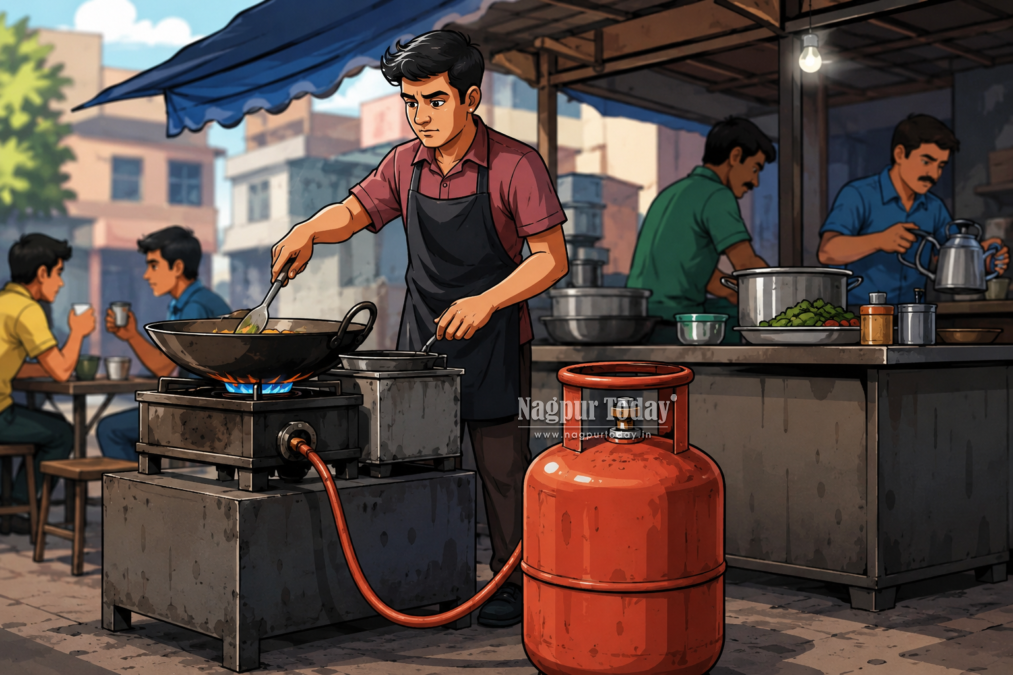
Nagpur: The rampant misuse of domestic LPG cylinders by commercial establishments has emerged as a growing concern in Nagpur, raising serious questions about regulatory enforcement, public safety and the diversion of subsidised cooking gas meant for households.
Amid continuous hikes in commercial LPG cylinder prices, a large number of hotels, dhabas, tea stalls, fast-food centres and small eateries across the city are allegedly operating on domestic LPG cylinders in blatant violation of government regulations.
Residents claim that the practice has become so widespread that domestic cylinders can be seen being openly used even at roadside stalls located near government office complexes, with little fear of detection.
The illegal trend has sparked concerns among citizens and consumer rights groups, who argue that subsidised domestic gas intended for household consumption is increasingly finding its way into commercial establishments looking to cut operational costs.

Officials and safety experts warn that the issue extends far beyond regulatory violations. The use of domestic LPG cylinders in commercial settings is considered a serious safety hazard, particularly at roadside food stalls and small establishments where basic fire safety measures are often absent.
In many cases, cylinders are reportedly kept in cramped spaces near stoves, electrical wiring and combustible materials, significantly increasing the risk of fires, gas leaks and explosions. Any accident involving such illegally used cylinders could endanger not only business operators but also customers, pedestrians and nearby residents.
Price gap driving illegal practice
Consumer activists and industry observers believe the widening price difference between domestic and commercial LPG cylinders is one of the primary reasons behind the growing misuse. Commercial establishments are required to use 19-kg commercial LPG cylinders, which are significantly more expensive than domestic cylinders.
Adding to the burden, commercial LPG prices were recently increased again, with the price of a 19-kg cylinder rising by Rs 43. The recurring hikes have pushed operating costs higher for restaurants, hotels and food vendors.
While larger establishments may be able to absorb the increased expense, many small eateries, roadside stalls and tea vendors are allegedly opting for domestic cylinders to reduce costs and maintain profit margins.
Enforcement drives underway
Authorities maintain that strict action is being taken against violators. According to the Food and Civil Supplies Department, the use of domestic LPG cylinders for commercial purposes is completely illegal and punishable under relevant regulations.
In recent months, enforcement teams have conducted multiple raids across the city, seizing domestic cylinders found in use at hotels, dhabas and food establishments. Legal action has also been initiated against several violators.
Officials say the department is continuing its campaign mode enforcement drive to curb the practice and prevent the misuse of domestic LPG supplies.
“Domestic LPG cylinders cannot be used in commercial establishments, roadside stalls, handcarts, hotels or food businesses. Such use is completely illegal. The Food and Civil Supplies Department is carrying out special enforcement drives across the city, and regular action will continue. We also respond immediately to complaints received from citizens,” said Shalini Gedam, Food Distribution Officer (City), Nagpur.
Despite repeated seizures and enforcement actions, the persistence of the practice suggests that stronger monitoring and stricter penalties may be required to deter offenders.
Consumer groups have urged authorities to intensify surprise inspections and strengthen vigilance mechanisms to ensure that subsidised LPG reaches its intended beneficiaries and is not diverted for commercial gain.
With safety concerns mounting and violations reportedly continuing in several parts of the city, the issue has once again highlighted the challenge of balancing enforcement with the economic pressures faced by small businesses.