

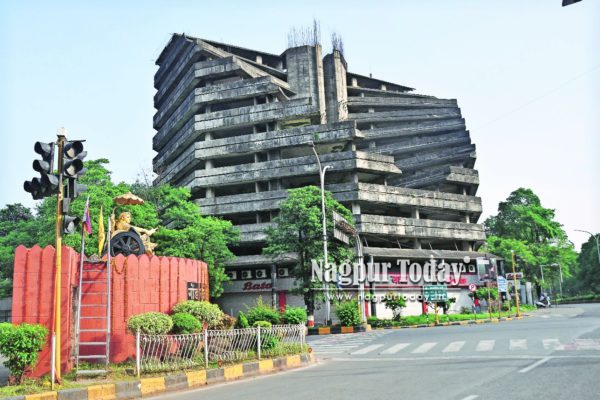
Nagpur: In a significant development, the Nagpur Bench of the Bombay High Court on Monday granted interim protection against the demolition of the controversial multi-storey Poonam Tower, situated opposite the Vidhan Bhavan in the high-security Civil Lines area, after the building management placed a revised architectural proposal before the court.
The division bench directed the Nagpur Municipal Corporation (NMC) to examine the revised plan and submit its detailed reply within a week. The interim relief came as a temporary reprieve for the occupants, halting the demolition drive that had commenced on Friday pursuant to a civic notice issued on January 13.
Gold Rate
Mar 30,2026 - Time 10.25Hrs

Acting on the notice, the NMC had initiated demolition proceedings after identifying large-scale unauthorised construction, including irregularities in the basement, several upper floors, and an additional service floor constructed below the first level. However, the demolition was immediately stopped following the High Court’s intervention.
Advocate Gemini Kasat represented the civic body during the hearing.
The matter stems from a public interest litigation (PIL) filed by Vijay Babhare, who alleged serious violations in the construction of the building and flagged the structure as a potential security threat, given its proximity to the Vidhan Bhavan and the Reserve Bank of India (RBI) buildings. The PIL, filed as far back as 2016, sought the complete demolition of the allegedly illegal structure.
During the hearing, the bench comprising Justices Anil Pansare and Nivedita Mehta perused NMC’s earlier affidavit, which laid out the chronology of actions initiated under Section 53 of the Maharashtra Regional and Town Planning (MRTP) Act. The affidavit revealed that as early as 2004, the seventh floor of the building had been officially declared entirely unauthorised.
The court also revisited its earlier concern over the prolonged inaction by civic authorities, questioning why no conclusive steps were taken for nearly nine years, even after the matter attained legal finality in 2015. The delay, the bench observed earlier, raised serious questions about administrative accountability and enforcement of planning laws in sensitive zones.
With the submission of the revised plan, the court has now afforded the NMC an opportunity to reassess the legality of the construction before taking further coercive action. The case is expected to be taken up again after the civic body files its response, which will be crucial in determining the future of the contentious structure.