


Let’s talk about a very familiar Indian habit: jaldi ka kaam (doing things in a frantic rush). From technology to taxes, our policymakers love launching massive changes at breakneck speed. The big goals, making India self-reliant and modern, are fantastic. But when you sprint without looking down, it’s the ordinary citizen on the street who trips and gets hurt.
Right now, you can see this exact bhaag-daud (rush) playing out every single day at your local petrol pump with the rapid switch to E20 ethanol blended petrol.
Before we look at the problems, let’s clear the air about the science: ethanol itself is a clean, safe, and brilliant fuel. Chemically, it works perfectly. It has a high octane rating, which stops engine knocking and makes your vehicle run smoothly. Even better, it is made right here at home from sugarcane and extra food grains. This keeps thousands of crores circulating inside our own villages, directly helping Indian farming families instead of filling the pockets of foreign oil kings. Countries like Brazil have been driving safely on high ethanol blends for fifty years.
So, what is the actual problem? It isn’t the fuel; it is the sheer panic of an unnecessary rush, where fayda sahi hai, par jaldbazi galat hai (the benefit is real, but the haste is wrong).
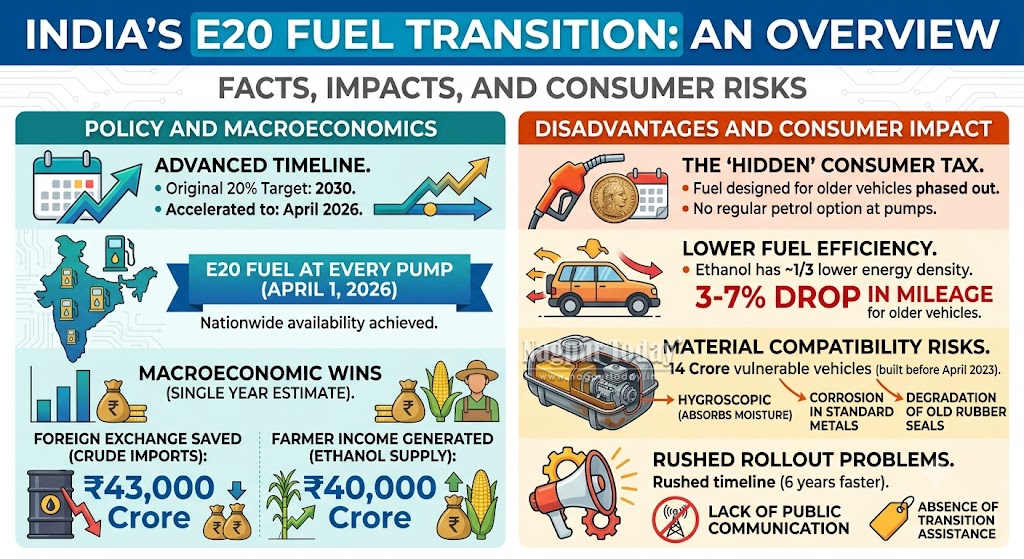
Instead of waiting for the country to adapt naturally, the government aggressively pulled the 20% national blending timeline forward. By making E20 the mandatory base fuel everywhere, they created a massive headache for the common man overnight.
Think about the millions of middle class families, college students, and low income delivery drivers. They are riding scooters and driving family cars built before the April 1, 2023 manufacturing cut-off. Those older engines were strictly built for normal petrol. They were never designed to handle high mix ethanol, which naturally acts like a sponge, pulling moisture out of the air. When water mixes with fuel inside an older engine, it can slowly rust metal tanks and rot standard rubber pipes and seals.

Because of this aggressive shift, much of the public’s frustration and social media blame gets directed straight at Union Minister Nitin Gadkari. Known as India’s ‘Highways and Green Fuel’ champion, his relentless, vocal push for flex fuels and green energy has made him the public face of the policy. While his macro calculations for saving national wealth are spot on, everyday motorists feel his ministry sprinted too fast without setting up a safety net for legacy vehicles.
To make things worse, there is absolutely no choice left at the pump. Because the transition happened so fast, oil companies didn’t have the time or infrastructure to keep separate nozzles for regular, protection grade petrol. Whether you are filling up a brand new car or a ten year old scooter you bought with your first salary, you are forced to take E20. On top of that, because ethanol has less energy density than pure petrol, older vehicles suffer a direct 3% to 7% drop in mileage. For a delivery guy logging 100 kms a day, this is a quiet, permanent salary cut. Even though major car makers report that engines aren’t breaking down catastrophically in the real world, the total lack of clear public awareness campaigns has turned a great national victory into a source of daily anxiety.
This habit of launching a great idea before the ground reality is ready feels exactly like a movie we have all seen before: India’s historic rollout of the Goods and Services Tax (GST).
Conceptually, GST was an extraordinary masterstroke, a dream to unify a messy tax system into One Nation, One Tax. But just like the ethanol swap, it was launched with so much urgency that the bureaucracy had to continuously patch and change the rules while the system was already running live.
Look at the dizzying numbers: since GST started on July 1, 2017, the Central Government alone has issued over 1,700 notifications, circulars, and clarifications. Across roughly 3,280 days of active operations, the fundamental rules of doing business in India were tweaked or completely turned upside down approx. once every 48 hours.
The human strain in both stories is identical. Just like the ethanol mandate left drivers managing mileage drops and engine worries with zero alternatives at the pump, the nonstop GST amendments turned small and medium business owners (MSMEs) into real time software testers. Tax slabs for regular household items jumped up and down erratically, and confusing new online forms forced local shopkeepers into a state of perpetual whiplash.
Make no mistake: both GST and the E20 ethanol mandate are massive macroeconomic victories. GST is bringing in historic, record breaking revenue every month, and the ethanol program has saved a massive ₹1.90 lakh crore in foreign exchange while putting over ₹1.60 lakh crore into the pockets of Indian farmers. These are undeniable wins for India’s national sovereignty.
Lessons to be learnt : But the vital lesson across both reforms is the same: India is fully capable of pulling off structural miracles, but a democracy cannot assume its citizens have an infinite capacity for daily confusion. True policy success isn’t just about hitting a fast tracked target on a government spreadsheet; it’s about making sure that the ordinary people footing the bill aren’t left stranded in the dust.