

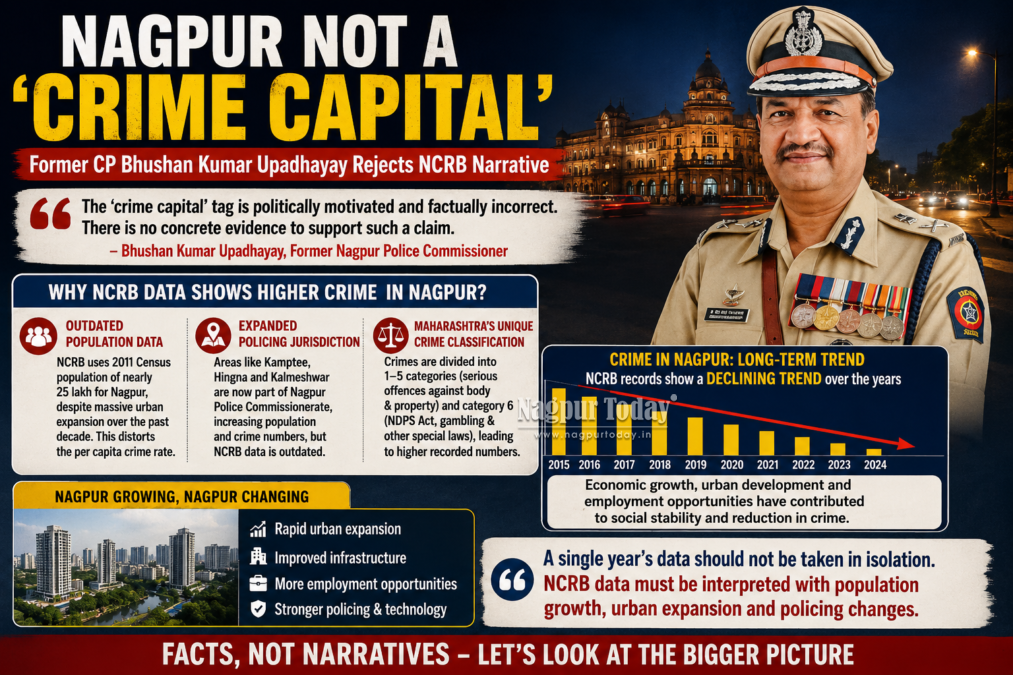
Nagpur: Amid rising debate over Nagpur’s positioning in the National Crime Records Bureau (NCRB) 2024 report, former Nagpur Police Commissioner Bhushan Kumar Upadhayay has dismissed the city’s “crime capital” image, attributing it to outdated population data and differences in crime classification systems rather than an actual surge in criminal activity.
Speaking on the issue, Upadhayay said the NCRB continues to calculate per capita crime rates using Nagpur’s 2011 Census population of nearly 25 lakh, despite the city witnessing massive urban expansion over the past decade. According to him, the outdated population base creates a distorted picture and artificially inflates crime statistics. He pointed out that several adjoining regions, including Kamptee, Hingna, and Kalmeshwar, are now part of the Nagpur Police Commissionerate jurisdiction, significantly increasing the city’s policing coverage and actual population. However, the NCRB calculations, he said, still rely on decade-old demographic data. Upadhayay further stated that Maharashtra’s unique method of classifying crimes also contributes to higher recorded figures when compared to other states.
He explained that crimes in the state are divided into two broad groups — categories one to five, covering serious offences such as crimes against the body and property, and category six, which includes offences under the NDPS Act, gambling, and other special laws.
According to the former top cop, this broader categorisation often results in Maharashtra cities reporting comparatively higher crime numbers than states that follow different reporting formats. Calling for a long-term analysis of crime trends, Upadhayay cautioned against interpreting a single year’s NCRB data in isolation. He maintained that historical NCRB records indicate that crime in Nagpur has largely shown a declining trend over the years, despite occasional fluctuations.

He attributed this trend to economic development, urban growth, and improved employment opportunities in the region, which he said have contributed to social stability. Strongly rejecting the “crime capital” narrative, Upadhayay termed the label “politically motivated” and lacking factual basis. He asserted that there are no concrete figures or credible evidence supporting such a claim and described the narrative as a political statement that gained traction without legitimacy.
The remarks come at a time when Nagpur’s ranking in national crime statistics has triggered public and political debate, with several experts calling for a more balanced interpretation of NCRB data that takes into account demographic growth, urban expansion, and administrative changes in policing jurisdictions.