

 Mumbai: After four years of service to the nation, the first batch of Agniveers is approaching the time to take off its uniform. As the first major ‘exit’ phase under the Agnipath scheme begins in 2026, Maharashtra faces a significant question: what lies ahead for these young people after four years?
The issue is not limited to 2026. Agniveers from subsequent batches will also complete four years of service and leave in 2027, 2028, 2029 and 2030. This has led to discussions over whether the current arrangement of 1,000 positions will be sufficient to meet the needs of the growing numbers in the years ahead.
The 2026 exit is not the end, but the beginning
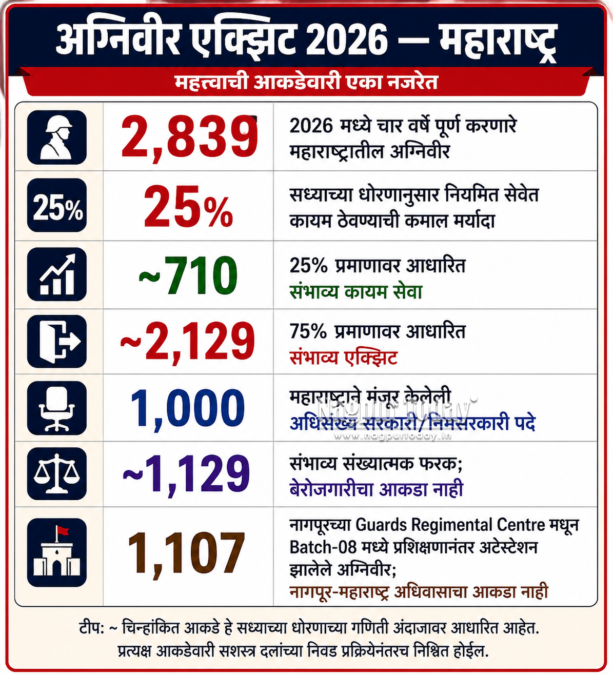
Under the Agnipath scheme, Agniveers have to leave the service after four years. Up to 25% of eligible Agniveers may be given an opportunity to continue in regular service. The remaining Agniveers will have to return to civilian life.
Therefore, although the first major batch will leave in 2026, the process will continue every year thereafter.
Broadly:

2022–23 batch → Exit in 2026
2023–24 batch → Exit in 2027
2024–25 batch → Exit in 2028
2025–26 batch → Exit in 2029
2026–27 batch → Exit in 2030
Resolving the issue in 2026 will not bring the matter to an end. Instead, the government will face the challenge of rehabilitating new groups of Agniveers every subsequent year.
The issue of 2,839 Agniveers from Maharashtra
The figure of 2,839 Agniveers has emerged for Maharashtra’s first major exit batch. However, how many of them will be retained in regular service and how many will actually enter the civilian employment market will become clear only after the relevant process is completed.
Thus, the real question is not the figure of 2,839, but how many Agniveers will actually come into Maharashtra seeking employment after completing four years of service. Moreover, clear, domicile-based, year-wise data on how many Agniveers from Maharashtra will leave the service between 2027 and 2030 is not easily available in the public domain. As a result, the calculations for future rehabilitation remain unclear.
Nagpur and Vidarbha face a separate question
Nagpur and Vidarbha also need to be considered separately in the context of the Agniveer issue. In June 2026, an attestation parade was held after the training of 1,107 Agniveers from ‘Guards Agniveer Batch-08’ at the Brigade of the Guards Regimental Centre in Nagpur.
However, it would be incorrect to conclude that these 1,107 Agniveers are from Nagpur or Maharashtra. The figure represents Agniveers who completed their training at the Nagpur-based training centre; it does not indicate their domicile.
This raises another important question for Vidarbha: how many Agniveers from Nagpur and Vidarbha are part of Maharashtra’s first exit batch?
Availability of district-wise data would make the impact of the Agniveer exit on the local employment market clearer.
The government created 1,000 positions—but what next?
The Maharashtra government has decided to create 1,000 supernumerary positions for former Agniveers. This is an important decision in view of the first exit batch.
But it raises the next question: if new Agniveers will leave the service every year, what is the plan for the years after these 1,000 positions?
Will the arrangement made for 2026 be sufficient for the batches leaving in 2027, 2028 and thereafter? Or will new employment opportunities have to be created every year? The answer to this question must be found now.
Government jobs are not the only option
Former Agniveers will have opportunities not only in Maharashtra government jobs but also in the services of the Union government. Recruitment processes for the Central Armed Police Forces and Assam Rifles include provisions for reservation, age-limit relaxations and certain other concessions for former Agniveers.
In addition, their military training could create opportunities in several fields, including private security, industry, technical work, transport, management, self-employment and entrepreneurship.
However, it will also be important to assess how many Agniveers can actually access these opportunities and how effective the arrangements for skill development and guidance are.
Will the data become transparent?
Clear data with the government is essential for resolving the rehabilitation issue. How many Agniveers will leave the service from Maharashtra in 2026? How many of them will be retained in regular service? How many will apply for government jobs in Maharashtra? How many will turn to Union government services? And what is the plan for the remaining Agniveers?
Without clear answers to these questions, it will not be possible to properly assess the rehabilitation policy.
The uniform is coming off; now the government faces the test
Agniveers have devoted four years to discipline, training and service to the nation. The first batch is now on the threshold of taking off its uniform and entering civilian life. The government has taken the first step by creating 1,000 positions, but the scale of the road ahead will now become clear.
The 2026 Agniveer exit is not the end. The year 2027 will arrive, followed by 2028, 2029 and 2030.
New batches will leave the service every year. Maharashtra must therefore build a rehabilitation system that is sustainable for years, rather than a temporary arrangement. The real responsibility for ensuring employment for Agniveers after they take off their uniforms now rests with Maharashtra.