

 Over the past few days, India’s ethanol-blended petrol programme has come under intense public scrutiny. Social media is flooded with questions about E20 petrol, vehicle compatibility, fuel efficiency, and whether motorists have become part of a nationwide experiment.
One name repeatedly appearing in the debate is Union Road Transport and Highways Minister Nitin Gadkari. But this has also led many people to ask a simple question:
If Nitin Gadkari isn’t the Petroleum Minister, why is he at the centre of the ethanol controversy?
The answer lies in understanding how the policy works-and which ministry is responsible for what.
Who Actually Controls Ethanol Blending?
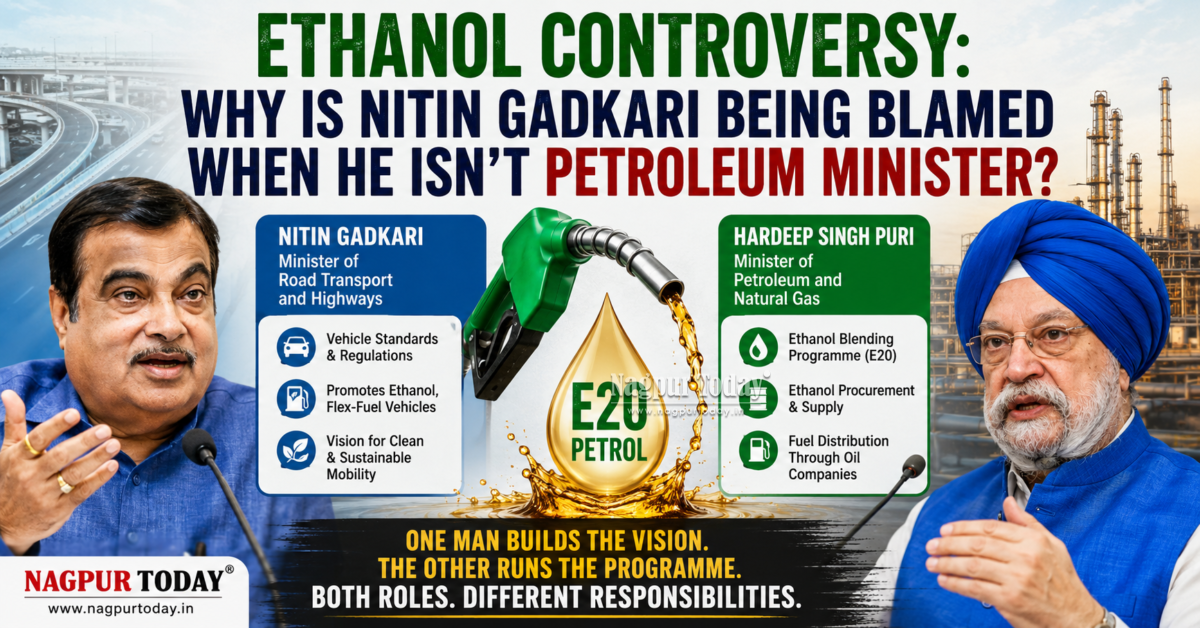
The nationwide Ethanol Blended Petrol (EBP) Programme, including E20 petrol, is implemented by the Ministry of Petroleum and Natural Gas.

This ministry is responsible for:
- Setting ethanol blending targets.
- Procuring ethanol from producers.
- Directing oil marketing companies such as Indian Oil, BPCL and HPCL.
- Managing fuel supply across petrol pumps.
- Determining ethanol procurement prices.
The current Union Petroleum Minister is Hardeep Singh Puri, whose ministry oversees the rollout of E20 fuel across the country.
So Why Is Nitin Gadkari Being Blamed?
Although he does not run the Petroleum Ministry, Nitin Gadkari has spent nearly a decade becoming the country’s strongest advocate for alternative fuels.
He has consistently promoted:
- Ethanol as an alternative to petrol.
- Flex-fuel vehicles.
- E20, E85 and E100 fuels.
- Reducing India’s dependence on imported crude oil.
- Creating additional income opportunities for farmers through biofuels.
Whether launching flex-fuel vehicles, addressing industry conferences, or speaking at public events, Gadkari has repeatedly projected ethanol as an important part of India’s future transport ecosystem.
As a result, many Indians naturally associate the ethanol mission with him.
Different Ministries, Different Responsibilities
The confusion largely arises because multiple ministries are involved in India’s ethanol ecosystem.
Ministry of Petroleum & Natural Gas
- Implements ethanol blending.
- Supplies E20 petrol.
- Coordinates with oil companies.
- Frames fuel distribution policies.
Ministry of Road Transport & Highways
- Frames vehicle regulations.
- Approves standards for ethanol-compatible vehicles.
- Encourages flex-fuel technology.
- Works with automobile manufacturers.
In simple terms:
One ministry manages the fuel. The other ensures vehicles can safely use it.
Why Has the Debate Intensified?
The controversy gained momentum after remarks made during proceedings in the Supreme Court sparked widespread discussion about the E20 rollout. Those comments were widely interpreted on social media as suggesting that the long-term impact of E20 would become clear only after wider implementation. Although the government later clarified the context of the remarks, public concerns had already intensified.
Many motorists have reported concerns such as:
- Reduced mileage.
- Higher fuel consumption.
- Questions about older vehicles.
- Limited availability of regular petrol in several areas.
Experts point out that fuel efficiency depends on several factors-including engine design, driving conditions, and whether a vehicle is designed or calibrated for higher ethanol blends. The impact may therefore vary between vehicles.
Is It Fair to Hold Gadkari Responsible?
The answer depends on the aspect being discussed.
If the issue relates to:
- ethanol blending,
- fuel availability,
- procurement,
- or implementation,
the primary responsibility lies with the Ministry of Petroleum and Natural Gas.
However, if the discussion is about:
- promotion of ethanol-powered mobility,
- flex-fuel vehicles,
- transport policy,
- and encouraging alternative fuels,
then Nitin Gadkari has undoubtedly been one of the most influential voices driving that vision.
In other words, he is the public face of India’s ethanol mobility push-but not the minister responsible for implementing the country’s fuel blending programme.
The Bigger Picture
India’s ethanol programme was introduced with several long-term objectives:
- Reduce crude oil imports.
- Improve energy security.
- Cut vehicular emissions.
- Provide additional markets for agricultural produce such as sugarcane and maize.
- Increase farmer incomes.
Like any large-scale public policy, its success will ultimately depend on balancing environmental goals, economic benefits, vehicle compatibility, and consumer confidence.
Conclusion
The current controversy has highlighted an important distinction that is often overlooked.
Nitin Gadkari has been the country’s most visible advocate for ethanol-powered transport, but the implementation of ethanol blending in petrol is led by the Ministry of Petroleum and Natural Gas.
Understanding this difference is essential for an informed public debate. Criticism, support, and accountability should be directed at the appropriate institutions based on their actual responsibilities—not merely on public perception.