

There is a moment every family car buyer knows. You pull up at a fuel station, watch the numbers climb on the pump, and wonder how much of the household budget is disappearing into everyday travel. Then comes the next question: would switching to an electric car actually save money, or would it simply replace one set of expenses with another?
For families considering the MG Windsor EV, the answer depends on more than the cost of electricity versus diesel. It comes down to daily driving distances, access to home charging, weekend travel habits, luggage requirements and how comfortable the family is with planning longer journeys.
The Windsor EV has a different proposition from a traditional diesel SUV. It offers a spacious five-seat cabin, a flat-floor layout, reclining rear seats and the convenience of electric driving. But can it handle the everyday responsibilities of a family car without forcing its owner to rethink every journey?

Let’s look at the practical side of making the switch.
Key highlights at a glance
- Running costs: Home charging can cost considerably less per kilometre than diesel, depending on electricity tariffs and vehicle efficiency.
- Family comfort: A spacious cabin and reclining rear seats make the Windsor EV worth considering for everyday family use.
- Driving range: The larger 52.9 kWh battery has a claimed MIDC range of 449 km, although actual range varies with driving conditions.
- Purchase price: The MG Windsor EV price depends on the variant and whether the battery is purchased upfront or leased through Battery-as-a-Service (BaaS).
- The verdict: It can replace a family diesel SUV for many urban and mixed-use households, but frequent long-distance travellers need to consider charging access and journey planning.
The running-cost difference: Where an EV can make a real impact
Fuel is one of the biggest differences between owning a diesel SUV and an EV. Using ₹99.82 per litre as an illustrative diesel price, a diesel SUV averaging 14 km/l costs around ₹7.13 per kilometre, compared with approximately ₹1.14 for an EV averaging 7 km/kWh at a home electricity rate of ₹8 per unit.
Actual costs vary by location, fuel prices, electricity tariffs, driving efficiency and charging methods. Home charging generally offers the greatest financial advantage, while frequent public charging can reduce the savings.
The MG Windsor EV price: Look beyond the showroom figure
The purchase price is where the comparison becomes more complicated.
The MG Windsor EV is offered with different battery and equipment combinations. The 38 kWh version has a claimed range of 332 km, while the larger 52.9 kWh battery in the Pro versions has a claimed MIDC range of 449 km. Neither figure should be treated as a guaranteed everyday range.
The official MG Windsor EV price page lists variant-wise pricing and also explains the Battery-as-a-Service model.
Under BaaS, the initial vehicle price is lower because the battery is billed separately through a per-kilometre rental charge. This can make the purchase easier to enter, but it changes the running-cost calculation.
For example, a BaaS plan charging ₹4.50 per kilometre adds ₹67,500 in battery rental over 15,000 km, before the cost of electricity. That is in addition to the initial vehicle purchase price.
So, when comparing an EV with a diesel SUV, do not compare the BaaS purchase price directly with the full purchase price of a conventional car and assume the cheaper option will remain cheaper. Include the battery rental, electricity, financing and expected ownership period.
The same applies to searches for “Morris Garages car price”: what matters is the current price of the specific MG model and variant you are considering, rather than a general brand-level figure.
A useful way to assess the Windsor EV is to obtain two quotations—one with the battery included and another under BaaS, if available. Then compare the total expected expenditure over three to five years using your annual distance.
Can it handle everyday family life?
For many households, replacing a diesel SUV is less about saving money and more about avoiding compromises.
The Windsor EV is a five-seater crossover, not a direct substitute for every large, seven-seat diesel SUV. But for a family of four or five, its cabin layout is one of its more relevant strengths.
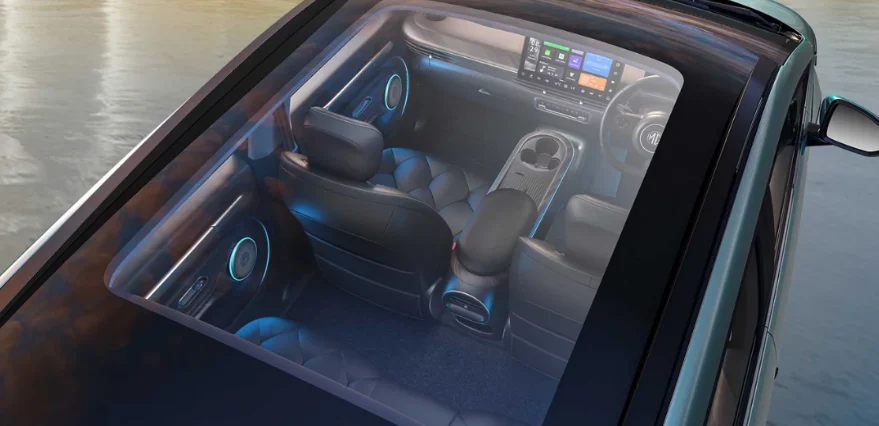
The rear seats recline, giving passengers more flexibility on longer journeys. The flat-floor design helps the cabin feel open, while the large boot offers practical space for shopping, school bags and weekend luggage. Depending on the variant, the Windsor also offers features such as ventilated front seats, connected technology and a panoramic-style glass roof.
These are the details that shape day-to-day ownership. A family car spends far more time on school runs, office commutes and grocery trips than it does on dramatic road trips. Quiet electric driving and smooth acceleration can make those everyday journeys more relaxed.
Still, buyers moving from a traditional SUV should look carefully at their needs. If the current diesel vehicle regularly carries seven people, tows equipment or handles rough rural roads, the Windsor EV may not be a like-for-like replacement.
The sensible question is not whether the electric car is better in every respect. It is whether it suits the journeys your family actually makes.
Charging and long-distance travel: The part you need to plan for
Charging is often the biggest adjustment for a household moving from diesel to electric.
If you have a dedicated parking space and can install a home charger, the experience can be remarkably convenient. Instead of making a separate trip to refuel, you can start many mornings with the car charged for the day ahead.
The Windsor EV Pro versions support a 7.4 kW AC charger, with charging times depending on battery size, starting charge and conditions. DC fast charging can help on longer journeys, although actual charging speeds and times depend on the charger and battery conditions.
The challenge is that family travel does not always follow a predictable schedule.
Before switching, consider three questions:
- Can you charge reliably at home or at work?
- Are dependable public chargers available along your regular intercity routes?
- Does your family often make long trips where stopping to charge would be inconvenient?
If the answer to the first two is yes, the Windsor EV becomes easier to live with. If you regularly cover long distances through areas with limited charging infrastructure, a diesel SUV may still offer greater flexibility.
That does not make electric mobility impractical. It simply means charging access should be treated as part of the buying decision, not something to figure out after delivery.
The real cost of ownership: What the fuel calculation leaves out
Lower energy costs are attractive, but they do not automatically make an electric car cheaper over the entire ownership period.
The final calculation should include the purchase price, loan interest, insurance, scheduled servicing, tyres, battery-related terms, charging equipment and resale value. It should also account for the possibility that a diesel SUV and an EV will depreciate differently.
Electric vehicles generally have fewer routine powertrain service requirements than conventional diesel vehicles, but they are not maintenance-free. Tyres, suspension, brakes, air-conditioning and other systems still need attention. Insurance premiums and repair costs can also vary.
For BaaS buyers, battery rental deserves special attention because it scales with distance travelled. A household driving 20,000 km a year will pay substantially more in per-kilometre rental than one covering 8,000 km.
For MG Motor India, as for any manufacturer trying to expand electric mobility, the challenge is making the ownership proposition clear beyond the headline price. Buyers need to understand the charging routine, warranty terms, battery arrangement and total cost—not just the savings promised at the fuel pump.
This is also where the broader EV market in India is evolving. As buyers become more familiar with electric vehicles, confidence will depend increasingly on the quality of the ownership experience: access to charging, predictable costs, useful support and straightforward information.
Final verdict: Should you replace your diesel SUV with the MG Windsor EV?
For a family that mainly drives in the city, covers a predictable daily distance and can charge at home, the Windsor EV makes a strong case. Lower energy costs, quiet driving and a spacious five-seat cabin can make it a practical everyday car.
For families who regularly travel long distances, need seven seats or frequently drive through places with limited charging access, replacing a diesel SUV may involve more compromises.
The financial answer also depends on how the car is purchased. Buying the battery upfront and choosing BaaS produce different cost structures, so compare both over your expected ownership period rather than relying on the initial price alone.
Ultimately, the right family car is not the one with the lowest theoretical running cost. It is the one that fits your family’s journeys, budget and daily routine without creating new inconveniences.
The MG Windsor EV can make sense as a replacement for many diesel SUVs—but only when the numbers and the family’s actual needs point in the same direction.