

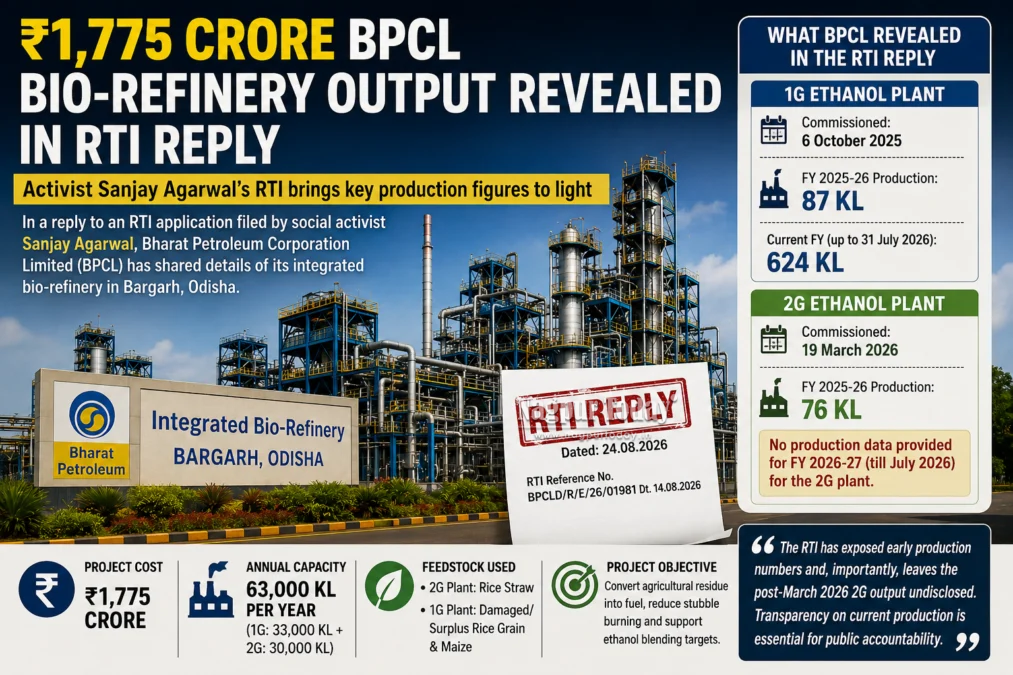
 Nagpur: A ₹1,775-crore integrated bio-refinery set up by Bharat Petroleum Corporation Limited (BPCL) in Bargarh, Odisha, produced a combined 163 kilolitres (KL) of ethanol during FY 2025-26, according to information provided by the company in response to an RTI application filed by Nagpur-based activist Sanjay Agrawal.
BPCL issued the point-wise RTI response on August 24, 2026, providing details of the Bargarh bio-refinery, including its project cost, production capacity, feedstock, commissioning dates and ethanol output.
63,000 KL annual production capacity
According to the RTI response, BPCL has established both 1G and 2G ethanol plants at its Bargarh bio-refinery.
The company puts the approved project cost at ₹1,775 crore.
The stated production capacities are:

- 1G ethanol plant: 33,000 KL per annum
- 2G ethanol plant: 30,000 KL per annum
- Combined capacity: 63,000 KL per annum
The 2G plant uses rice straw as feedstock, while the 1G facility uses damaged/surplus rice grain and maize.
Plants commissioned at different times
The production figures need to be viewed in the context of the commissioning dates.
BPCL stated that its 1G ethanol plant was commissioned on October 6, 2025, while the 2G ethanol plant was commissioned on March 19, 2026.
For FY 2025-26, BPCL reported:
| Plant | Commissioning date | FY 2025-26 production |
|---|---|---|
| 1G Ethanol | October 6, 2025 | 87 KL |
| 2G Ethanol | March 19, 2026 | 76 KL |
| Total | — | 163 KL |
Since the two plants were commissioned part-way through FY2025-26—and the 2G facility only in the final days of the financial year—the 163 KL figure does not represent a full-year production run against the plants’ combined 63,000 KL annual design capacity.
1G production reaches 624 KL in current FY
The RTI response also provides a production figure for the 1G plant for the current financial year.
BPCL reported 624 KL of 1G ethanol production up to July 31, 2026.
However, the response does not provide a corresponding production figure for the 2G plant for FY2026-27 up to July 31.
This is significant because BPCL states that the 2G facility was commissioned on March 19, 2026.
What the RTI sought
Agrawal’s RTI application sought details including the locations and costs of BPCL’s ethanol plants, annual production capacity, feedstock used, commissioning dates and full details of annual production achieved since operations began.
In response to the production query, BPCL supplied the 87 KL figure for 1G and 76 KL for 2G for FY2025-26, along with the 624 KL 1G figure for the current financial year up to July 31, 2026.
The absence of a corresponding current-year 2G production figure leaves the post-commissioning output of the 2G facility beyond March 2026 unclear from the reply.
Why the 2G plant matters
The Bargarh facility’s 2G component is designed to produce ethanol from rice straw, turning agricultural residue into fuel rather than relying on conventional food-grain-based feedstock. BPCL’s RTI response specifically identifies rice straw as the feedstock for the 2G plant.
The project is therefore significant not only because of its scale but also because 2G ethanol technology is aimed at converting agricultural waste into fuel while supporting India’s ethanol-blending programme.
The key numbers
₹1,775 crore — approved project cost
63,000 KL/year — combined stated annual capacity
33,000 KL/year — 1G capacity
30,000 KL/year — 2G capacity
87 KL — 1G production in FY2025-26
76 KL — 2G production in FY2025-26
163 KL — combined FY2025-26 production disclosed
624 KL — 1G production up to July 31, 2026
The RTI response provides a snapshot of the project’s early operating phase. With both plants now commissioned, the more significant indicator going forward will be whether production begins to approach the stated annual capacity and how the 2G facility performs after its March 2026 commissioning.