
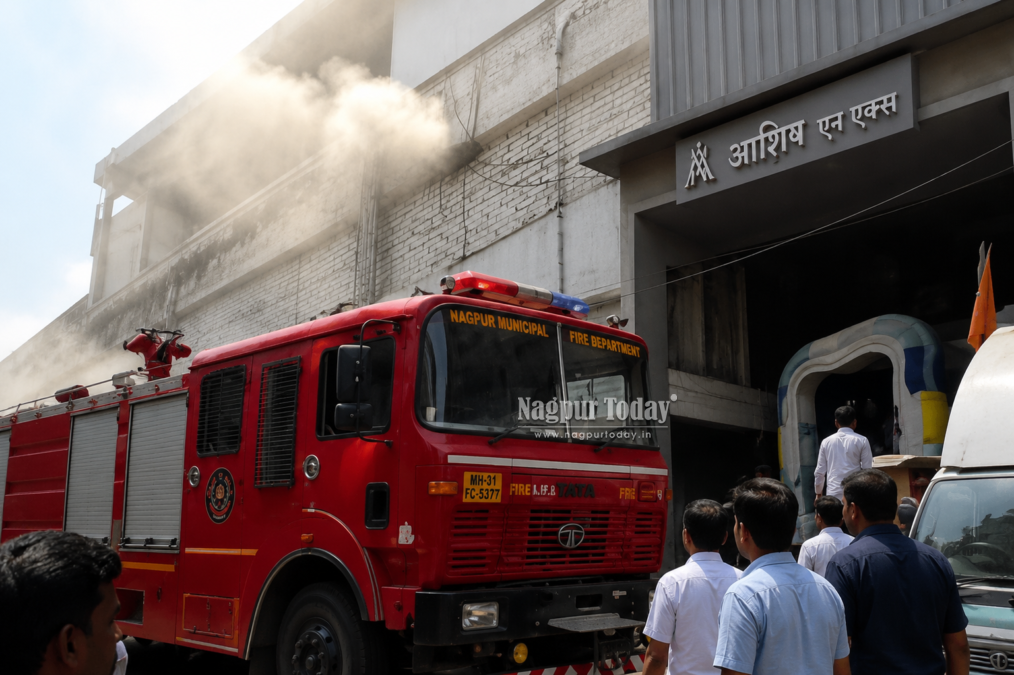
 Nagpur: The devastating fire at Ashish NX showroom in one of Nagpur’s busiest commercial hubs has triggered outrage across the city and raised uncomfortable questions about the enforcement of fire safety regulations.
In the aftermath of the blaze, the Fire Department has swung into action. Fire safety audits are underway. Notices are being issued. Buildings operating without valid Fire No Objection Certificates (NOCs) are now under scrutiny.
But citizens are asking a simple question:
If thousands of commercial establishments, complexes and multi-storey buildings were allegedly operating in violation of fire safety norms, where were the authorities before the fire?
The Ashish NX blaze has exposed more than just gaps in fire safety compliance. It has exposed a system that often appears to react after disaster strikes rather than prevent it.

For years, Nagpur has witnessed rapid commercial expansion. Shopping complexes, showrooms, warehouses and commercial buildings have multiplied across the city. Yet many residents are now wondering how many of these structures were regularly inspected, how many complied with mandatory fire safety requirements, and how many continued operations despite deficiencies.
The focus of any investigation will naturally fall on the building owners and management. However, public anger is no longer limited to private parties.
People want answers.
Who was responsible for monitoring compliance?
Who conducted inspections?
Were violations identified earlier?
If they were, what action was taken?
And if no action was taken, why?
These are not political questions. They are questions of public safety.
Speaking exclusively to Nagpur Today, Chief Fire Officer Tushar Barahate said the department has launched a citywide fire safety audit and inspection drive following the incident.
According to Barahate, buildings found violating fire safety regulations are being issued notices, and strict action will be taken wherever necessary.
He stressed that compliance with prescribed fire safety norms is mandatory for all commercial establishments and multi-storey buildings.
“To prevent incidents like this, every commercial and high-rise building must adhere to fire safety regulations. Our teams are continuously conducting inspections, and action will be taken against those found violating the rules,” he said.
While the department’s crackdown has been welcomed, many citizens are questioning why such urgency emerged only after a major fire exposed the risks.
If numerous buildings are now being found without valid Fire NOCs or with inadequate safety measures, it raises a troubling question: Were these shortcomings invisible before the Ashish NX fire, or were they simply ignored?
Every major tragedy follows a familiar pattern. There is shock, outrage, inspections, notices, inquiries and promises of reform. Yet months later, the system often returns to business as usual until another disaster exposes the same failures.
The Ashish NX fire should not become another file that gathers dust after public attention fades.
The real test is whether accountability stops at the lowest level or reaches every layer responsible for enforcement.
If investigations reveal that rules were ignored, approvals were granted despite deficiencies, inspections were not conducted properly, or warnings were overlooked, then accountability cannot be selective.
The public expects authorities to identify every failure that contributed to the tragedy—not just the final link in the chain.
The conversation should not be limited to whether a building owner violated regulations. The larger question is whether the regulatory system functioned as it was supposed to.
A fire of this magnitude does not simply expose one building’s shortcomings. It exposes weaknesses in oversight, enforcement and governance.
The Fire Department’s current drive is a welcome start. However, Nagpur’s citizens will judge its success not by the number of notices issued, but by whether meaningful action follows.
Will buildings that have ignored safety norms for years finally face consequences?
Will compliance become mandatory rather than optional?
Will accountability extend beyond paperwork and public statements?
Or will this too become another post-disaster exercise that fades once the headlines disappear?
Nagpur now stands at a crossroads.
The city can either treat the Ashish NX fire as another unfortunate incident and move on, or it can use this moment to conduct a transparent investigation, enforce accountability at every level and ensure that fire safety laws are more than paperwork.
Because when regulations exist only on paper, inspections become formalities and accountability disappears, tragedies stop being accidents.
They become preventable failures.
And that is the question Nagpur is asking today:
Will only the owners be held responsible, or will the system finally be forced to answer for its role as well?