

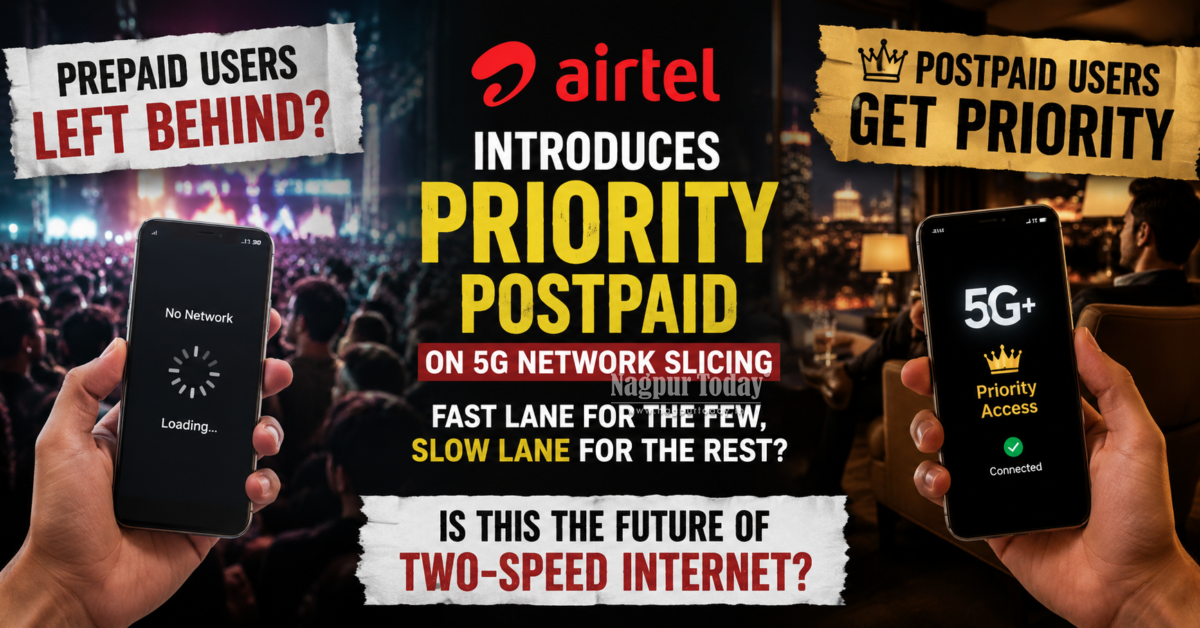
 New Delhi: India’s telecom industry may have just entered a completely new era – one where your internet speed may depend not only on signal strength, but also on how much money you can spend.
Bharti Airtel has launched ‘Priority Postpaid’, a new premium 5G experience powered by Network Slicing technology. Officially, the company says the feature is designed to provide faster and more stable connectivity in crowded places.
But the launch has triggered a larger public debate:
Is this the beginning of a ‘VIP Internet’ system in India?
And more importantly:

Will ordinary users now get pushed into the slow lane while premium users enjoy priority access?
The development has sparked discussions around digital inequality, net neutrality, and whether India’s telecom future could slowly become divided between premium users and everyone else.
What Exactly Has Airtel Introduced?
Airtel says its new Priority Postpaid service uses advanced 5G Network Slicing technology.
In simple terms, this allows the telecom company to create separate virtual lanes within the same network.
That means even if thousands of people are using the internet in the same area — such as a cricket stadium, concert, airport, railway station, or mall — some users may continue getting smoother speeds and more stable connectivity because they are placed in a “priority” category.
The company says the move is aimed at professionals, creators, gamers, business users, and people who depend heavily on uninterrupted internet.
But critics say the technology introduces a dangerous possibility:
A two-class internet system.
Airtel Says It’s About Better Experience – Not Discrimination
Airtel has clarified that it is not prioritizing specific apps, websites, or platforms.
Instead, the telecom giant says the technology simply improves network quality for eligible postpaid customers.
According to the company, this is similar to premium airport lounges or express highway lanes – users paying more receive additional convenience.
However, digital rights experts believe telecom networks are fundamentally different from luxury services.
Why?
Because today, internet access is directly linked to:
Education
Jobs
Banking
Healthcare
Government services
Emergency communication
Online business
This is why critics argue that “priority internet” raises ethical and policy concerns.
What is Network Slicing?
Network slicing is one of the most powerful features of 5G technology.
Traditionally, everyone shared the same mobile network equally.
Now, telecom operators can divide a single network into multiple digital slices.
Each slice can be customized separately.
For example:
One slice for gaming
One slice for hospitals
One slice for factories
One slice for emergency services
One slice for premium mobile users
Supporters say this improves efficiency.
Critics fear it could eventually create digital inequality.
The Net Neutrality Debate Returns
The launch has once again brought back discussions around Net Neutrality.
Net neutrality is the principle that all internet users should receive equal treatment online.
India witnessed massive debates on this issue during the Free Basics controversy several years ago.
Now, experts believe 5G technology could reopen similar policy battles.
The concern is simple:
Today it’s “priority speeds.” Tomorrow could it become premium-quality internet only for people who can afford higher plans?
Some analysts warn that once telecom companies realize users are willing to pay for faster and more reliable access, the pressure to create multiple premium tiers could increase.
Why This Matters Beyond Telecom
This is no longer just a telecom story.
It is becoming a social and economic conversation.
India already has:
Unequal digital access
Rural vs urban internet gaps
Expensive device barriers
Different levels of network quality
Now, critics say “priority internet” could create another divide:
Better internet for premium users. Compromised experience for ordinary consumers.
At the same time, supporters argue that premium services exist in every industry – airlines, banking, hotels, entertainment, and transport.
According to them, users paying more for better connectivity is simply the next evolution of telecom business.
What Happens Next?
For now, Airtel says the service is limited to select postpaid plans and is meant to improve customer experience.
But the larger question remains unresolved:
In the future, will internet access remain equal for everyone – or will India move toward a layered digital society where speed, stability, and performance depend on how much users can pay?
That debate has officially begun.
Why This Story Matters
This is no longer just about faster mobile internet.
The bigger concern being raised is whether India’s digital future could slowly become divided between premium users and ordinary consumers.
Supporters of the move say premium services already exist in sectors like airlines, banking, and entertainment, and telecom companies should also be allowed to offer differentiated experiences.
Critics, however, argue that internet access today is deeply connected to education, jobs, healthcare, banking, emergency communication, and public services. Because of that, they believe creating “priority internet” could eventually widen the digital divide.
For now, Airtel maintains that the feature is designed only to improve user experience and does not violate net neutrality principles.
But the larger public debate has already begun:
Will India’s 5G future remain equal for everyone, or will faster and more stable internet increasingly become a premium privilege?