

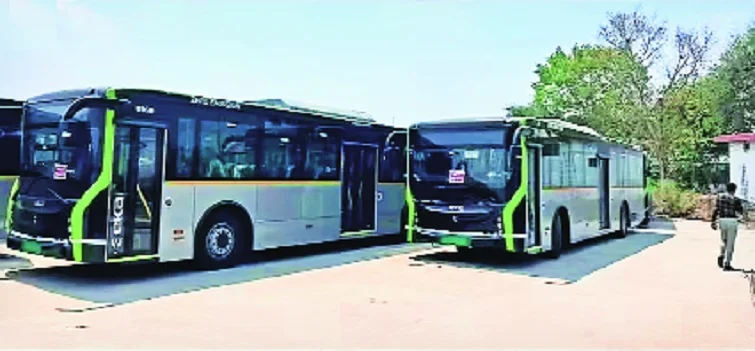
Nagpur: Nagpur Municipal Corporation’s (NMC) public transport finances are coming under increasing strain, with the Transport Department returning to the civic administration for another massive financial bailout barely seven months after presenting its annual budget. Despite projecting a budget of Rs 575.58 crore, the department has now sought an additional Rs 108.51 crore to keep the Aapli Bus service running smoothly, raising serious questions about financial planning, revenue projections and expenditure control.
The proposal was cleared by the Transport Committee at a meeting chaired by its Chairperson Mangala Khekre and will now be forwarded to the Standing Committee for consideration. The Transport Department has also approached the NMC’s Accounts and Finance Department to arrange the additional funds.
However, the fresh demand has run into a financial reality check. A senior official from the Accounts Department indicated that mobilising more than Rs 100 crore at this stage would be difficult, considering the NMC’s existing financial obligations and limited budgetary headroom.
The department’s original budget had projected revenue of Rs 190 crore against expenditure of Rs 574.89 crore. It had sought an NMC subsidy of Rs 200 crore, which was already Rs 50 crore higher than its earlier demand. Yet, within a few months, the department has returned with another requirement of Rs 108.51 crore, exposing the widening gap between its financial projections and actual operational needs.

Sources pointed out that the initial revenue estimates included earnings from bus depots, advertising rights and other commercial avenues without adequately assessing their realistic income potential. The latest demand has therefore brought the credibility of the department’s original budgeting exercise under scrutiny.
According to the proposal placed before the committee on Tuesday, Aapli Bus operations will require approximately Rs 295 crore between October 2026 and March 2027. Against this expenditure, the department expects to mobilise Rs 186.49 crore through the remaining NMC grant, passenger ticket collections, assistance from the Nagpur Metropolitan Region Development Authority (NMRDA) and funds under the PM e-Bus Sewa scheme. This leaves a substantial deficit of Rs 108.51 crore, which the civic body is now being asked to bridge.
The department has attributed the mounting financial burden largely to the expansion of its bus fleet. The number of buses increased from 430 in April to 825 in October. With nine private operators managing services across eight depots, contractual payments and day-to-day operational expenses have risen considerably.
However, the rapid expansion has also raised questions about whether the financial implications were adequately assessed before increasing the fleet and committing to additional operational expenditure.
While approving the additional funding proposal, the Transport Committee returned several other proposals for modifications.
These included revised rates for contract-hired buses, advertising rights for 242 bus shelters and a proposed expenditure of Rs 13.84 crore on infrastructure development at six bus depots. The committee sought changes in these proposals, while clearing the remaining items on the agenda.
Five CNG pumps proposed on NMC land
In another significant decision, the committee approved the setting up of five CNG filling stations on NMC-owned land at Wathoda, Khapri, Wadi, Hingna and the municipal workshop premises under the Build-Operate-Transfer (BOT) model.
The proposal, however, triggered questions among committee members over its commercial rationale. With a substantial portion of the city’s expanding bus fleet now operating on electricity, members questioned the need for additional CNG infrastructure.
The proposal also failed to clearly specify the revenue expected to accrue to the NMC through leasing its land for these facilities. Opposition members went further, alleging that the arrangement was designed to benefit a particular individual.
In a contrasting decision, the committee approved concessions ranging from 20% to 50% on bus rental charges for Government and semi-Government departments, educational institutions, social organisations, industrial establishments and private institutions. The concessions will bring down the proposed rental charges by as much as Rs 4,000, depending on the category of bus and nature of service.
Under the original rate structure, pick-up and drop services were priced at Rs 5,000 for mini/midi diesel buses, Rs 6,000 for midi electric buses and Rs 7,000 for standard electric buses.
For full-day rentals, the proposed charges were Rs 12,000 for mini/midi diesel buses, Rs 13,000 for midi electric buses and Rs 14,000 for standard electric buses.
The decision to reduce rental rates even as the department struggles to meet its operational expenses has added another dimension to the debate over its revenue strategy.
Financial planning under scanner
The latest demand has placed the NMC’s transport finances under a cloud, particularly when the civic body itself is facing multiple competing expenditure commitments.
The expansion of Aapli Bus services may improve public transport accessibility, but the financial burden cannot be ignored. The department’s inability to meet its projected requirements within the original budget raises fundamental questions about cost calculations, revenue generation and the sustainability of the current operating model.
The crucial question now is whether the NMC can continue pouring additional public money into Aapli Bus operations without a clear and credible financial roadmap. More importantly, will the civic administration revisit the department’s revenue assumptions and expenditure controls before approving yet another substantial subsidy?