

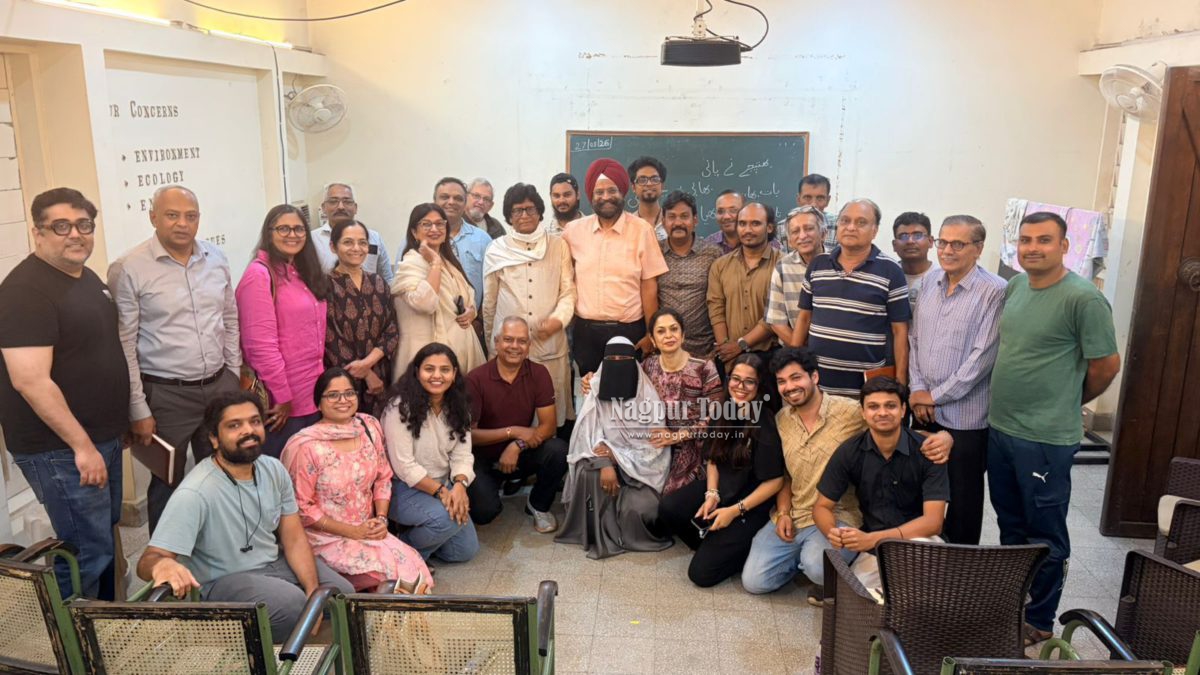
 Nagpur: Aamozish-e-Urdu witnessed a week of literary and cultural engagement with two special programmes held on August 28 and 31, bringing together Urdu learners, poets, academics and literature enthusiasts.
The first programme featured an interaction with renowned Urdu poet, critic and scholar Sheen Kaaf Nizam, who visited the Aamozish-e-Urdu classroom on August 28. Three days later, on August 31, the students and literary enthusiasts gathered to mark the 107th birth anniversary of legendary poet and writer Amrita Pritam.
The two programmes reflected Aamozish-e-Urdu’s broader objective of taking language learning beyond the Urdu script and vocabulary and introducing learners to literature, poetry, culture and India’s composite heritage.
Sheen Kaaf Nizam interacts with Urdu learners
Sheen Kaaf Nizam, who was in Nagpur for another programme, made a special visit to Aamozish-e-Urdu, where he was welcomed by Dr Tejinder Singh Rawal, who conducts the classes, and the students.
An informal interaction soon developed into an engaging discussion on Urdu poetry, literature, language and the creative process. Dr Rawal led a wide-ranging conversation with the poet, while students actively participated by putting forward their questions.

Nizam responded to the questions with warmth, wit and humility, making the session an enriching literary experience for the learners.
The poet expressed particular happiness on learning that Aamozish-e-Urdu has been conducting classes in Nagpur for the past 13 years and attracts learners from diverse educational, professional, social and religious backgrounds.
He appreciated the sight of people from different communities learning Urdu together and said initiatives of this nature play an important role in preserving the language and the composite cultural traditions associated with it.
Nizam congratulated Dr Rawal and the students and observed that similar initiatives should be encouraged and replicated in other cities.
Amrita Pritam remembered on her 107th birth anniversary
On August 31, Aamozish-e-Urdu transformed its classroom into a literary gathering to remember Amrita Pritam, one of the most influential and fearless literary voices of the Indian subcontinent.
Rather than holding a conventional commemorative programme, the organisers designed the evening as a participatory exploration of Pritam’s life, poetry, fiction and philosophy. Students and participants presented her poems, reviewed her works and discussed different aspects of her literary and personal journey.
The programme was anchored by artist RJ Tejal.
Dr Nazneen Chimtanawala recited a poem by Amrita Pritam, while Satyendra Singh spoke about Pritam’s philosophy of communal harmony and her deeply humanistic response to the trauma of Partition.
Singh highlighted that despite personally experiencing displacement and witnessing the violence of 1947, Pritam’s writings moved beyond religious identities and focused on human suffering rather than blaming any particular community.
Dr Jyotimani Rock presented another poem by Pritam, while Sonal Bisen recited the celebrated Punjabi poem “Main Tainu Phir Milangi”, one of Pritam’s most moving expressions of love, separation and the idea of emotional continuity beyond physical presence.
The poem, closely associated with Pritam’s relationship with artist Imroz, brought another dimension of her literary personality into focus.
Monika Dixit presented a review of Pritam’s acclaimed novel Pinjar, discussing its principal characters and the questions raised by the story about women’s identity, dignity and autonomy amid the social upheaval of Partition.
The discussion around Puro, the novel’s central character, also examined the oppressive notions of family honour and social expectations against the backdrop of Partition.
Mr Pasha shared his experience of working with All India Radio and having an opportunity to interview Amrita Pritam.
Dr Supanth Bhattacharya, academician, writer, poet and theatre personality, presented a reading of Pritam’s short story “Laal Mirch”, highlighting a lesser-discussed aspect of her diverse literary output.
Dr Rawal traces Pritam’s literary journey
A detailed presentation by Dr Tejinder Singh Rawal formed the central part of the evening.
Rawal traced Amrita Pritam’s life from her early years in Gujranwala and the loss of her mother at a young age to her early entry into literature, her years in Lahore, the trauma of Partition and her eventual emergence as one of the most distinctive literary voices of twentieth-century India.
He discussed in detail her iconic Punjabi poem “Ajj Aakhaan Waris Shah Nu”, placing it in the context of Waris Shah’s Heer and explaining the literary symbolism through which Pritam transformed the anguish of Partition into a universal lament for humanity.
The invocation of Waris Shah, the imagery of Punjab and the reference to Kaido from the Heer-Ranjha tradition were discussed as examples of the poem’s literary depth.
The presentation also underlined the significance of Pritam’s response to Partition. Rather than writing a poem of revenge or hatred, she invoked Punjab’s shared cultural memory and mourned the suffering of its people, particularly women, regardless of their religious identity.
This universal humanism, participants noted, has helped make the poem an enduring literary bridge between India and Pakistan.
Amrita Pritam’s feminism and unconventional life
Dr Rawal also explored Pritam’s identity beyond that of a poet, including her emergence as an early feminist voice and her progressive and unconventional approach to life and literature.
Her relationships with poet Sahir Ludhianvi and artist Imroz were discussed in the context of her ideas about love, freedom, companionship and the distinction between affection and possession.
Several anecdotes from her life and autobiography Rasidi Ticket, including the story behind its unusual title and its association with Khushwant Singh, added an engaging dimension to the presentation.
The programme also highlighted Pritam’s contribution as an editor and her long association with the Punjabi literary magazine Nagmani, demonstrating that her contribution extended beyond her own poetry and fiction to nurturing a wider literary culture.
Speaking about Pritam’s continuing relevance, Dr Rawal said her feminism should not be understood merely as rebellion against patriarchy or social convention, but as an assertion of a woman’s right to be recognised as a complete individual with her own voice, aspirations, desires and choices.
“Perhaps Amrita’s greatest rebellion was that she refused to surrender to society the authorship of her own life. She wrote not only her poetry and fiction; in a very real sense, she wrote her own life as well,” Dr Rawal said.
Aamozish-e-Urdu’s 13-year literary journey
The two programmes offered the learners two distinct but complementary literary experiences — an intimate interaction with a leading contemporary Urdu poet and a collective rediscovery of Amrita Pritam, whose writings continue to cross boundaries of language, religion, gender and nationality.
Sheen Kaaf Nizam is an eminent Urdu poet, critic, editor and literary scholar. He received the Sahitya Akademi Award in 2010 for his poetry collection Gumshuda Dair Ki Gunjati Ghantiyan and was conferred the Padma Shri in 2025 for his contribution to literature and education. His work includes poetry and literary criticism, besides editorial engagement with the works of major poets, including Ghalib.
Aamozish-e-Urdu has been conducting classes in Nagpur for 13 years. The initiative teaches the Urdu script while introducing learners to Urdu language, poetry, literature and India’s broader composite cultural traditions.
Its students come from different age groups, professions, educational backgrounds and communities, united by an interest in Urdu and literature.
The events on August 28 and 31 reflected this philosophy — that a language comes truly alive not merely when its alphabet is learnt, but when its literature is read, its poetry is experienced, its ideas are discussed and its cultural heritage is shared.
Those present included Mayank Sharma, Ravi Rao, Dr Suhas Deotale, Dr Naznin Chimthanawala, RJ Tejal, Sonal Bisen, Dr S. P. Singh, Sanjeev Chawla, Kovid Sontakke, Dr Sonal Singrakhia, Alefia Master, Rupinder Nanda, Ravindra Paranjape, Shreyas Bahadure, Jasmeet Bamrah, Mariyam Chimthanawala, Ishwinder Kaur, Mohhnish Zade, Mayank Tembhurne, Ajay Nagrare, Dr Manoj Singrakhia, Yashpal Ramavat, Sajjad Hussain, Dr Nirankush ‘Neer’, Amjad Khan, Thomas Francis, Suresh Vinchurkar, Shabi Hasnain, Sunil Nikhare, Joginder Kumar and others.