

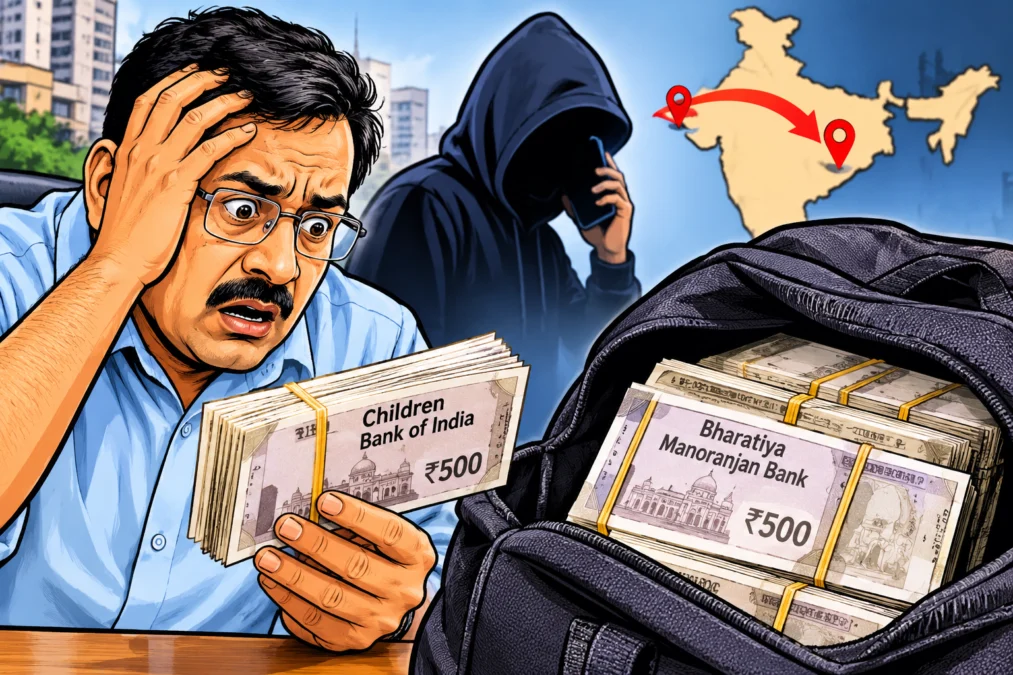
Nagpur: In a bizarre case of organised financial fraud, a Nagpur-based trader was allegedly cheated of Rs 40 lakh after a gang replaced a legitimate business payment with bundles of imitation currency notes bearing the bizarre labels ‘Children Bank of India’ and ‘Bharatiya Manoranjan Bank’. The counterfeit currency, cleverly packed and handed over as genuine cash, travelled all the way to Gujarat before the fraud was discovered, exposing what police suspect to be an interstate racket targeting traders through fraudulent money-transfer arrangements.
The fraud came to light on November 17 when a Gujarat-based trader opened eight tightly packed bundles delivered to him and discovered that the purported Rs 500 currency notes were nothing but imitation money.
The complainant, Hitesh Kesvani (46), a grocery broker and commission agent from Lakadganj, operates from an office in Chuna Oli area of Itwari. He deals in commodities such as cumin and fennel and had to settle a payment of Rs 40 lakh with Unjha-based trader Rohit Patel against a consignment of cumin.
According to the complaint, the fraudsters contacted Kesvani on WhatsApp on November 9, with one of them claiming to represent an entity called ‘Maa Durga Transfer’. The gang allegedly convinced him that it could facilitate the transfer of the business payment.

The accused subsequently devised an unusual verification trick to gain the trader’s confidence. On November 16, the caller asked Kesvani to provide the serial number of a Rs 10 currency note, ostensibly as part of the transaction verification process.
The following day, a person arrived at Kesvani’s shop, displayed a Rs 10 note bearing the exact serial number and collected Rs 40 lakh in cash packed inside a college bag. The seemingly convincing verification exercise apparently left the trader believing that the transaction had been executed safely.
However, the deception was exposed within barely half an hour. Patel contacted Kesvani and informed him that the eight bundles received in Gujarat contained imitation notes instead of genuine currency. The bundles carried fake Rs 500 notes bearing the names ‘Children Bank of India’ and ‘Bharatiya Manoranjan Bank’, revealing the audacity of the fraudsters.
Rajasthan youth caught in police trap
Following the complaint, Tehsil Police registered a case against four persons and launched an investigation into the suspected interstate network. The police subsequently arrested Niteshkumar Sanjeev Sharma (21), a resident of Bikaner in Rajasthan, from Shaheed Chowk.
Investigators discovered that the gang was allegedly attempting to repeat the same modus operandi with other traders. During the probe, police found that another trader, Avinash Jain, had also received suspicious calls resembling those made to Kesvani.
Police used Jain’s case to lay a trap for the suspects. Sharma was allegedly apprehended when he arrived to execute a proposed transaction involving Rs 10 lakh. His arrest provided investigators with crucial leads about the network and its operations.
Ahmedabad seizure points to wider racket
The investigation subsequently took an interstate dimension, with police uncovering a suspected link to Ahmedabad. On November 19, police in Ahmedabad intercepted couriers carrying 17 bundles containing 1,666 imitation Rs 500 notes.
During questioning, the couriers allegedly disclosed that they had collected the bundles from a railway station in Delhi on the instructions of a contact based in Noida. They were reportedly promised Rs 5,000 each along with travel expenses for transporting the bundles.
The revelations have widened the scope of the investigation, with police now examining the roles of the alleged masterminds, handlers and couriers operating across different cities.
Investigators are also trying to establish whether the imitation currency consignments seized in Ahmedabad were connected to the Rs 40-lakh fraud in Nagpur and whether the gang had targeted other traders using similar payment-transfer arrangements.
Police are continuing efforts to identify and arrest the remaining accused, trace the money trail and recover the cheated amount. The case has raised serious concerns over the use of impersonated financial-transfer services and elaborate verification tricks to defraud businessmen dealing in large cash transactions.