

India has millions of young people entering the workforce, thousands of engineering colleges and a rapidly growing technology sector. Yet, when it comes to manufacturing the technologies of the future, China remains far ahead. Why? A recent interaction by Rahul Gandhi in the United States has raised an important question: Is India preparing its young generation to build the future, or merely to work with products manufactured elsewhere?
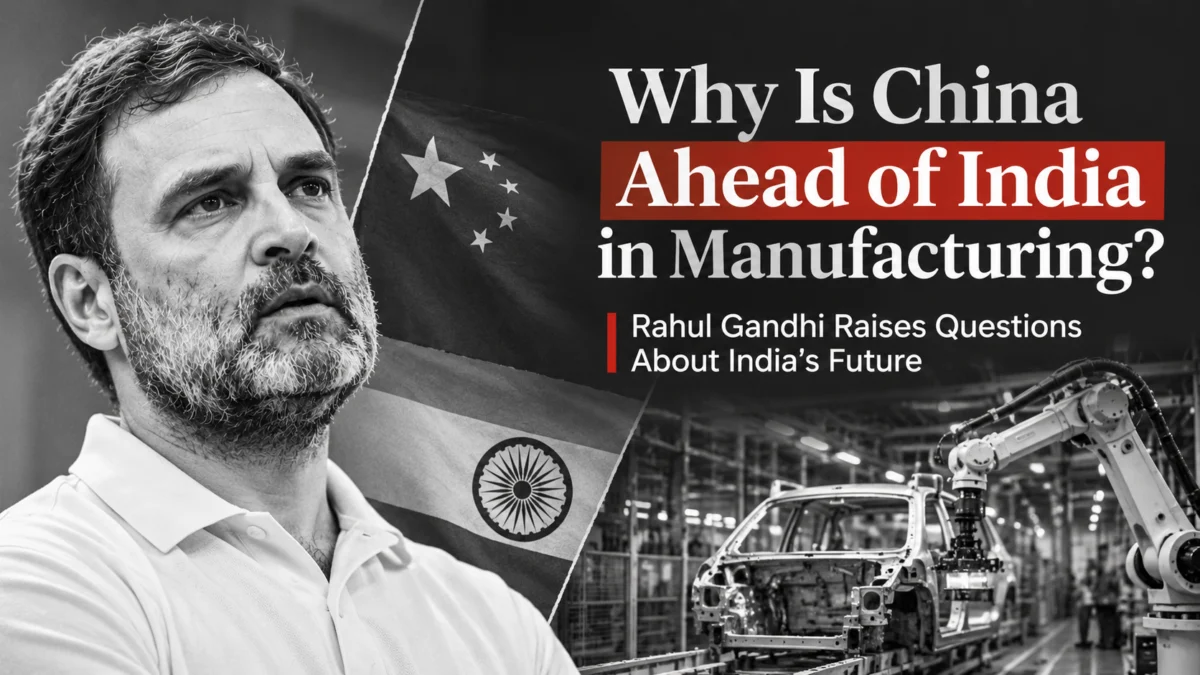 India produces engineers. China produces the machines, batteries and components used across the world.
That difference may sound simple, but it reflects a much bigger economic challenge.
During a recent US interaction, Rahul Gandhi made some interesting observations about China’s manufacturing strength, India’s dependence on services and the next global energy transition.
His argument was that no major country can become a superpower without developing strong production and manufacturing capabilities.

“You’re not building a drone; you’re assembling a Chinese drone”
Rahul Gandhi narrated his experience of visiting a German factory manufacturing advanced drones, including drones used in the Ukraine war.
After watching a presentation, he asked the factory representatives where the motors and batteries used in the drones came from.
The answer, he said, was China.
“You’re not building a drone; you’re assembling a Chinese drone.”
— RAHUL GANDHI | US INTERACTION
He argued that assembling a drone in Germany does not necessarily mean Germany controls the technology behind it if its critical components come from another country.
He also referred to his visit to Boston Dynamics, an American robotics company, to make a broader point about the importance of manufacturing.
His central message was that countries cannot become global industrial powers simply by assembling products or expanding their services sectors. They must develop the ability to manufacture the technologies and components themselves.
Whether one agrees with his political assessment or not, the question deserves serious attention.
India vs China: The manufacturing gap in numbers
The difference is visible in the economic data. According to World Bank data for 2025, manufacturing value added stood at approximately US$4.82 trillion for China and US$533 billion for India.
In simple terms, China’s manufacturing value added was roughly nine times India’s.
GRAPHIC 01 | MANUFACTURING COMPARISON
China’s manufacturing economy is nearly 9 times India’s
Manufacturing value added | 2025 | Current US dollars
CHINA US$4.82 trillion
INDIA US$533 billion
| 24.73% China manufacturing value added as a share of GDP |
13.47% India manufacturing value added as a share of GDP |
Source: World Bank, World Development Indicators, 2025. Values rounded. Manufacturing value added measures the value created after deducting intermediate inputs. Current US dollar comparisons are also affected by exchange rates and prices.
The manufacturing share of GDP also highlights the gap. Manufacturing accounted for 24.73% of China’s GDP in 2025, compared with 13.47% in India.
China’s manufacturing ecosystem has developed over decades, connecting raw materials, component suppliers, industrial technology, logistics and finished products.
India has made progress, but it still has considerable ground to cover.
The next industrial revolution: Who controls the battery and motor?
Rahul Gandhi also highlighted an important global shift: the transition from conventional fuel-powered engines to electric motors and batteries.
This transition is not limited to cars. Batteries, electric motors and optical technologies are increasingly important in drones, robotics, industrial machinery and modern defence systems.
The International Energy Agency’s Global EV Outlook 2026 illustrates China’s advantage.
GRAPHIC 02 | CHINA’S TECHNOLOGY ADVANTAGE
China’s dominance in the global EV supply chain
Approximate share of global production in 2025
Electric cars 70%
Battery cells Over 80%
Cathode active materials About 85%
Anode active materials Over 90%
Source: International Energy Agency, Global EV Outlook 2026, Manufacturing and Trade. Figures are approximate.
In other words, China’s advantage is not just about manufacturing electric vehicles. It extends to the components and materials needed to build them.
That is the bigger challenge for India: developing the entire manufacturing ecosystem rather than depending on imported critical components.
What does this mean for India’s youth?
This is perhaps the most important part of the debate.
Every year, millions of young Indians look for employment after completing their education. India has built a strong services industry, particularly in IT, finance, consulting and business services.
But can services alone create enough opportunities for a country of India’s size?
Manufacturing creates employment across a much wider range of skills. An expanding electric vehicle industry needs battery technicians, electrical engineers, production workers and quality-control specialists. Semiconductor manufacturing needs engineers, technicians and research professionals. Drone and robotics industries require electronics specialists, software developers, designers and skilled operators.
GRAPHIC 03 | INDIA’S NEXT GENERATION
What could India’s youth build?
Emerging industries and potential career pathways
| BATTERY TECHNOLOGY Battery engineers, technicians and energy-storage specialists |
SEMICONDUCTORS Chip designers, fabrication and testing specialists |
| ROBOTICS Automation engineers, robot developers and maintenance experts |
DRONE TECHNOLOGY Electronics engineers, software developers and component makers |
| ELECTRIC MOBILITY Motor engineers, power electronics and EV specialists |
ADVANCED MANUFACTURING Precision engineers, CNC operators and production managers |
The opportunity is not just to get a job in a technology company. It is to build the technology itself.
BUILD TECHNOLOGY. BUILD INDIA.
But that requires more than engineering degrees. It requires practical training, research facilities, industry partnerships and companies willing to manufacture and innovate in India.
The challenge is also about the quality of employment. India needs to create opportunities not only for highly qualified engineers but also for technicians, machine operators, electricians, mechanics and skilled production workers.
Can India catch up?
India has several advantages: a large domestic market, a growing workforce, engineering talent and increasing international interest in diversifying global supply chains.
Government initiatives such as Make in India and Production Linked Incentive schemes are intended to strengthen domestic manufacturing.
However, the next step must be to move beyond assembling finished products.
India needs to manufacture more of the batteries, electric motors, electronic components, semiconductors and advanced technologies that go into those products.
Rahul Gandhi also suggested that India and the United States could work together on manufacturing and the global energy transition. But international partnerships will only deliver lasting benefits if India develops its own technical capabilities and domestic supply chains.
The question India needs to answer
India does not necessarily have to become another China. But it must become a country capable of building the technologies that will shape the future.
The next industrial revolution is already taking shape around electric mobility, batteries, semiconductors, robotics and advanced manufacturing.
China has established a significant lead in several of these areas. India still has the talent and opportunity to compete, but the challenge is to turn that potential into production.
Rahul Gandhi’s US interaction has raised a debate that should extend beyond political parties and speeches. It should be discussed in classrooms, engineering colleges, boardrooms and government policy meetings.
Will India’s young generation build the industries of tomorrow, or watch the rest of the world build them?
Frequently Asked Questions
1. Why is China ahead of India in manufacturing?
China has developed a much larger manufacturing ecosystem, supported by industrial infrastructure, integrated supply chains, technology investment and production scale.
2. What did Rahul Gandhi say about China’s manufacturing strength?
He argued that China’s strength comes from production and highlighted India’s dependence on Chinese components such as drone motors and batteries.
3. Why are batteries and electric motors important for India’s future?
They are essential to electric vehicles, drones, robotics, industrial machinery and energy storage technologies.
4. Can India compete with China in manufacturing?
India has the potential to expand manufacturing, but it needs stronger domestic supply chains, technical skills, research, industrial infrastructure and investment in critical components.