

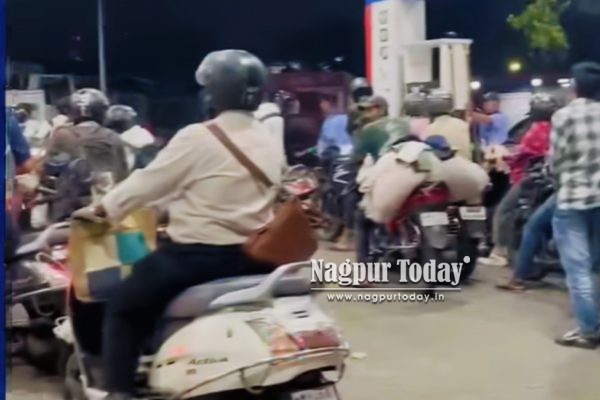
 Nagpur Petrol and diesel supply across Nagpur was disrupted over the past two days, leading to temporary closure of several fuel stations and long queues across the city. Contrary to public speculation, the situation is not linked to any war or external crisis, but rather a combination of policy changes, banking delays, technical issues, and panic buying.
According to Amit Gupta, President of the Federation of Maharashtra Petrol Dealers Association, the disruption stems from a recent shift by oil companies to an advance payment system. Under this new system, fuel is dispatched only after dealers make full payment in advance.
Earlier, petrol pump operators were provided short-term credit, but this facility has now been completely phased out. Hindustan Petroleum (HPCL) and Bharat Petroleum (BPCL) discontinued credit from March 12, while Indian Oil Corporation (IOC) followed on March 18. From March 21 onwards, all three companies stopped extending credit entirely — even during bank holidays.
Gold Rate
June 30,2026 - Time 10.30Hrs

This transition coincided with weekend bank closures, preventing many dealers from processing payments on time. As a result, fuel dispatch was delayed, directly impacting supply at the retail level. Petrol pumps in key areas such as Ajni Police Station, Medical Square, and Ashok Chowk were among those forced to shut temporarily due to lack of stock.
The situation worsened due to panic buying. Fearing a prolonged shortage, residents rushed to fuel stations, leading to an unusual surge in demand. Several pumps, including those around Panchsheel Chowk, witnessed heavy crowds even late at night, rapidly depleting available stock.

In addition, technical issues in Hindustan Petroleum’s system further delayed fuel loading and dispatch operations, compounding the disruption.
Gupta explained that rising crude oil prices — currently around $115 per barrel — have increased financial pressure on oil companies. As they continue to sell fuel at controlled retail prices, the advance payment system has been introduced to better manage cash flow.
He also noted that while oil companies have stopped extending credit to dealers, many pump operators still provide credit to long-term customers such as transporters and industrial clients, creating additional financial strain at the dealer level.
Importantly, there has been no increase in retail fuel prices. Only bulk consumers are being charged market-linked rates.
The situation is now gradually improving. With banks reopening, payments are being processed and fuel dispatch has resumed. However, officials caution that continued panic buying could still lead to temporary disruptions.
The petrol situation in Nagpur is not the result of a supply shortage or global conflict, but a chain reaction triggered by policy changes, banking delays, and public panic. Normalcy is expected to return as supply stabilizes – provided demand remains steady.


NMC Commissioner Pulls Up Officials Over Waterlogging

सोलर प्लांट के बावजूद भारी बिजली बिल #maharashtranews #smartmeter #electricity #bills #newsupdate

ट्यूशन फीस बढ़ोतरी के खिलाफ कांग्रेस आंदोलन #maharashtranews #tuitionfees #congress #andolan

महिला को एमडी ड्रग्स के झूठे केस में फंसाने की साजिश नाकाम...

एमआईडीसी में युवक की बेरहमी से हत्या #nagpurnews #crime #murdernews #newsupdate

सिर्फ एक धक्का... फिर चला चाकू #nagpurnews #crime #accusedarrested #murdernews