


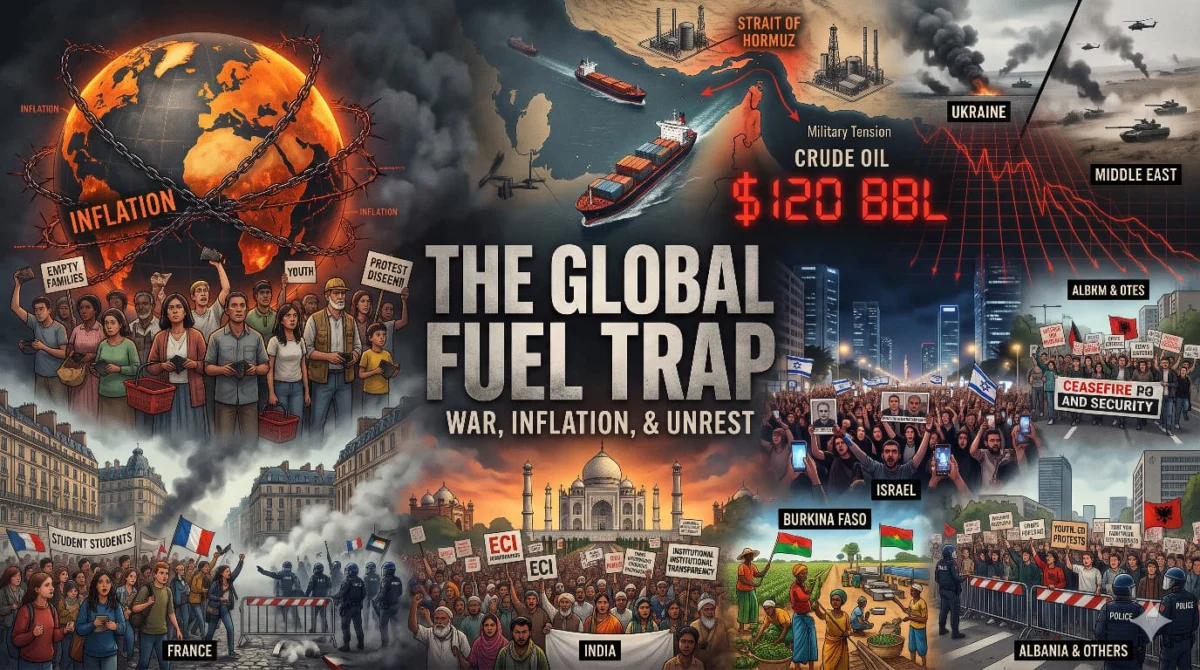
 The sharp rise in protests, high inflation, and economic pressure around the world is connected by a single story. Ongoing wars are acting as an engine that drives up the cost of living, while harsh government responses turn daily financial struggles into widespread anger on the streets.
युद्ध की शुरुआत आसान, अंत की कोई सीमा नहीं
It is always easy to start a war, but history shows that ending one is almost impossible. When military leaders and politicians make initial battle plans, they hope for quick and easy victories. However, war rarely goes according to plan.
When Russian forces entered Ukraine on 24 February 2022, military experts expected the war to end within a week to ten days with a quick change of power. Years later, the war remains stuck in a long and painful fight with no end in sight. The human loss has been terrible, with total military deaths across both sides estimated at over 500,000, combined casualties of killed, wounded, and missing approaching 1.8 million, and more than 17,000 civilians killed.
The same grave miscalculation repeated itself when joint air strikes launched the conflict between the US, Israel, and Iran on 28 February 2026. Expecting a rapid campaign to destroy key targets and force immediate compliance, leaders quickly discovered that initial strikes only open a box of endless problems. Months into the war, retaliatory missile strikes, sea blockades in the Strait of Hormuz, and regional fights have killed over 9,000 soldiers and civilians, turning an intended short intervention into a long global crisis.

Looking at this tragic pattern, on a purely humorous note, and strictly not to be taken seriously, one might conclude that February is simply a bad month for military ambitions. If any world leader is contemplating another conflict, they should at least be advised to pick a different month on the calendar, as wars started in February seem cursed to drag on forever.
The situation is most painful in Palestine and the wider Gaza conflict. What started as a local military action has led to more than 75,000 Palestinian deaths, mostly women and children, over 174,000 injured, and more than 2,000 Israeli casualties. This massive destruction shows the deep human cost of endless war.
The lesson of modern conflict is simple. Starting a war takes just one order, but ending it requires agreements that leaders are rarely willing to make once blood is shed. As wars drag on far beyond their planned deadlines, leaders get trapped in their own decisions, leaving common citizens across the world to pay the heavy price with their money and their lives.
वैश्विक महंगाई की जड़: हॉर्मुज़, कच्चे तेल का बढ़ता बोझ और कोई भी देश अछूता नहीं
Today’s worldwide price rise comes from a simple truth: the world runs on energy, and energy has become very expensive. The biggest problem area is the Strait of Hormuz, the narrow sea route that carries about one fifth of the world’s oil. As war threatens oil tankers moving through Hormuz along with disruptions in the Black Sea, crude oil prices have jumped past $110 to nearly $120 a barrel.
Because crude oil is used to run cargo ships, power factories, generate electricity, and make crop fertilizers, no country in the world can escape this price rise. Rich or poor, every household in every corner of the world feels the direct impact of $120 oil. It leads to higher transport costs, expensive farming materials, rising electricity bills, and costly food. It acts like an unavoidable global tax that eats away everyday savings.
युद्ध और महंगाई: संकट की मुख्य वजह
The chain reaction behind global protests starts on the battlefields of Eastern Europe and the Middle East. Fighting in Ukraine and the Middle East breaks key shipping routes, cuts off energy flows, and pushes fuel, fertilizer, and food prices higher across borders. Combined with oil price spikes from the Persian Gulf, war driven inflation acts as a heavy burden on ordinary families worldwide, making basic daily needs unaffordable.
France: जीवन–यापन की जंग और सख्त रुख
As fuel and energy costs shot up, the French government cut public spending heavily, hurting schools and hospitals the most. High school and college students joined working class families to block roads and protest in major cities against rising college fees, expensive housing, and poor school funding. When police used tear gas and heavy riot gear to disperse student blockades, economic frustration quickly evolved into a broader protest against executive power and institutional authority.
India: भारत निर्वाचन आयोग और लोकतांत्रिक संस्थाओं का सवाल
In India, war driven price rises increased daily household expenses, adding to public worry over jobs and governance. This economic strain led to widespread civic protests following concerns over institutional transparency, exam paper leaks, and controversies surrounding the Election Commission of India. Opposition parties, student groups, and civil rights organizations held demonstrations across the country, including anti CEC rallies, demanding fair voter lists and independent institutions. When authorities responded with protest bans and detentions, citizens felt their democratic right to ask questions was being suppressed, turning local worries into a national movement for democratic fairness.
Israel: युद्ध की मार और नेतृत्व पर सवाल
In Israel, months of ongoing war have created both severe financial pressure and deep personal grief. Weekly rallies in Tel Aviv and Jerusalem, led by families of hostages, college students, and worker unions, are demanding an immediate ceasefire and hostage release deal while opposing government plans to reduce the power of local courts. Dismissive statements from leaders toward these crowds have created deep anger, making citizens feel that politicians care more about keeping power than protecting public safety and human life.
Albania: युवाओं की चिंता और शासन का दबाव
In Albania, high fuel and food prices hit young citizens who are already struggling with a lack of jobs and high university fees. Protests known as the Flamingo Revolution brought thousands of students onto the streets against government corruption, expensive education, and the loss of public land. When police used force to clear college campuses, student groups expanded their demands, turning local school disputes into a nationwide call for government change.
Serbia: भ्रष्टाचार का परिणाम और युवा नेतृत्व की ताकत
Recent events in Serbia offer a vital warning to governments everywhere. Following a deadly infrastructure disaster at the Novi Sad railway station caused by state corruption and poor oversight, public anger exploded into a massive youth led movement.
To challenge the ruling party, university students across Serbia formed democratic assemblies, known as plenums, across five state universities. Rather than running for office themselves to seek personal political careers, student organizers built a rulebook to compile a 250-candidate slate called the Student List. Under strict criteria vetted by open assemblies, active students, current political party officials, and individuals with criminal records were barred from candidate slots.
The assemblies vetted and nominated a slate of respected non-partisan academics, doctors, judges, farmers, and civic activists, giving the student assemblies veto power over every candidate. In the October 2026 snap parliamentary elections, this student compiled panel achieved a historic victory, defeating the ruling party and reshaping the nation’s leadership. Serbia demonstrates that when governments allow corruption to fester and ignore public safety, youth led movements will step up to replace them at the ballot box.
Burkina Faso: आत्मनिर्भरता और राष्ट्रीय विकास का नया रास्ता
In contrast to countries where citizens feel hurt by government cuts, Burkina Faso under military leader Captain Ibrahim Traoré offers a clear example of how strong, decisive leadership can guide a country toward self-reliance. As the world’s youngest head of state at 38 years of age, he is showing global leaders what young leadership can achieve with courage and a clear vision. Facing tough global conditions, his government has proven that smart leadership can turn national challenges into opportunities for growth.
Following the practical ideas of former leader Thomas Sankara, Traoré’s government has focused on national self reliance by bringing key resources like gold mining under direct state control and using that money to build public roads, local factories, and agricultural security. By growing more food locally, setting up domestic industries, and reducing reliance on foreign loans, the 38-year-old leader has protected his people from global market shocks.
By fighting corruption firmly and focusing on the welfare of common citizens, Burkina Faso shows the world that young, focused leadership and self-reliance can build stability and public trust even during global crisis.
संवाद ही अकेला समाधान
Military conflicts create global inflation, inflation breaks household budgets, and harsh police action turns economic pain into public protests. Restoring peace requires political leaders to understand that police force cannot fix global supply chains or lower market prices. True stability will only come when leaders stop fighting, clear important sea routes like Hormuz to bring crude oil prices down, and sit down for honest, compassionate talks to solve the daily financial struggles of working families.