

Most articles about data careers in Delhi assume you already know something. They open with “Step 1: Learn SQL” — as if you’ve already decided what role you want, already bought a course, and just need a checklist. This one starts earlier than that.
Gold Rate
Sept 12,2026 - Time 10.30Hrs

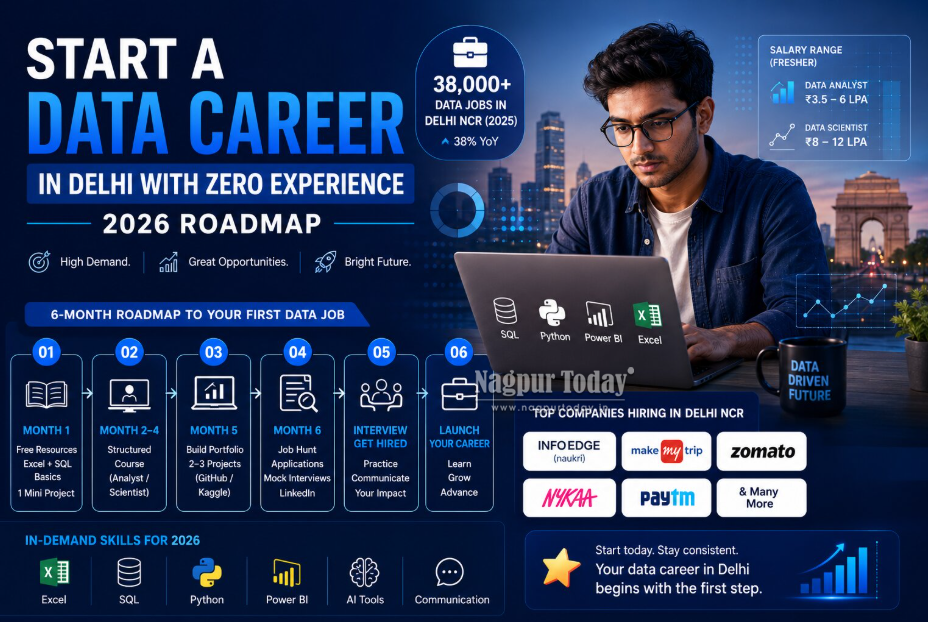
Delhi NCR added over 38,000 data-related job postings in 2025, a 38% jump from the year before. And still, most beginners quit within the first 60 days — not because the field is too hard, but because nobody told them where to actually start.
Here’s the honest roadmap.

First, Pick the Right Role
This is the decision every other article skips. You can’t start learning until you know what you’re building toward.
Data Analyst is the faster path. You’ll spend most of your time in Excel, SQL, and Power BI — cleaning data, building dashboards, spotting trends. A good fresher analyst earns ₹3.5–6 LPA in Delhi. Realistically, you can be job-ready in 4–5 months from zero.
Data Scientist is a longer game. More Python, statistics, and machine learning. The ceiling is higher — ₹8–12 LPA for a strong fresher — but the baseline knowledge you need is steeper, and hiring managers are pickier about portfolios.
Here’s the thing most people get wrong: they try to become a data scientist first, burn out on maths, and quit. If you’re from a commerce or arts background, start as an analyst. Get your first job. Then move toward data science from inside the industry, where you’ll actually have real data to practice on. Engineering graduates can go either direction — but even then, analyst-first gets you employed faster.
The Skills — In the Right Order
Don’t learn everything at once. Learn in this sequence:
Excel first. Not because it’s exciting, but because every company in India uses it, every interview tests it, and it trains your brain to think about data before you touch code. Pivot tables, VLOOKUP, basic charts — spend 2–3 weeks here.
SQL second. This is the skill that actually gets you hired. Nearly every analyst job listing in Delhi mentions SQL. It’s also genuinely learnable in 3–4 weeks. W3Schools and Mode Analytics both have free SQL tracks that are good enough to get you to interview-ready level.
Python third. Specifically: Pandas for data manipulation, Matplotlib or Seaborn for charts. Don’t learn Python in the abstract — learn it to do things you already know how to do in Excel, but faster and on bigger datasets.
Power BI or Tableau last. Pick one. Power BI has more demand in Delhi’s BFSI and e-commerce sectors. Tableau shows up more at MNC consulting firms. If you’re unsure, go Power BI.
Soft skills matter more than most courses admit. Delhi hiring managers consistently say the gap isn’t technical — it’s that candidates can’t explain what they found in data to a non-technical manager. Practice translating numbers into decisions, not just charts.
Before You Pay for a Course — Do This First
Spend 30 days testing whether you actually like this work before committing ₹30,000–₹80,000. Honestly, this is the advice I wish every beginner got.
- Kaggle Learn (kaggle.com/learn) — free, structured tracks in Python, SQL, and data visualisation. Takes about 15 hours total. If you finish these and still want more, you’re ready for a paid course.
- Google Career Certificates — the Google Data Analytics certificate on Coursera costs money but financial aid is available.
- NASSCOM Future Skills Prime — India’s government-backed platform has free analytics modules specifically designed for the Indian job market. Most people have never heard of it. It’s worth your time.
Do one small project in week two. Pull any public dataset from Kaggle — retail sales, cricket scores, air quality in Delhi — clean it in Excel, build three charts, write five sentences about what you found. That’s your first portfolio piece. It sounds tiny. But it’ll tell you more about whether this career is right for you than any YouTube video will.
The Realistic Timeline
| Phase | What You’re Doing | Duration |
| Month 1 | Free resources, Excel + SQL basics, one mini-project | 4 weeks |
| Month 2–4 | Structured course (data analyst or data science) | 10–12 weeks |
| Month 5 | Portfolio: 2–3 projects on GitHub / Kaggle | 3–4 weeks |
| Month 6 | Active job hunt — applications, mock interviews, LinkedIn | Ongoing |
Most courses promise “job-ready in 3 months.” That’s true only if you’re already doing the Month 1 work in parallel. If you start from absolute zero, plan for six months to your first offer. That’s not discouraging — it’s just accurate, and it means you won’t panic when month three arrives and you’re still preparing.
Choosing a Course in Delhi
Once you’ve done the 30-day free phase, you’re ready to invest.
For a data analyst role, look for courses that cover Excel, SQL, Python (Pandas), and Power BI with hands-on projects — not just recorded lectures. Gyansetu’s data analyst course in Delhi covers the full stack with live projects and placement support, which is the combination that actually moves the needle on hiring.
For a data science role, the requirements shift — you need ML, statistics, and Python at a deeper level. Gyansetu’s data science course in Delhi covers Python, Machine Learning, AI, and Power BI with a 6-month structured program and small batch sizes (5–10 students), which means you actually get feedback on your work rather than sitting in a 200-person cohort.
Red flags to watch for in any course: vague placement claims with no named companies, a curriculum that doesn’t mention Gen AI tools, and “projects” that are just pre-built templates you follow step by step without making decisions yourself.
Where the Jobs Actually Are in Delhi NCR
The companies actively hiring junior data talent in Delhi NCR right now include Info Edge (Naukri), MakeMyTrip, Zomato, Nykaa, Paytm, and dozens of mid-size BFSI firms in Gurugram’s Cyber City corridor. E-commerce and fintech have the highest volume of analyst roles for freshers.
One thing worth knowing about 2026 specifically: companies are now asking analysts to work alongside AI tools — Copilot for Excel, ChatGPT for data querying, Python-based AI libraries. They don’t expect you to be an AI engineer. But candidates who’ve used these tools even once in a project get noticed. Add that to your portfolio.
FAQs
Can I get a data job with a non-tech background?
Yes — and honestly, commerce and economics graduates often make better analysts than engineers because they already think in business terms. The tools are learnable. The business judgment is harder to teach.
Which tool should I learn first?
Excel. Every time. It’s in every interview, every company, and every dataset you’ll touch in your first year.
What salary can a fresher data analyst expect in Delhi?
Between ₹3.5 and ₹6 LPA depending on company size and your portfolio strength. Product companies and MNCs pay at the top of that band. Smaller agencies sit at the bottom.
Is a course worth it?
Only after you’ve done the free 30-day test. If you pass that test and still want more, yes — a structured course with placement support cuts your job search time significantly.
Six months from now, you’ll either have your first data job or you’ll know the field isn’t for you. Both outcomes are worth the investment. The only wrong move is waiting another month to start.