
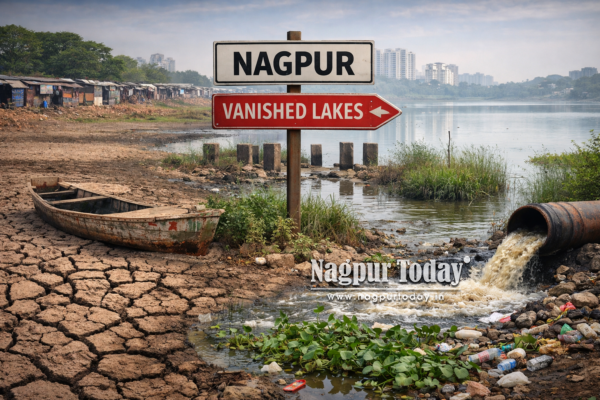
Nagpur: Once regarded as the city’s natural shield against flooding and a lifeline for groundwater recharge, Nagpur’s historic network of lakes is rapidly disappearing under the combined assault of civic apathy, rampant encroachments, unchecked urbanisation, and the continuous discharge of untreated sewage. What was once a well-balanced ecosystem of interconnected water bodies is now steadily collapsing, exposing the alarming extent of administrative neglect and the absence of a coherent conservation policy.
The gravity of the situation came to light after an RTI response from the Nagpur Municipal Corporation’s (NMC) Public Health Engineering Department revealed shocking details about the shrinking inventory of the city’s lakes. According to the reply, two lakes, Dobi Lake and Sanjay Gandhi Lake, have effectively vanished from official records after merging into one, underscoring how Nagpur’s water bodies are quietly disappearing from the city’s landscape.
Gold Rate
June 03- 2026 - Time 10.30Hrs

The RTI application was filed by city-based activist Abhay Kolarkar, whose query exposed that the crisis runs far deeper than previously acknowledged. While Nagpur officially had 11 lakes between January 1, 2015, and January 31, 2026, the civic body admitted that only five of these water bodies are currently under the direct ownership of the NMC. The remaining six are controlled by different government agencies, creating a fragmented system of management that environmentalists say has severely weakened accountability and conservation efforts.
Experts warn that this administrative fragmentation has allowed the lakes to deteriorate unchecked for years. Environmentalists describe the situation as a classic example of institutional indifference, where the absence of a unified authority has resulted in poor monitoring, delayed action, and a gradual ecological collapse.
Even the condition of the surviving lakes paints a grim picture. Ambazari Lake, the largest and most prominent lake in Nagpur, is slowly choking under the unchecked spread of water hyacinth and the relentless discharge of untreated sewage from multiple sources. Environmental experts say the lake now receives polluted inflows from more than five locations, steadily eroding its ecological health. If immediate and sustained restoration measures are not undertaken, specialists warn that Ambazari could lose its ecological capacity within a few years.
The situation is equally alarming at Sonegaon Lake and Sakkardara Lake, where large portions of the natural catchment areas have been lost over the years due to unchecked construction activities permitted by planning authorities. With natural water channels either blocked or diverted, these lakes are increasingly dependent on stormwater runoff and contaminated sewage inflows for survival — a situation that threatens their long-term sustainability.
Pollution continues to plague several other lakes as well. Naik Lake, Binaki Lake, and Lendi Talao are still receiving untreated sewage, severely degrading water quality and undermining any meaningful attempts at rejuvenation. Environmentalists say these water bodies have effectively been reduced to polluted reservoirs rather than functioning ecological systems.
Encroachments have further complicated conservation efforts. Hutments and informal settlements have mushroomed along the periphery of several lakes, restricting access for restoration work and altering natural drainage patterns. The proposed rejuvenation of Lendi Talao, for instance, could not proceed due to widespread encroachments around the water body.
According to the RTI reply, Nagpur’s lakes include Ambazari, Futala, Sonegaon, Pandhrabodi, Police Line Takli, Binaki Mangalwari, Naik, Gorewada, Sakkardara, and Gandhi Sagar, apart from the lakes that have effectively disappeared. However, the NMC acknowledged that only Gorewada, Ambazari, Sonegaon, Sakkardara, and Gandhi Sagar are currently owned by the civic body, while the rest fall under the jurisdiction of other departments or agencies.
Urban planners say this fragmented ownership structure is one of the biggest obstacles to effective lake conservation. With multiple agencies controlling different lakes, responsibility is often diluted, and long-term planning becomes nearly impossible.
Perhaps the most disturbing revelation in the RTI documents is the complete absence of financial support for lake conservation in recent years. According to the NMC’s Information Officer, no funds have been received under the Rajya Sarovar Samvardhan Yojana, the State Government’s dedicated lake conservation scheme, for the restoration or revival of Nagpur’s lakes. Both the “funds received” and “expenditure” columns under the scheme remain marked as ‘Nirank’ (zero), reflecting a glaring lack of financial commitment toward protecting the city’s vanishing water bodies.
Civic officials clarified that some limited works have been undertaken using funds from other State Government schemes, as the dedicated lake conservation programme was discontinued nearly a decade ago. One such project is the Gandhi Sagar Lake rejuvenation initiative, which received Rs 48 crore for beautification and restoration. While most civil works under the project are reportedly completed, key components such as the installation of fountains and the construction of retaining walls on the western and northern sides are still pending.
Environmental experts say Nagpur once had a carefully balanced system of natural and man-made lakes that played a crucial role in regulating stormwater flows, replenishing groundwater reserves, and supporting urban biodiversity. Today, however, the shrinking number of lakes, combined with relentless urban expansion, is significantly increasing the risk of urban flooding, groundwater depletion, and the loss of ecological diversity.
The latest revelations, experts say, should serve as a wake-up call for city planners and policymakers. They stress that Nagpur urgently needs a comprehensive lake conservation policy, strict protection of catchment areas, removal of encroachments, and a coordinated management mechanism involving all responsible agencies.
Without decisive and immediate intervention, environmentalists warn, more lakes could soon disappear from Nagpur’s map, turning what was once the city’s natural water security system into a tragic example of ecological neglect.