

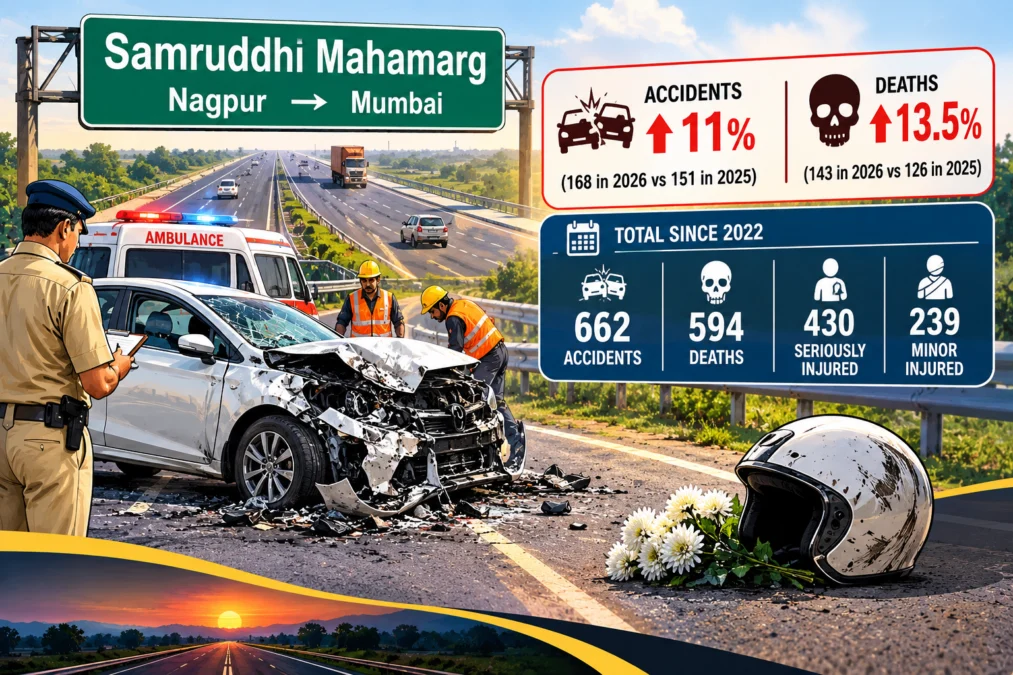
Nagpur: The Samruddhi Mahamarg, envisioned as a high-speed corridor to cut travel time between Nagpur and Mumbai, is facing a disturbing road-safety challenge, with accidents and fatalities continuing to rise despite investments in advanced safety systems and preventive measures.
The expressway recorded 168 accidents between January and September 2026, claiming 143 lives, compared with 151 accidents and 126 deaths during the corresponding period in 2025. The figures represent an approximately 11% increase in accidents and a nearly 13.5% rise in fatalities, highlighting the urgency of strengthening road-safety enforcement and examining the effectiveness of existing preventive measures.
The increase in casualties raises serious questions about whether speed-control mechanisms, traffic-rule enforcement, advance-warning systems and emergency-response arrangements are delivering the intended results on the high-speed corridor.
Fatal accidents show an upward trend

The number of fatal accidents on the expressway increased from 105 during January–September 2025 to 111 in the corresponding period this year. Fatalities rose from 126 to 143, indicating that the road continued to witness a higher death toll even as safety measures remained in place.
The figures underline the need to distinguish between the number of crashes and their severity. While the total number of accidents increased, the rise in fatalities was proportionately greater, warranting a closer examination of the circumstances surrounding deadly collisions.
Speeding, driver fatigue, failure to maintain a safe distance and loss of vehicle control are among the risks commonly associated with high-speed expressways. However, the available figures alone do not establish the causes of individual accidents on the Samruddhi Mahamarg. A detailed analysis of crash locations, vehicle types, driving conditions and other contributing factors would be necessary to identify the principal reasons behind the rising toll.
594 lives lost since December 2022
The cumulative figures paint an even more concerning picture of road safety on the expressway since its opening in December 2022.
Available data shows that 662 accidents were recorded between the opening of the corridor and September 2026. Of these, 430 were classified as fatal accidents, resulting in 594 deaths.
The expressway also recorded 123 accidents involving serious injuries, leaving 430 people seriously injured. Another 56 accidents involving minor injuries resulted in 239 people sustaining injuries.
These figures highlight the human cost of crashes on a corridor designed to facilitate faster and more convenient travel. They also point to the need for sustained monitoring and targeted interventions rather than relying solely on the installation of safety infrastructure.
Safety systems need effective enforcement
Advanced equipment can help warn motorists about potential hazards, monitor traffic and facilitate emergency responses. However, its effectiveness depends on consistent enforcement, proper maintenance and timely action when dangerous driving or hazardous conditions are detected.
Authorities need to assess whether speed limits are being effectively enforced, whether motorists are receiving adequate warnings about dangerous stretches and whether emergency services can reach accident sites without delay.
Identification of accident-prone locations is equally important. A detailed review of repeated crashes could help determine whether particular stretches require additional signage, improved road markings, better lighting, changes in traffic management or other corrective measures.
Driver awareness also remains essential. Motorists using high-speed corridors must avoid fatigue, take adequate breaks during long journeys, maintain safe distances and comply with prescribed speed limits.
Rising toll demands accountability and corrective action
The continued rise in accidents and deaths underscores the need for a comprehensive road-safety review of the Samruddhi Mahamarg. Authorities must examine not only whether safety systems have been installed, but also whether they are functioning effectively and producing measurable results.
Regular publication of accident data, detailed investigations into fatal crashes and transparent reporting on corrective measures could help identify shortcomings and improve accountability.
With 143 people losing their lives in just nine months of 2026 and the cumulative death toll reaching 594 by September, the challenge is no longer merely to provide faster connectivity. It is to ensure that motorists can use the expressway without being exposed to preventable risks.
The rising figures make one point clear: infrastructure and technology alone cannot guarantee road safety. Effective enforcement, responsible driving, rapid emergency assistance and evidence-based corrective action must work together to prevent further loss of life.