

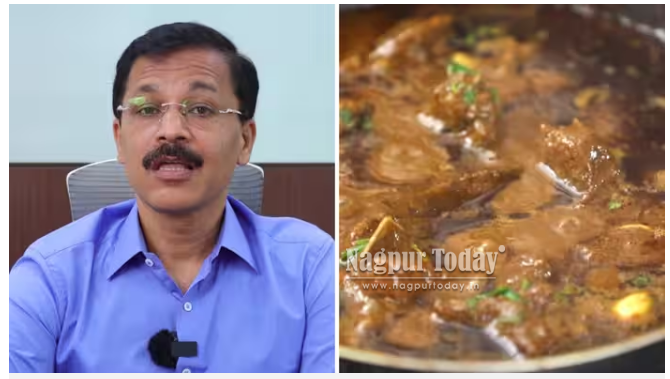
Nagpur: Maharashtra Food and Drug Administration (FDA) Commissioner Tukaram Mundhe has refused to apologise for his controversial remarks on Nagpur’s iconic Saoji cuisine, insisting that his comments reflected his personal opinion and were intended to highlight health concerns associated with excessive consumption of oily and spicy food.
The controversy erupted after Mundhe, speaking at a public event, remarked that if someone like him ate Saoji food, he would end up in hospital for at least a month. He also warned that regularly consuming such oil-rich dishes could increase the risk of lifestyle diseases, including heart ailments.
Gold Rate
Sept 17,2026 - Time 10.30Hrs

The comments drew sharp criticism from Saoji restaurant owners and members of the Saoji community, who accused the senior IAS officer of tarnishing the reputation of one of Nagpur’s most celebrated culinary traditions. Several restaurateurs demanded that Mundhe withdraw his remarks and issue a public apology.
However, speaking to reporters on Wednesday, Mundhe remained defiant. “Those were my personal remarks. There is no question of an apology,” he said.

His statement has reignited a broader debate over the balance between public health awareness and respect for traditional cuisines that form an integral part of a region’s cultural identity.
Celebrity chef Vishnu Manohar came out in defence of Saoji cuisine, saying it represents far more than a spicy meat dish. According to him, Saoji is deeply rooted in Nagpur’s industrial and social history.
Manohar explained that the cuisine evolved during the city’s textile mill era when workers from the Koshti community migrated from Multai, Betul and Chhindwara in present-day Madhya Pradesh to work in Nagpur’s cotton mills. After long working hours, labourers gathered in the evenings and began experimenting with increasingly spicy recipes, leading to friendly cooking competitions that eventually gave birth to the distinctive Saoji style. Separate vegetarian versions were also developed for those who did not consume meat.
At the heart of authentic Saoji cuisine lies a carefully guarded spice blend comprising 32 ingredients. Slow roasting of chilli powder in oil gives the curry its trademark dark colour, intense aroma and fiery flavour. Traditionally, the dishes are prepared with generous quantities of oil and spices, features that have become synonymous with Saoji food.
The culinary tradition spread beyond Nagpur and today enjoys immense popularity across Bhandara, Gadchiroli, Wardha, Chandrapur, Amravati and Buldhana, where the term “Saoji” has become synonymous with bold flavours and robust cooking.
Historically, Saoji cooks were entrusted with preparing meals for large community gatherings and weddings, sometimes serving thousands of guests. Since cooking for such events was traditionally handled by men, the cuisine evolved into a hearty, spice-rich style designed for large-scale preparation. While modern cooking has adapted to changing lifestyles—with comparatively lighter gravies and reduced oil in many establishments, the essence of Saoji cuisine has remained intact.
Nagpur today is home to hundreds of Saoji restaurants, each boasting its own signature blend of spices, flavour profile and cooking technique. For many residents, Saoji is more than just food—it is a symbol of the city’s heritage, hospitality and culinary identity.
While Mundhe’s remarks have triggered a storm among food lovers and restaurateurs, they have also sparked renewed conversations about healthy eating habits and the evolving place of traditional cuisines in contemporary lifestyles.