

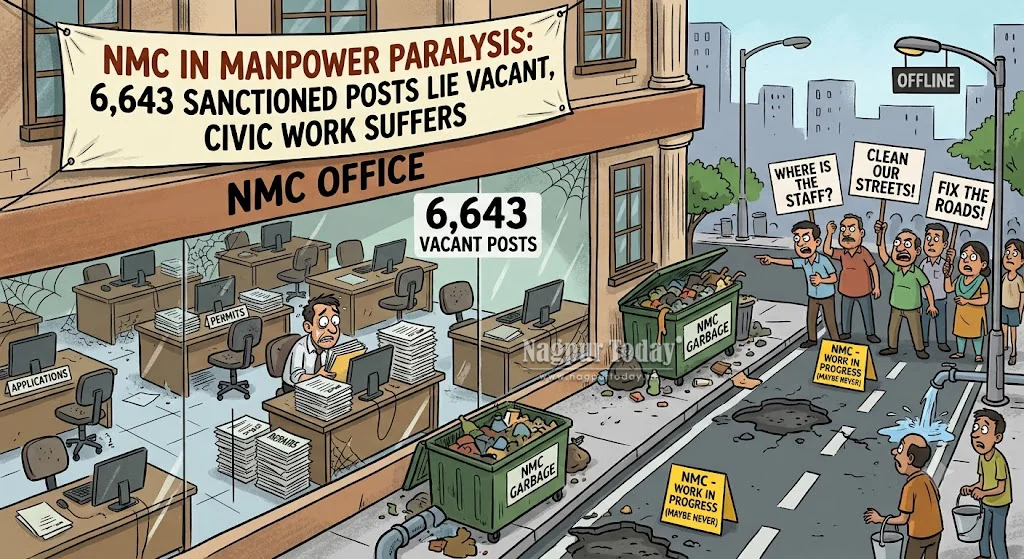
Nagpur: The Nagpur Municipal Corporation (NMC) is functioning with a dangerously depleted administrative workforce, with a staggering 71.26 per cent of its sanctioned regular posts lying vacant, exposing a serious manpower crisis that is increasingly affecting civic governance and delivery of essential services.
Data obtained under the Right to Information (RTI) Act by activist Sanjay Thul reveals that out of 9,321 sanctioned regular posts across Class 1 to Class 4 cadres, only 2,678 employees are currently on the active payroll, leaving as many as 6,643 posts vacant.
Gold Rate
Sept 17,2026 - Time 10.30Hrs

The figures, supplied by the Public Information Officer and officials of the NMC’s General Administration Department, reflect the staffing position as on September 1, 2026, against the civic body’s approved statutory staffing pattern, or Akrutibandh, sanctioned on May 10, 2023.
The shortage is not confined to one particular level. It cuts across almost the entire administrative hierarchy, raising questions over how a civic body responsible for managing a rapidly expanding city is expected to deliver services with such a depleted workforce.

The crisis is particularly acute at the senior and supervisory levels.
Of the 309 sanctioned Class 1 posts, as many as 194, or 62.78 per cent, are vacant. Only 115 officers are available for policymaking, supervision and administration.
The situation is even worse in Class 2, where 177 of 229 posts are vacant, translating into a vacancy rate of 77.29 per cent. Only 52 personnel are working in this cadre, including 10 school teachers deputed to these positions.
The Class 3 cadre, which forms the administrative, clerical, field and technical backbone of the civic body, has 4,560 vacancies against 6,534 sanctioned posts, leaving 69.78 per cent of the positions unfilled. Only 1,974 employees are working, including 310 teachers.
The Class 4 cadre is equally depleted. Of 2,249 sanctioned posts, 1,712 are vacant, leaving only 537 employees and resulting in a vacancy rate of 76.12 per cent.
One officer, multiple departments
The shortage of senior and mid-level officers has created a system in which officials are increasingly being asked to perform multiple responsibilities simultaneously.
Executive engineers and assistant commissioners are reportedly handling additional charges of three to four different departments, leaving little scope for effective supervision of individual portfolios.
The consequences are increasingly visible in routine civic administration. Town planning permissions, property tax corrections and development-related files face delays, while the additional workload raises concerns over effective scrutiny and accountability.
For citizens, the manpower crisis can translate into a frustrating experience at NMC headquarters and zonal offices. Officers may be unavailable because they are attending field meetings or simultaneously handling responsibilities of other departments, forcing citizens to make repeated visits for routine work.
The issue, therefore, goes beyond vacant posts on an administrative chart. A shortage of personnel at such a scale directly affects the civic body’s ability to process applications, supervise infrastructure projects, respond to complaints and maintain public services.
Sanitation wing also short of hands
The manpower crisis extends beyond the regular administrative establishment.
The sanitation workforce, which is directly responsible for street sweeping, solid waste collection and other field-level civic operations, is also facing vacancies. Against 8,660 sanctioned posts for sweepers and sanitation workers, 2,162 posts are vacant, amounting to a deficit of 24.96 per cent.
The shortage assumes significance as Nagpur continues to expand into its peripheral areas, increasing the demand for waste collection, sweeping, drain cleaning and desilting operations.
When the regular administrative workforce and sanitation personnel are considered together, the NMC faces an overall manpower deficit of 49.02 per cent, with 8,805 posts vacant.
The RTI figures expose a fundamental contradiction: while the responsibilities of the civic body continue to expand with the city’s growth, a substantial portion of the workforce required to discharge those responsibilities remains missing.
The immediate challenge before the NMC is therefore not merely filling vacancies on paper, but ensuring that critical departments have sufficient qualified personnel to prevent administrative overload, reduce pendency and provide citizens with timely civic services.