

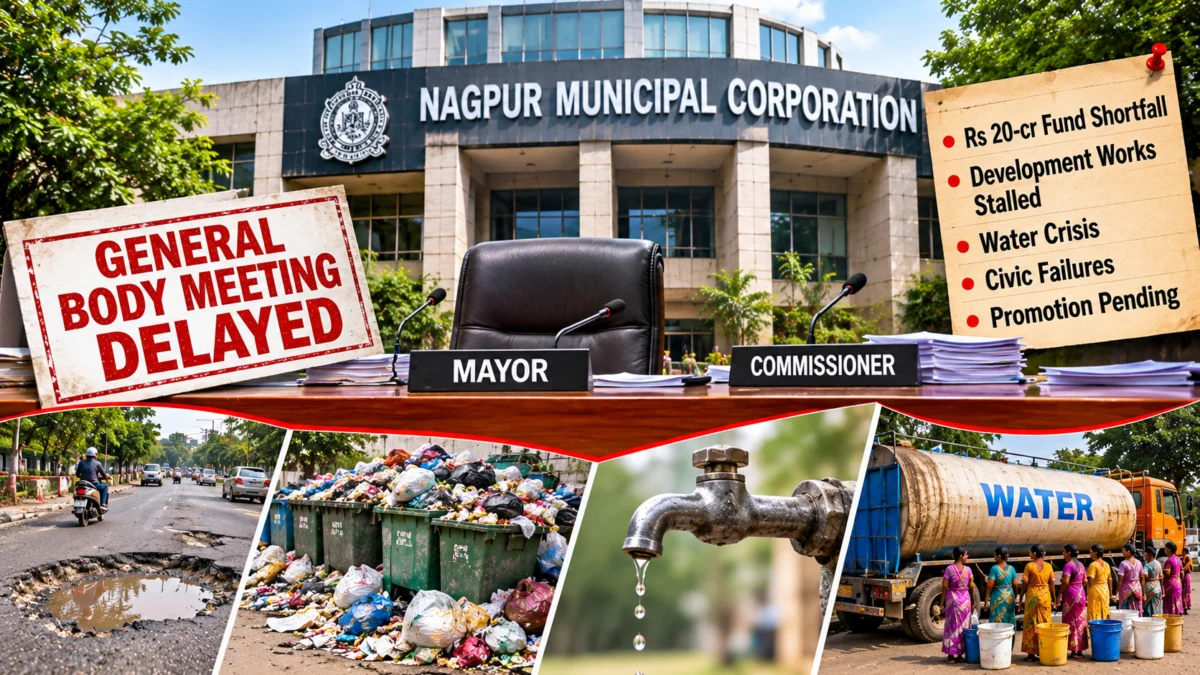
Nagpur: Nagpur Municipal Corporation’s (NMC) General Body Meeting has become the latest casualty of administrative and political delays, leaving elected corporators across party lines increasingly frustrated and raising serious questions over the functioning of the civic administration. With the last meeting held on September 16, the prolonged absence of the city’s highest elected decision-making forum has left a mounting pile of civic grievances, financial disputes and development-related issues without an appropriate platform for resolution.
Corporators had expected the House to reconvene by November 20 after the Model Code of Conduct for Legislative Council elections was lifted. However, Mayor Neeta Thakre and Municipal Commissioner Vipin Itankar’s foreign visit further pushed the meeting into uncertainty, triggering resentment among representatives who accuse the administration of keeping elected members waiting while civic problems continue to deteriorate.
The delay is particularly significant as dissatisfaction is no longer confined to opposition benches. From allegations of discriminatory fund distribution to bureaucratic obstruction, stalled development works, deteriorating sanitation and the worsening water situation, corporators across political affiliations have a long list of questions for the administration.
The Muslim Bahujan Vikas Aghadi’s 10 corporators have questioned how development activities in their respective wards can be undertaken when adequate financial provisions are missing. Congress corporators have also raised concerns over alleged discrimination in the distribution of development funds, while even Mahayuti representatives have complained that officials are displaying an indifferent attitude towards newly elected corporators.

The newly introduced work module system has emerged as another major irritant. Corporators allege that instead of expediting development activities, the system has created additional procedural hurdles, slowing the movement of files and delaying the execution of projects. They want the administration to explain why proposals are getting stuck and whether the new mechanism is serving any purpose beyond adding to bureaucratic delays.
Rs 35-crore budget, Rs 55-crore commitments: Weaker Sections Committee controversy
An explosive financial controversy surrounding the Durbal Ghatak (Weaker Sections) Committee is also expected to put the administration on the defensive.
In a letter dated November 17 to Municipal Commissioner Vipin Itankar, committee chairperson Laxmi Hattithele demanded cancellation of all letters issued in connection with proposed fund allocations. The dispute centres on a glaring mismatch between the committee’s approved budget provision of Rs 35 crore for 2026-27 and allocation letters and proposals reportedly issued for nearly Rs 55 crore.
This has created an apparent funding gap of around Rs 20 crore, even as the committee is reportedly burdened with previous liabilities of approximately Rs 11 crore.
Hattithele’s demand to scrap the existing allocation process and reassess the proposals has opened another contentious front. Corporators awaiting funds for development works are likely to question how commitments exceeding the available budgetary provision were allowed in the first place.
Congress has already demanded an inquiry into alleged financial irregularities and commitments made without sufficient budgetary backing. The controversy could turn into a major political confrontation, with the administration expected to explain who authorised the proposals and how the financial mismatch was allowed to emerge.
Civic failures pile up as administration faces questions
Beyond the financial disputes, the proposed House meeting is expected to expose the widening gap between civic promises and ground realities. Road excavations, erratic water supply, uncollected garbage, poor sanitation, defunct streetlights, overflowing sewer lines and rampant encroachments are among the issues demanding urgent attention.
Corporators have accused the civic machinery of failing to respond adequately to complaints about unhygienic conditions, drainage blockages and sewage overflows. They are likely to question why basic civic services continue to suffer despite the substantial annual budgetary allocations made by the corporation.
Promotions stuck, departments suffer
The pending promotion proposals of NMC employees and officers are another issue awaiting scrutiny. Several cases are reportedly stuck with the General Administration Department, affecting the functioning of different departments and potentially hampering public service delivery. Corporators want clarity on the reasons behind the delay and a definite timeline for clearing the pending cases.
Water crisis could trigger a stormy debate
Water management is likely to emerge as one of the most contentious subjects, particularly amid mounting concerns over water stress and the corporation’s preparedness to ensure an uninterrupted supply.
With NMC having already announced a seven-point programme to prevent the misuse of treated water, corporators are expected to question whether the administration has a credible strategy for equitable distribution, plugging leakages, preventing wastage and maximising the utilisation of treated sewage water.
The administration may also face questions over the effectiveness of its conservation measures and the steps being taken to ensure that citizens do not bear the consequences of poor planning and inefficient water management.
With financial controversies, administrative bottlenecks and deteriorating civic infrastructure converging at the same time, the next General Body Meeting is unlikely to be a routine affair. The longer the House remains out of action, the greater the backlog of unanswered questions — and the sharper the confrontation awaiting the civic administration.