

From PM2.5 pollution to respiratory risks, the impact of firecrackers raises fresh questions about Nagpur’s air quality
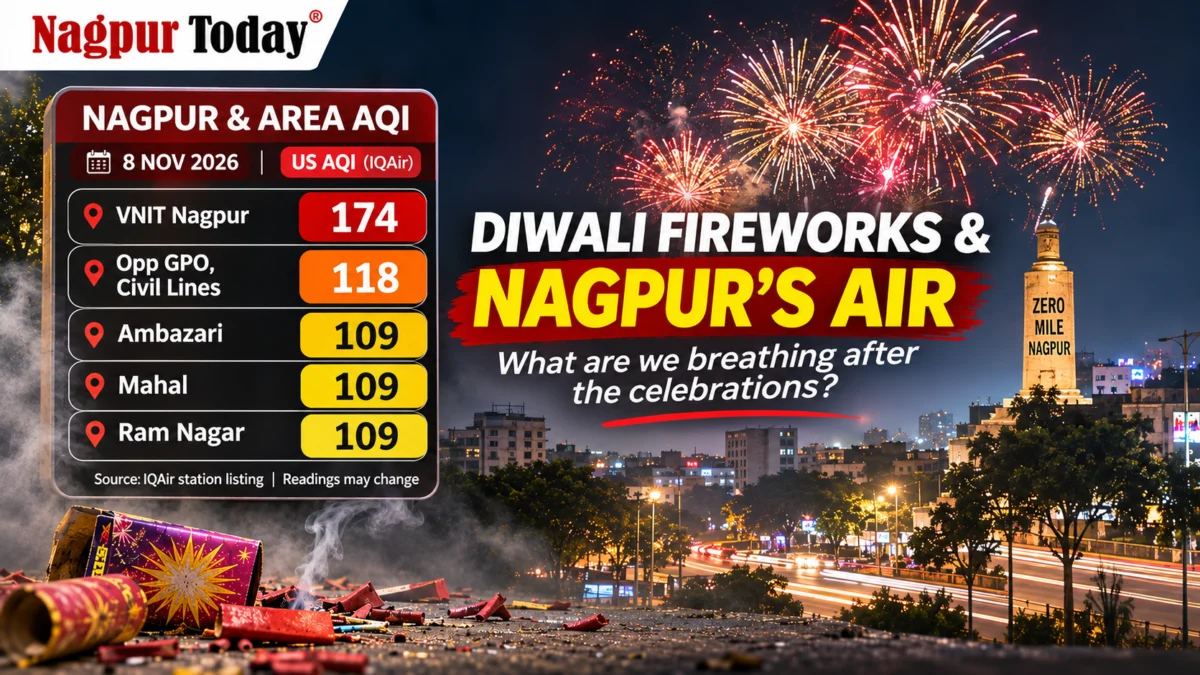 NAGPUR: The lights, celebrations and fireworks of Diwali bring the city alive every year. But behind the colourful bursts in the night sky lies an environmental concern that deserves greater attention: the impact of firecrackers on the air that Nagpur’s residents breathe.
With air quality already deteriorating ahead of Diwali, the increased use of firecrackers could add another layer of pollution to the city’s atmosphere, particularly during late-night hours when weather conditions may prevent pollutants from dispersing quickly.
| Monitoring Location | US AQI | Air Quality |
|---|---|---|
| VNIT Nagpur | 174 | Unhealthy |
| Opp. GPO, Civil Lines | 118 | Unhealthy for Sensitive Groups |
| Ambazari | 109 | Unhealthy for Sensitive Groups |
| Mahal | 109 | Unhealthy for Sensitive Groups |
| Ram Nagar | 109 | Unhealthy for Sensitive Groups |
Source: IQAir station listing | US AQI scale | November 8, 2026. Readings are indicative and subject to change. Station-level readings may not represent the entire locality.
Nagpur’s air quality was deteriorating even before Diwali
Nagpur’s pollution situation was already a matter of concern before the main Diwali celebrations.

According to a data available ,PM2.5 readings at monitoring locations in the city had reached elevated levels during the preceding two days. The report cited a PM2.5 reading of 265 on November 5 and 211 on November 6, while highlighting that pollution levels were particularly high during late-night and early-morning hours.
The report also pointed towards industrial emissions, thermal power plants, vehicle exhaust and open waste burning as possible contributors to the deterioration.
This is an important distinction: Nagpur’s worsening air quality cannot be attributed to firecrackers alone. However, fireworks can add a sudden and concentrated pollution load to an already polluted atmosphere.
What happens when firecrackers explode?
Firecrackers release a mixture of pollutants into the atmosphere, including:
- PM2.5: Extremely fine particles that can penetrate deep into the lungs and even enter the bloodstream.
- PM10: Larger inhalable particles that can irritate the respiratory system.
- Sulphur dioxide (SO2): A gas that can aggravate respiratory conditions.
- Nitrogen oxides (NOx): Pollutants that contribute to respiratory irritation and atmospheric chemical reactions.
- Metal particles: Compounds containing barium, aluminium, strontium and potassium, among others, are used in fireworks to create different colours and effects.
The immediate consequence can be a temporary increase in airborne particulate matter, smoke and chemical pollutants, particularly in neighbourhoods where large numbers of firecrackers are burst simultaneously.
Scientific studies show the pollution spike
Research conducted in different Indian cities has documented significant deterioration in air quality during Diwali.
A study published in Scientific Reports in June 2026, examining 14 cities in the Indo-Gangetic Basin, found that PM2.5 and PM10 concentrations during Diwali exceeded national and WHO guideline levels. It also identified firecracker emissions as a source of fine particles, heavy metals and gaseous pollutants.
Another study conducted in Bhubaneswar found that Diwali-day PM2.5 concentrations reached 113.83 micrograms per cubic metre in 2021, with PM10 reaching 204.32 micrograms per cubic metre.
Research in Amritsar also identified a substantial contribution of metal-bound particles to PM2.5 during Diwali fireworks.
Although these studies were not conducted in Nagpur, they demonstrate the potential environmental consequences of intensive firecracker use.
Who is most affected?
The health impact of increased air pollution is not the same for everyone.
Children, senior citizens and people with asthma, COPD or other respiratory conditions are particularly vulnerable.
Exposure to elevated concentrations of fine particulate matter can cause:
- Coughing and throat irritation.
- Burning or watering eyes.
- Breathlessness and wheezing.
- Aggravation of asthma and other lung conditions.
- Increased cardiovascular stress, particularly among vulnerable individuals.
Even healthy individuals may experience discomfort when exposed to dense firecracker smoke.
Why does pollution remain in the air?
The problem is not limited to the minutes when firecrackers are being burst.
During November, falling night temperatures, low wind speeds and atmospheric stability can restrict the dispersion of pollutants. Smoke and fine particles may consequently remain suspended near ground level for longer periods.
This means the pollution generated during Diwali celebrations may continue affecting residents even after the fireworks have stopped.
The bigger question for Nagpur
Nagpur is often associated with its green spaces and relatively open urban environment. However, the city’s air quality is influenced by several factors, including industrial activity, vehicular emissions, construction dust, waste burning and seasonal weather conditions.
Diwali fireworks add to this existing pollution burden.
The important question is not whether residents should celebrate Diwali, but whether celebrations can become less polluting without losing their festive spirit.
Choosing community celebrations, limiting firecracker use and avoiding prolonged exposure to firecracker smoke can help reduce pollution and protect vulnerable residents.
This Diwali, while Nagpur lights up the sky, an equally important question remains: What happens to the air we breathe after the celebrations end?