

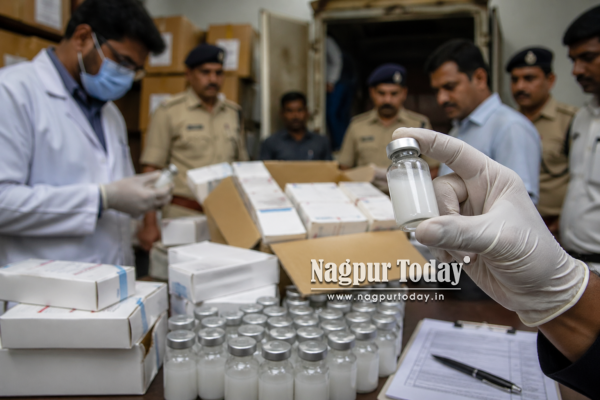
Nagpur: In a shocking revelation that has exposed a dangerous underbelly of the pharmaceutical supply chain, authorities in Nagpur have uncovered a massive stock of suspected counterfeit “Alburel” injections, medication critically used in the treatment of burn victims. The bust, carried out by the Food and Drug Administration India, has triggered alarm bells over how fake or substandard drugs are infiltrating the healthcare system and endangering lives.
Life-saving drug or silent killer?
Gold Rate
June 30,2026 - Time 10.30Hrs

What makes the case particularly disturbing is the nature of the drug involved. Alburel injections are administered to patients requiring urgent protein supplementation, especially those battling severe burns where recovery depends heavily on precise medical support. But instead of healing, these injections may have been silently sabotaging recovery.
Laboratory tests revealed a chilling truth: the protein content in the seized injections was nearly 20% lower than declared on the label, a discrepancy that could drastically compromise patient outcomes. For critically ill patients, such dilution is not just negligence, it borders on criminal endangerment.

Raid uncovers suspicious stockpile
The operation zeroed in on M/s Hitashi Pharmaceuticals in Shanti Nagar, where officials seized a substantial quantity of the suspect drug. The raid followed a complaint and subsequent inspection conducted in September 2025, with samples sent for testing. Within a month, the lab findings confirmed what investigators feared, this was not a minor lapse, but a potentially organized fraud.
As investigators dug deeper, the case began to unravel into a multi-state nexus. The accused allegedly sourced and distributed the injections through a chain of firms spanning Mumbai, Navi Mumbai, and Telangana, between September and December 2025.
But the most damning detail? No proper invoices. No purchase records. No accountability.
“When questioned, the accused failed to produce basic documentation. This raises serious doubts about the legitimacy of the entire operation,” a senior officer involved in the probe stated.
Based on the findings, Shanti Nagar Police have registered an FIR against six accused, including pharmaceutical firms and individuals from across India, ranging from Mumbai and Navi Mumbai to Hyderabad, Delhi, and Chandigarh.
Among those named are M/s Hitashi Pharmaceuticals, M/s N R Mitra Distributors (Mumbai and Hyderabad), and M/s RRT Pharma, indicating that the supply chain may be far more extensive than initially believed.
Bigger racket under scanner
Investigators are now probing whether this is just the tip of the iceberg. The possibility of a wider interstate racket dealing in counterfeit or substandard medicines cannot be ruled out.
“This is not just about one batch or one company. We are examining if a larger network is systematically pushing fake medicines into the market,” officials said, hinting at deeper rot within the system.
A wake-up call for healthcare oversight
The incident has once again exposed glaring loopholes in drug monitoring and distribution. When life-saving medicines can be tampered with and sold without documentation, the question arises—how many such drugs are already in circulation?
For patients and their families, this is not just a regulatory failure, it is a betrayal of trust.
As the investigation intensifies, one thing is clear: this is not merely a case of counterfeit drugs. It is a chilling reminder that in the absence of strict vigilance, even medicines meant to save lives can turn into instruments of silent harm.


NMC Commissioner Pulls Up Officials Over Waterlogging

सोलर प्लांट के बावजूद भारी बिजली बिल #maharashtranews #smartmeter #electricity #bills #newsupdate

ट्यूशन फीस बढ़ोतरी के खिलाफ कांग्रेस आंदोलन #maharashtranews #tuitionfees #congress #andolan

महिला को एमडी ड्रग्स के झूठे केस में फंसाने की साजिश नाकाम...

एमआईडीसी में युवक की बेरहमी से हत्या #nagpurnews #crime #murdernews #newsupdate

सिर्फ एक धक्का... फिर चला चाकू #nagpurnews #crime #accusedarrested #murdernews