
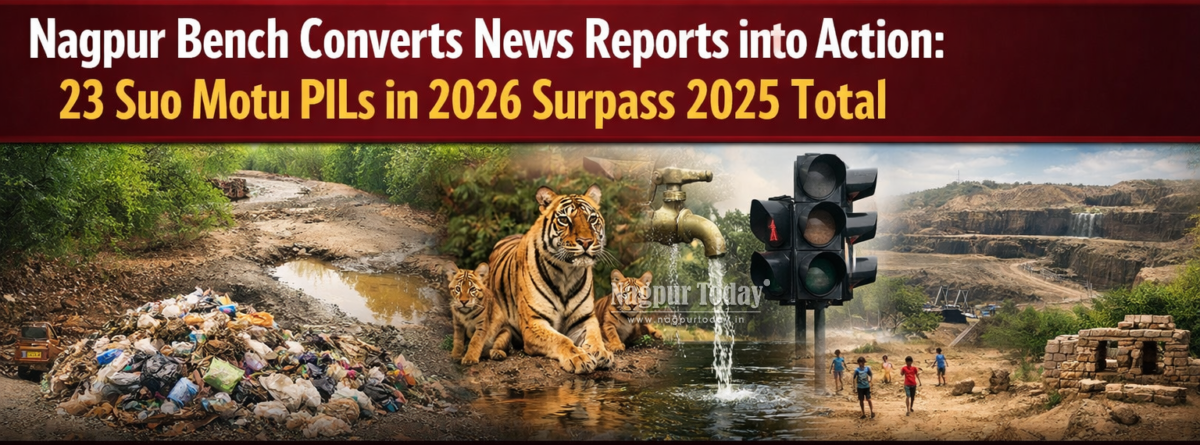
 Nagpur: The Nagpur Bench of the Bombay High Court has taken an unusually proactive stance in 2026, converting 23 news reports and communications into suo motu public interest litigations (PILs) within just the first 11 weeks of the year-already exceeding the 18 such cases initiated throughout 2025.
Driving this assertive approach are benches frequently led by Justice Anil S. Kilor alongside Justice Raj D. Wakode. The judges have been treating media reports, letters, and emails as triggers for judicial intervention, appointing amici curiae to assist in ensuring accountability.
Unlike traditional PILs that often address broader policy matters, the Bench has zeroed in on everyday governance failures. Issues taken up include broken village roads, absence of cremation grounds, garbage accumulation, unsafe drinking water, medicine shortages, and lack of playgrounds in residential areas. Each issue is being handled as a separate case with specific directions issued to authorities.
Gold Rate
Mar 21 2026 - Time 10.22Hrs

This approach builds on the Bench’s 2025 interventions. In one notable case involving tigress F2 and her cubs in the Umred-Karhandla sanctuary, the Court pulled up authorities and sought action reports after tourist vehicles obstructed wildlife. Another major case on “dignity in death” led to a state policy change after it was revealed that 204 villages lacked cremation facilities, prompting Maharashtra to prioritise such infrastructure.
In 2026, the Court’s focus has intensified on health, environment, and civic administration. A key PIL highlights a severe faculty shortage at AIIMS Nagpur, where 137 out of 373 posts remain vacant, impacting patient care. The Bench is also hearing matters related to tiger deaths, flooding in Chandrapur, and Nagpur’s malfunctioning traffic signals-only 10 out of 171 upgraded signals are operational.
Environmental scrutiny has also increased, with cases examining mining permissions in the Tadoba-Andhari landscape and irregularities in the Lohardongri opencast mine. Other cases include medicine shortages at the Government Mental Hospital and large-scale tree felling along the city’s “London Street.”
The Court has been particularly critical of Nagpur’s civic conditions. In February, it initiated a PIL over uncollected garbage despite the Nagpur Municipal Corporation spending nearly ₹100 crore annually. Days later, it took up the issue of contaminated drinking water affecting nearly 50 localities after reports of illness surfaced.
On March 9, 2026, the Bench expanded its scope to heritage protection by converting reports on prehistoric archaeological sites in Chandrapur into a PIL, recognising their cultural significance.
In sensitive matters, the Court has ensured continuity of justice. In a quartzite mining case where the petitioner withdrew citing threats, the Bench converted it into a suo motu PIL to keep the issue alive.
The judiciary has also addressed rising human-wildlife conflict in Pench Tiger Reserve and expanded a local issue of playground scarcity into a city-wide review of open spaces in Nagpur.
While some critics argue that such frequent use of suo motu PILs risks judicial overreach into executive functions, others see it as a necessary push for accountability. The surge clearly reflects the Nagpur Bench’s growing reliance on PIL jurisdiction to address persistent civic and environmental lapses-often forcing action where administrative response has lagged.
Key Suo Motu PILs Initiated by Nagpur Bench (2026)
- Garbage Crisis in Nagpur
Uncollected waste despite ~₹100 crore annual spending by NMC. - Contaminated Drinking Water
Dirty water supply reported in nearly 50 localities; illness concerns raised. - AIIMS Nagpur Faculty Shortage
137 out of 373 posts vacant, affecting patient care. - Defunct Traffic Signals
Only 10 of 171 upgraded signals functional across the city. - Medicine Shortage at Govt Mental Hospital
Linked to centralized procurement delays. - Broken Rural Roads
Poor connectivity impacting villages. - Lack of Cremation Grounds
Basic infrastructure gaps in rural areas. - Playground Shortage in Urban Areas
Started from Hindustan Colony, expanded city-wide. - Flooding in Chandrapur
Caused by non-functional bund infrastructure. - Tiger Deaths in Maharashtra
11 deaths in January flagged for scrutiny. - Human-Wildlife Conflict (Pench Tiger Reserve)
Court questioned tourism prioritisation over safety. - Mining in Tadoba-Andhari Landscape
Environmental concerns over iron ore permissions. - Lohardongri Opencast Mining Case
Examination of mining impact and legality. - Quartzite Mining Irregularities
Converted into PIL after petitioner withdrew citing threats. - Tree Felling on ‘London Street’ Road
Large-scale, uncompensated cutting under scrutiny. - Archaeological Sites Protection (Chandrapur)
Prehistoric sites in Bhatala & Mowad given legal attention.
2025 Reference Cases
- “Dignity in Death” Case
204 villages lacked cremation facilities → led to Maharashtra policy change. - Umred-Karhandla Tigress F2 Case
Court pulled up authorities over wildlife obstruction by tourists. - Solar Power Failure in Dharni Villages
Collapse of systems treated as larger public infrastructure issue.