

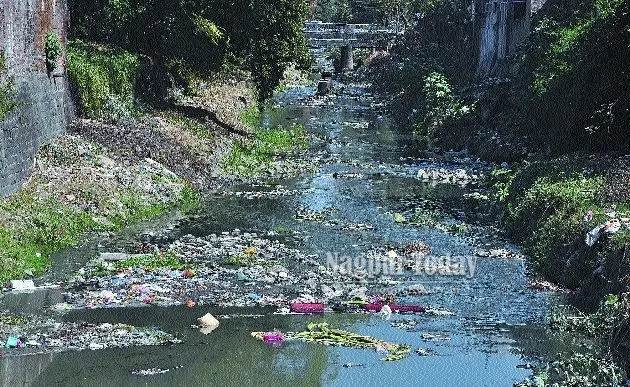
Nagpur: The much-touted Nag River rejuvenation project, projected as a historic intervention to rescue Nagpur’s dying urban watercourse from decades of pollution and neglect, has run into a familiar civic nightmare, grand announcements, massive budgetary allocations and virtually nothing to show on the ground. More than three years after receiving approval from the Union Ministry of Jal Shakti, the ambitious Rs 1,926.99-crore Nag River Pollution Abatement Project remains largely trapped in files, tender procedures and administrative formalities.
For a city that has repeatedly spoken of restoring its ecological heritage, the continued absence of substantial physical work along the heavily polluted Nag River is an embarrassing commentary on the pace of civic execution. Despite the project’s ambitious blueprint and the appointment of a project management consultant, the river continues to wait for the promised clean-up while the administration moves from one procedural stage to another.
The scale of the proposed intervention is enormous. The project is designed to establish a comprehensive 520-km sewerage network, construct three sewage treatment plants (STPs) with a combined treatment capacity of 92 million litres per day (MLD), install seven new pumping stations and undertake interception and diversion works to prevent untreated sewage from entering the river.
The financial burden is being shared by three levels of government, with the Centre contributing 60 per cent, the Maharashtra Government 25 per cent and the Nagpur Municipal Corporation (NMC) bearing the remaining 15 per cent. Yet, despite such substantial financial backing, the project has so far failed to translate its promises into visible construction activity.

The project has been divided into five contract packages (CP), but the progress report exposes the glaring gap between administrative movement and actual execution.
Five packages, but where is the work?
The only limited contract activity reported so far relates to Package CP-5, a non-sewerage component worth Rs 1.32 crore covering the electric crematorium at Mokshadham. This relatively minor intervention offers little evidence of progress on the project’s central objective, intercepting sewage, treating polluted discharge and restoring the Nag River.
The major sewerage and river-cleaning components remain caught in different stages of procurement and preparation.
Package CP-3, involving the North Zone sewer network and valued at Rs 253.17 crore, has moved to the stage of issuing a Letter of Intent (LOI) following technical scrutiny of bids. While this represents some administrative movement, it is still a far cry from completed infrastructure or operational sewer lines.
Package CP-4 remains stuck in the tendering process, while Package CP-2, involving construction of sewage treatment plants at an estimated cost of Rs 415.79 crore, is still undergoing scrutiny of draft tender documents.
Even more concerning is Package CP-1, worth Rs 411.72 crore, which covers crucial interception and diversion works. The package is still moving through preliminary surveys and the preparation of drawings and designs. These are fundamental interventions without which the project cannot achieve its principal objective of preventing untreated sewage from flowing into the river.
Thus, the project’s most critical components — sewer networks, sewage treatment facilities and interception infrastructure, have yet to make substantial progress towards physical execution.
Consultant appointed, but execution remains elusive
The appointment of Tata Consulting Engineers (TCE) as the project management consultant in late 2024 was expected to accelerate implementation, coordinate technical requirements and ensure that the massive undertaking moved towards execution.
However, the appointment has not yet translated into visible civil mobilisation across the project area. With the core packages still caught in procedural stages, the much-publicised river rejuvenation exercise continues to lack the physical momentum expected from a project of this magnitude.
The delay is particularly significant because the Nag River’s pollution problem cannot be addressed through isolated or cosmetic interventions. Without a functioning sewerage network, interception systems and adequate treatment capacity, untreated wastewater will continue to threaten the river’s ecological condition.
Five-year target against an eight-year sanctioned timeline
NMC Executive Engineer Rajesh Dufare sought to explain the implementation schedule, stating that the overall sanctioned timeline for the project was eight years. However, the civic administration intends to accelerate the work and complete the entire project within five years.
“The overall sanctioned timeline for the project spans eight years, but the civic administration aims to expedite execution and complete all works within five years. Preliminary survey and tendering process are underway,” Dufare said.
According to sources, following technical evaluation of Package CP-3, physical work on the remaining major sewerage and sewage treatment components is likely to begin in the next financial year.
However, such assurances offer little immediate comfort when the project has already lost considerable time in moving from approval to execution. The prospect of beginning major work only in the upcoming financial year raises fresh questions about the administration’s ability to meet even its accelerated five-year target.
Nag River cannot wait indefinitely
The Rs 1,926.99-crore project was supposed to mark a decisive break from decades of neglect and pollution. Instead, its slow progress has reinforced a familiar pattern in urban infrastructure development: securing approvals, announcing ambitious targets and allocating enormous sums are treated as milestones, while actual delivery remains a distant prospect.
The fundamental question facing the NMC is no longer how impressive the project blueprint looks on paper, but when citizens will see machinery, workers, sewer lines and treatment infrastructure on the ground.
For Nagpur, the Nag River is not another infrastructure file that can remain pending indefinitely. Every delay in establishing interception and treatment systems prolongs the pollution burden and postpones the promised environmental recovery.
A Rs 1,926.99-crore project cannot be called a river rejuvenation success merely because it has received government approval. Until the sewerage network is laid, sewage treatment plants are built and polluted discharge is intercepted, the Nag River will remain a victim of administrative promises rather than a beneficiary of public investment.