

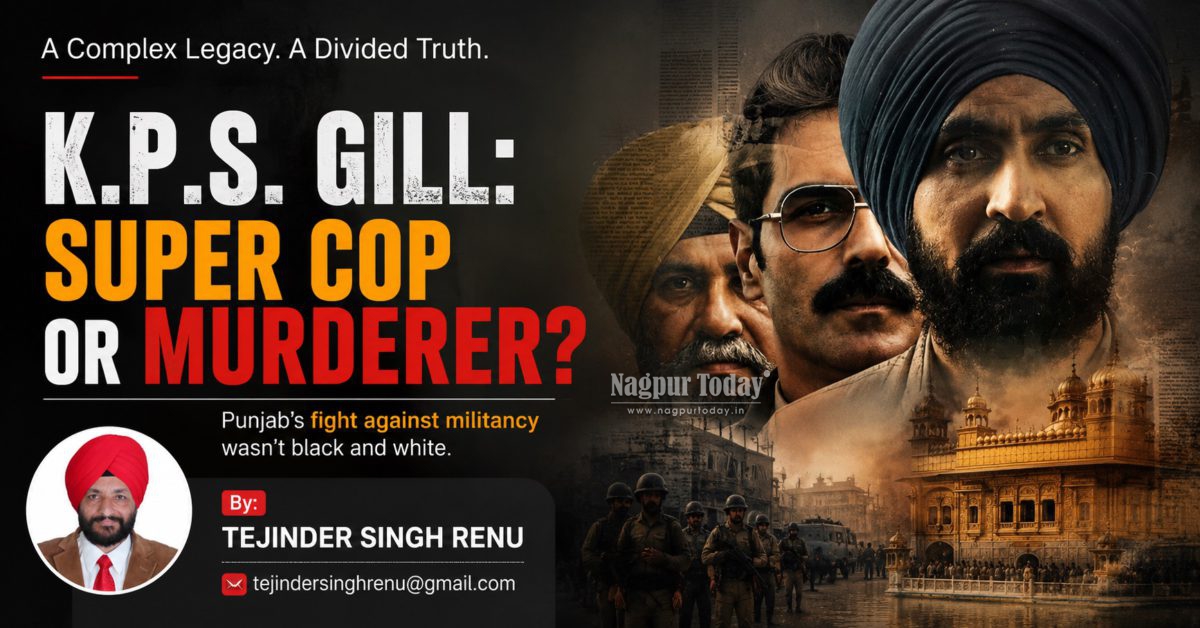
 After watching the film Satluj, many viewers are left with a troubling question: Was K.P.S. Gill a super cop who saved Punjab, or a man responsible for grave human rights violations? This question is asked particularly by those born after the 1990s, a generation that did not personally witness the dark years of militancy in Punjab.
In my view, the film presents only one side of a much larger and more complex story. To understand the debate surrounding K.P.S. Gill, one must first revisit the painful chapter of Punjab’s insurgency.
The Black Years of Punjab
During the late 1970s and especially throughout the 1980s, Punjab was engulfed by a violent separatist movement. Thousands of young men, many of whom were misguided, took up arms—not symbolic weapons, but AK-47 rifles, self-loading rifles, explosives, and other sophisticated weaponry. The aim of militant groups was to establish a separate Khalistan.
A substantial body of historical research, government records, journalistic accounts, and testimony from former officials indicates that militant groups received varying degrees of support, training, shelter, or encouragement from elements based in Pakistan. Financial and ideological support also came from some individuals and organizations within the Sikh diaspora, particularly in countries such as Canada, the United Kingdom, and the United States, although the overwhelming majority of Sikhs abroad were not involved in militancy.
As violence escalated, Punjab witnessed assassinations, bombings, extortion, kidnappings, and targeted killings. Civilians, political leaders, journalists, police personnel, and ordinary Sikhs who opposed militant activities became victims of terror. Fear spread across the state, and daily life was profoundly disrupted.

The Rise of Jarnail Singh Bhindranwale
No discussion of this period is complete without mentioning Sant Jarnail Singh Bhindranwale. To many Sikhs, he was a charismatic preacher and religious scholar who inspired a return to Sikh values. To others, he became the face of a militant movement that increasingly relied on violence. These two perceptions continue to coexist, making him one of the most controversial figures in modern Indian history.
As his influence grew, armed followers gathered around him, and the conflict between militants and the state intensified. Several attempts at political negotiation and compromise were made by different leaders, but the situation continued to deteriorate.
Operation Blue Star and Black Thunder
The crisis reached a turning point with Operation Blue Star in June 1984, when the Indian Army entered the Golden Temple complex to remove heavily armed militants who had fortified themselves inside the premises. The operation resulted in the death of Bhindranwale and many others and caused extensive damage to the Akal Takht. For many Sikhs, the military action in their holiest shrine became a source of deep anguish and trauma that remains alive even today.
In the years that followed, additional security operations, including Operation Black Thunder, were conducted to dismantle remaining militant networks and recover weapons from religious complexes. These operations are often viewed as having been carried out with greater restraint than Blue Star, but they too formed part of a prolonged and bitter conflict.
Enter K.P.S. Gill
By the late 1980s and early 1990s, Punjab was exhausted by violence. Businesses had suffered, investment had declined, and many industrialists had shifted operations elsewhere. A state that had once been among India’s leading contributors in agriculture and industry found itself struggling with insecurity, economic disruption, and widespread fear.
It was during this period that K.P.S. Gill, as Director General of Punjab Police, was given extraordinary authority to crush the insurgency. Under his leadership, the Punjab Police launched aggressive counterinsurgency operations that targeted militant organizations and their support networks. Gill’s supporters argue that he provided decisive leadership when the state was on the brink and that his tough methods restored law and order, allowing Punjab to return gradually to peace and normalcy.
Many police officers and soldiers lost their lives fighting militants. Their sacrifices, too, are an important part of this history and should not be forgotten.
The Allegations Against Gill
Yet this is only one side of the story.
Human rights organizations, journalists, lawyers, and families of victims have documented numerous allegations of extrajudicial killings, enforced disappearances, illegal detentions, torture, and secret cremations during the counterinsurgency campaign. Many families claimed that their loved ones were taken into custody and never returned. Some were allegedly killed without trial, while others disappeared without any official explanation.
These allegations raise a difficult and uncomfortable question: Can a democratic state abandon the rule of law even when confronting terrorism?
Supporters of the police often respond that the ordinary criminal justice system was struggling to cope with the scale of the insurgency. Witnesses were terrified, convictions were difficult to secure, and many feared that hardened militants would quickly obtain bail and return to violence. From this perspective, extraordinary circumstances demanded extraordinary measures.
Critics counter that such reasoning cannot justify unlawful killings. If the state itself ignores constitutional safeguards, they argue, it risks becoming what it is fighting against. They point out that among those who suffered were not only militants but also people whose involvement was never proven, and perhaps some who were entirely innocent.
A Painful Moral Dilemma
This is what makes the legacy of K.P.S. Gill so complicated. On one hand, Punjab eventually emerged from the nightmare of militancy, and many citizens credit the Punjab Police and Gill’s uncompromising strategy for that outcome. On the other hand, the stories of families searching for missing sons, brothers, and fathers continue to haunt the collective memory of the state.
One can acknowledge the bravery of police officers who fought terrorism while also recognizing that serious allegations of human rights abuses deserve attention. One can condemn militancy and still insist that constitutional values matter. These positions are not mutually exclusive.
So, Was He a Super Cop or a Murderer?
History rarely offers simple answers.
To some, K.P.S. Gill was the officer who broke the back of terrorism and saved Punjab from descending into chaos. To others, he symbolizes a period in which the state used methods that violated the principles of justice and humanity. His legacy contains both the restoration of peace and the shadow of unresolved accusations.
Perhaps the better question is not whether he fits neatly into a single label, but whether a society can confront terrorism effectively while remaining faithful to the rule of law. The Punjab of the 1980s and 1990s stands as a reminder of how devastating extremism can be and how dangerous it is when any side-whether militant or state—crosses the boundaries of law and morality.
I leave the final judgment to the reader: Was K.P.S. Gill a super cop, a violator of human rights, or a figure who embodied both the triumphs and the tragedies of Punjab’s struggle against militancy?
About Author: Tejinder Singh Renu is a hotelier, entrepreneur, and public policy advocate from Nagpur. He is the President of the Nagpur Residential Hotels Association (NRHA) and Secretary of the Vidarbha Taxpayers Association (VTA). He actively represents the hospitality industry and taxpayers’ interests while contributing to policy discussions, civic issues, and the promotion of tourism and economic development in the Vidarbha region.