

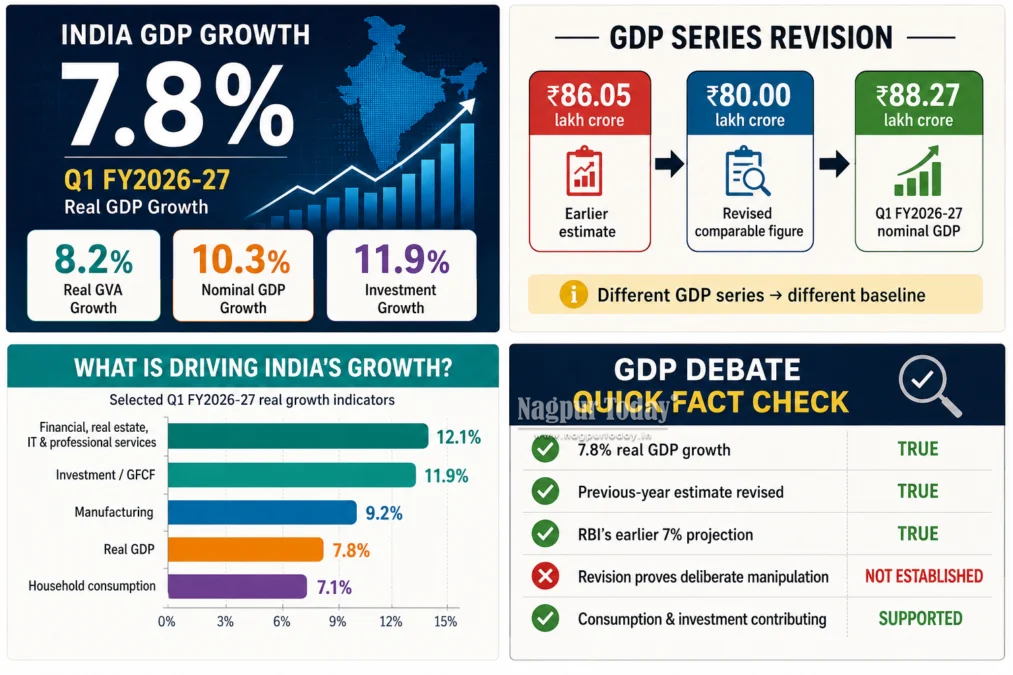
 India has reported 7.8% real GDP growth for the first quarter of financial year 2026-27. On the surface, it is a strong number – and it came in above the Reserve Bank of India’s earlier 7% projection.
But another number has attracted attention: the size of the economy in the same quarter a year earlier has been revised substantially under India’s new GDP series.
That revision has led some economists and economic commentators to question how much of the latest headline should be taken at face value.
First, the 7.8% number is real
The headline figure is not simply a mathematical trick. Under the latest GDP series, real GDP in Q1 FY2026-27 was estimated at approximately ₹81.36 lakh crore, compared with ₹75.46 lakh crore in Q1 of the previous financial year.
The result is an official 7.8% real GDP growth rate.

The important point: the growth calculation is based on the revised GDP series, where both periods are measured using the same methodology.
Then why is the ₹86 lakh crore figure being discussed?
This is where the story becomes more complicated.
Under the previous GDP series, Q1 FY2025-26 nominal GDP had earlier been estimated at approximately ₹86.05 lakh crore.
Under the new GDP series, the comparable Q1 FY2025-26 nominal GDP figure is now around ₹80 lakh crore.
That is a significant revision and is the basis for much of the criticism surrounding the latest GDP announcement.
Some commentators have pointed out that if the earlier ₹86.05 lakh crore figure were compared directly with the latest ₹88.27 lakh crore figure, the apparent nominal growth would be much lower.
But there is an important catch: those numbers come from different GDP series and methodologies.
The official growth calculation uses the revised, comparable series.
Does the revision prove that GDP was manipulated?
No — not by itself.
The revision is a fact. The interpretation is where caution is needed.
India introduced a new GDP series with 2022-23 as the base year. Along with the new base year, statistical authorities incorporated newer data sources, updated methodologies and improved coverage of economic activity.
When a new GDP series is introduced, historical estimates are recalculated so that past and present figures can be compared using the same methodology.
Therefore, the fact that an earlier estimate changed does not, on its own, demonstrate that the government deliberately reduced the previous year’s GDP to make the current growth rate appear stronger.
Such an allegation would require evidence of deliberate manipulation — not simply evidence that the statistical series was revised.
Real GDP vs nominal GDP: the crucial distinction
Another source of confusion is the difference between real GDP and nominal GDP.
Real GDP attempts to measure changes in the volume of economic activity after accounting for price changes. This is why real GDP growth is commonly used when discussing whether the economy actually expanded.
Nominal GDP measures the economy at current prices. It is useful for understanding the size of the economy in rupee terms and for measures such as tax collections and debt-to-GDP ratios.
Simply put:
Real GDP = how much the economy actually expanded in volume terms.
Nominal GDP = the value of economic output at current prices.
Mixing the two can produce misleading comparisons.
What is actually driving the growth?
The strongest argument in favour of the latest GDP number is that growth is not coming from just one part of the economy.
Official data shows manufacturing grew by 9.2%, while financial, real estate, IT and professional services recorded growth of around 12.1%.
Investment also remained strong, with gross fixed capital formation growing by about 11.9%.
Household consumption expenditure grew by approximately 7.1% in real terms, while exports also recorded strong growth.
This suggests that the 7.8% headline is being supported by multiple parts of the economy rather than a single sector.
What about consumption?
Some commentary around the GDP figures has questioned whether Indian consumers are actually spending strongly enough to support such rapid growth.
The official numbers, however, show household consumption expenditure growing by about 7.1% in real terms.
That does not mean every Indian household is financially better off.
GDP consumption is an aggregate measure. It does not directly tell us how wages, household savings, employment quality or purchasing power are changing for individual families.
In other words, strong GDP growth and financial pressure on some households can exist at the same time.
So, how should ordinary Indians read 7.8%?
A 7.8% real GDP growth rate means that the economy produced substantially more goods and services than it did in the comparable quarter under the revised series.
It does not mean that every person’s income increased by 7.8%.
It also does not automatically mean that unemployment is falling, household purchasing power is rising at the same rate, or that every sector and region is benefiting equally.
GDP tells us about the size and pace of the economy. It does not tell the complete story of economic well-being.
The bigger story is not just 7.8%
The latest GDP release presents a relatively broad-based picture of economic expansion. Manufacturing, services, investment, consumption and exports all recorded positive growth.
At the same time, the revision of historical GDP data deserves scrutiny because it changes the baseline against which economic performance is measured.
Both facts can be true at once:
India can be growing strongly, while questions about measurement, distribution and the durability of that growth remain legitimate.
What the numbers tell us – and what they don’t
They tell us: India’s economy recorded 7.8% real growth in Q1 FY2026-27, with strong contributions from investment, manufacturing, services and household consumption.
They don’t tell us: that every Indian household is better off, that growth will necessarily continue at the same pace, or that a historical data revision automatically proves manipulation.
The real economic story lies somewhere between the headline number and the criticism surrounding it.
Nagpur Today Fact Check
The 7.8% GDP growth figure is supported by official data. The revision to earlier GDP estimates is also factual.
However, the available figures alone do not establish that the revision was deliberately made to inflate the latest growth rate.