

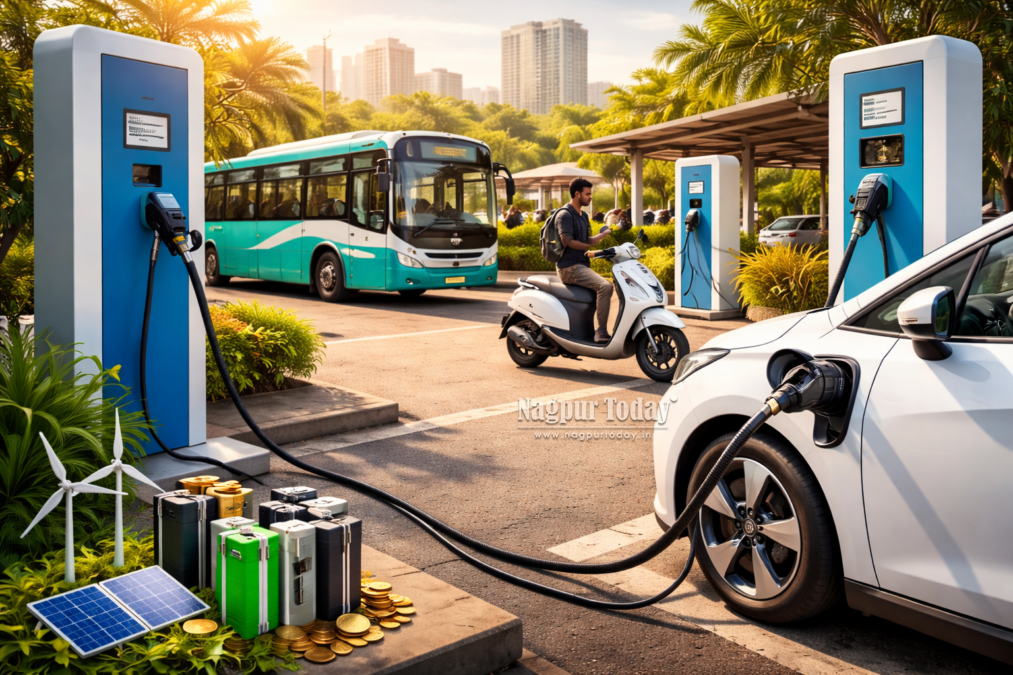
New Delhi: India’s existing and proposed electric vehicle (EV) targets have the potential to slash road transport emissions by 50% by 2050, according to a fresh global assessment by the International Council on Clean Transportation (ICCT).
The findings form part of the fourth edition of Vision 2050, ICCT’s annual analysis that models how current and upcoming policies worldwide could reshape vehicle sales, energy demand, and carbon emissions over the next 25 years.
Gold Rate
Mar 25,2026 - Time 11.05Hrs

India’s distinct advantage
Unlike many emerging economies, India enters the EV transition with a strong domestic manufacturing base. The report notes that nearly 80% of EVs sold in India are manufactured locally, placing the country alongside advanced markets such as the European Union and Japan in terms of domestic production capacity.
This localisation reduces import dependence and positions India to scale production rapidly if policy momentum continues.
50% cut in emissions and fuel demand
If national and state EV targets under development are fully implemented, India could:
• Reduce road transport CO2-equivalent emissions by half by 2050
• Cut liquid fuel demand by 50%
• Strengthen progress toward its net-zero target for 2070
• Lower exposure to volatile global fossil fuel markets
Given the sheer size of India’s transport sector, the report identifies the country as one of the world’s largest potential contributors to absolute emissions reductions from EV adoption.
Heavy-duty vehicles: The next frontier
While much of the current EV momentum is concentrated in two- and three-wheelers, ICCT points out that India is among the few emerging markets with long-term zero-emission ambitions for heavy-duty vehicles. Electrifying freight transport could become a major driver of emissions cuts in the coming decades.
The report underscores that India’s EV future will depend more on policy strength than market forces alone. Proposed fuel-efficiency standards, zero-emission vehicle targets, and state-level EV policies are expected to play a decisive role in accelerating adoption.
Although current EV penetration remains modest, projections show a sharp acceleration after 2030 as regulatory measures take effect.
Economic and climate dividend
According to Arijit Sen, Senior Researcher at ICCT, India’s combination of domestic manufacturing strength and evolving regulatory frameworks places it in a strong position to scale its EV transition while delivering substantial climate and air-quality benefits.
Amit Bhatt, India Managing Director at ICCT, emphasized that the EV transition is not merely an environmental strategy but an economic opportunity. With nearly 80% localisation already achieved, stronger supply-side regulations could deepen domestic value chains, create employment, and position India among the global leaders in transport decarbonisation.
The report concludes that India’s decisions over the next decade, particularly across passenger vehicles, two-and three-wheelers, and freight, will have global implications. A rapid shift to electric mobility could align industrial growth with climate commitments under the Paris Agreement, while delivering cleaner air and enhanced energy security at home.