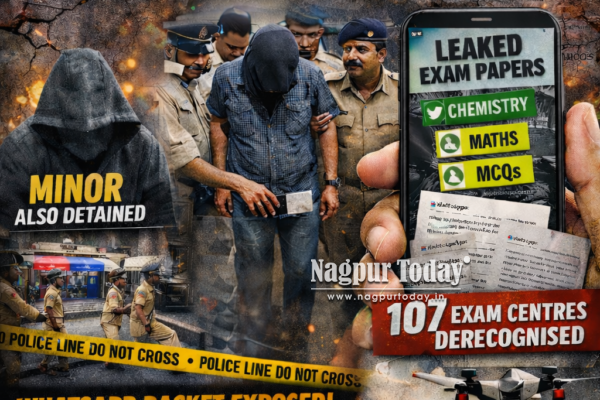
Nagpur: The Maharashtra HSC examination paper leak scandal has snowballed into a full-blown education racket, with four more arrests on Friday, including a junior college principal, taking the total number of accused behind bars to eight. Shockingly, police investigations have now confirmed that not just Physics and Chemistry, but even the Mathematics question paper was leaked and brazenly circulated on WhatsApp ahead of the examinations.
A minor has also been rounded up as the probe deepens, while the names of more tuition classes and a junior college have surfaced, pointing towards a well-oiled and meticulously operated network designed to give select students an unfair edge.
Gold Rate
Mar 25,2026 - Time 11.05Hrs

The latest arrests by Sadar Police include Dinesh Kotangale (37), Manish Shambharkar (46), director of a private tuition class, Pradeep Jangde (43), principal of a junior college, and Sandeep Sartkar (46). All four have been remanded to four days’ police custody. Police teams are on the lookout for Altaf Godil, suspected to be a key conduit in procuring and forwarding the leaked papers.
The offence has been registered under Sections 316(5) and 3(5) of the Bharatiya Nyaya Sanhita (BNS) along with provisions of the Maharashtra Prevention of Malpractices at University, Board and Other Specified Examinations Act, 1982. The complaint was lodged by Anil Dahifale, Education Officer (Secondary), Zilla Parishad, Nagpur.
WhatsApp racket unfolds
What began as suspicious activity during the Chemistry exam on February 18 between 10.37am and 12pm at a Sadar school has now exposed a disturbing digital trail. Investigations into seized mobile handsets have revealed WhatsApp groups being used as conduits for circulating leaked question papers and prepared answers well before the exams began.
Initial findings showed that accused Nishikant Moon of Mankapur allegedly circulated Physics and Chemistry papers through a WhatsApp group named “tech 1”, while Farhan Akhtar of Automotive Square allegedly prepared and shared answers in the same group.
The probe then led to a 17-year-old student from a Mominpura-based tuition class who allegedly forwarded the paper to the group. Interrogation of the minor brought police to Junaid Mohammad Abdul Javed (24), linked to another Mominpura tuition class, who allegedly widened the circulation chain.
Mustafa Khan (42), director of yet another tuition class in Mominpura, had earlier been arrested after investigators found the leaked paper on his phone and established prior knowledge of its circulation.
How the papers travelled
Police revealed that Dinesh Kotangale allegedly supplied the Chemistry and Mathematics papers to Junaid and others via WhatsApp. During questioning, Kotangale claimed that Altaf Godil approached him seeking access to the papers. Kotangale then contacted Suresh Sahare, who directed them to Manish Shambharkar.
In a startling twist, Kotangale and Godil allegedly met junior college principal Pradeep Jangde, who provided the Chemistry paper and MCQs. These were immediately forwarded on WhatsApp. The Mathematics paper, along with answers, was later circulated on February 21.
Further interrogation of Jangde reportedly pointed investigators to Sandeep Sartkar as the original source of the leaked papers, triggering Friday’s arrests.
Organised network under scanner
Investigators suspect the existence of an organised racket involving tuition operators, middlemen, and possibly insiders within examination systems. Digital forensics teams are analysing seized phones, chats, and WhatsApp groups to map the entire network and establish the flow of question papers.
The confirmation that multiple core subjects, Physics, Chemistry, and Mathematics, were leaked has sent shockwaves through the academic community and raised serious concerns over the integrity of the 2026 HSC examinations.
While the Maharashtra State Board had earlier downplayed similar incidents as isolated circulations not warranting re-examinations, the scale and coordination revealed in this case may force a re-evaluation.
Statewide crackdown: 107 exam centres derecognised
Amid mounting outrage, the Maharashtra Government has cracked down heavily on malpractice across the State. School Education Minister Dada Bhuse informed the Assembly that 107 board examination centres have been derecognised following reports of copying and irregularities during the Class 10 and 12 exams.
As part of a “copy-free examination campaign” for the February–March 2026 board exams, recognition of 31 Class 10 and 76 Class 12 centres was cancelled after malpractice instances surfaced around January 13.
CCTV cameras have been made mandatory at all exam centres. Staff at centres lacking surveillance coverage have been replaced, while special stationary squads and drone surveillance have been deployed at sensitive locations.
District-level vigilance committees headed by District Collectors have been formed, flying squads are conducting surprise inspections, and strict instructions have been issued to register cognisable and non-bailable offences under the Maharashtra Prevention of Malpractices Act against anyone involved in wrongdoing.
Earlier this month, drone cameras exposed large-scale copying during a Class 12 exam in Beed district, leading to the suspension of 17 teachers.
With arrests mounting and digital evidence unravelling layer after layer of collusion, the Nagpur HSC paper leak case has now evolved from a localised breach into a scandal threatening the credibility of the State’s examination system. Police say more arrests are likely as the investigation widens.