

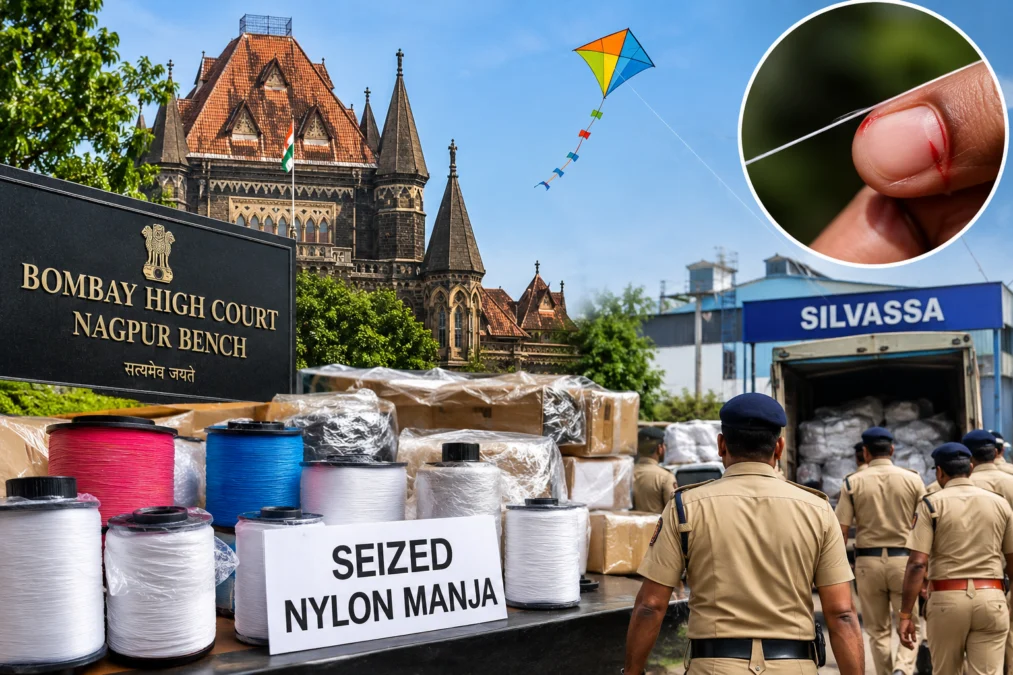
Nagpur: In a significant breakthrough in the fight against banned nylon manja, the Nagpur Bench of the Bombay High Court has commended Nagpur Rural Police for tracing a major source of the hazardous kite string to a manufacturing unit in Silvassa, where material worth over Rs 6 crore was seized.
A division bench of Justice Anil Kilor and Justice Rajnish Vyas appreciated the efforts of the Superintendent of Police (Rural), Nagpur, and his team while hearing a suo motu public interest litigation (PIL) on the nylon manja menace on Friday. The court, however, noted that the breakthrough came belatedly, following its strong displeasure on October 12 over the failure to investigate the supply network.
The bench had earlier sought the names of officers allegedly responsible for the lack of progress in identifying the sources of the banned string. The subsequent police action appears to have yielded a major lead in the investigation.
In an affidavit submitted before the court, the SP (Rural) informed the bench that police conducted raids after receiving inputs about the supply network and traced the manufacturing source in Silvassa. The affidavit also identified other suspected sources, which the police are now attempting to track down.

Appreciating the development, the bench observed that the investigation demonstrated the police’s ability to reach the root of the problem when they made a determined effort to do so.
HC seeks similar action across 10 Vidarbha districts
The court expects the police to replicate the investigative approach in the remaining 10 districts of Vidarbha to identify the networks supplying banned nylon manja. It directed the authorities to submit a comprehensive affidavit covering all districts by October 29.
The directive seeks to widen the crackdown beyond Nagpur and dismantle the supply chains responsible for making the dangerous kite string available in the region.
Nylon manja, widely used by some kite flyers, poses serious risks to people, birds and animals because of its sharp and durable strands. The court’s intervention is aimed at ensuring that enforcement agencies move beyond local seizures and identify the manufacturers and suppliers behind its circulation.
Advocate Nishchay Jadhav assisted the court as amicus curiae. The PIL will be taken up for further hearing on October 29.
Authorities given 15 days to dispose of seized manja
The bench also reviewed the disposal of seized nylon manja, an issue that had previously been brought before it by the Maharashtra Pollution Control Board (MPCB).
The MPCB had informed the district collectors of Nagpur, Bhandara, Gondia and Wardha that the confiscated material could be disposed of at a cement factory. During Friday’s hearing, the State Government informed the court that the seized manja had been crushed.
Since the cement factory concerned is located in Chandrapur, the court directed the authorities to obtain the requisite permission and ensure the proper disposal of the seized material. They have been given 15 days to complete the process and submit a statement confirming the disposal.
The direction is intended to ensure that confiscated nylon manja is disposed of through an appropriate process rather than remaining in storage or re-entering circulation.
Action against erring officers remains open
The bench also addressed the issue of possible action against police officers whose names it had sought during the previous hearing.
Without taking a final view on disciplinary action, the court observed that it could consider refraining from proceeding against the officers if they demonstrated diligence and exceptional commitment in tracing the supply sources.
The observation leaves the question of accountability open while giving the officers an opportunity to demonstrate effective results through the ongoing investigation.
The matter will next be heard on October 29, when the court is expected to review the progress of the supply-chain investigation across Vidarbha and the steps taken to ensure the disposal of the seized material.