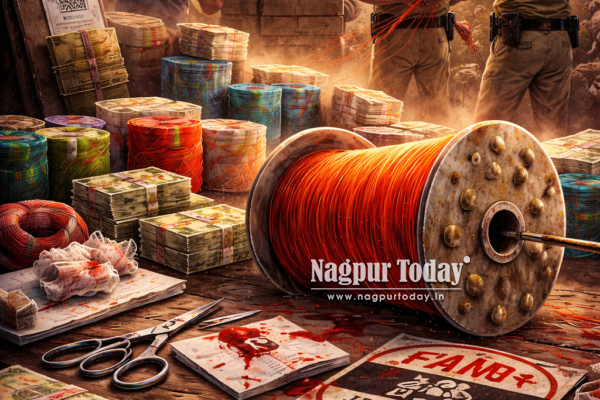
Nagpur: Sending out an unambiguous warning that reckless festivity cannot come at the cost of human lives, the Nagpur Bench of the Bombay High Court has reiterated its zero-tolerance approach towards the use and sale of deadly nylon manja, declaring that “no fine is greater than human life.” While the court reduced the penalty for users from Rs 50,000 to Rs 25,000, it firmly refused to dilute the crushing Rs 2.5 lakh fine imposed on sellers, making it clear that those who profit from this lethal material will face severe consequences.
The order, passed on Monday, comes amid repeated incidents of grievous injuries and deaths caused by nylon manja, which acts like a razor when airborne. The court made it clear that the reduced fine for users should not be mistaken for leniency, but as a practical measure following appeals from parents. The ban, the court stressed, is absolute and applies round the year, not merely during the Makar Sankranti festival.
Gold Rate
Mar 25,2026 - Time 11.05Hrs

To drive home the seriousness of the issue, the High Court directed District Collectors across Vidarbha to publish prominent public notices in newspapers on January 13 and 14, warning citizens of the ban and the stiff penalties involved. The matter will come up for further hearing on January 20.
The court ordered that all fines collected will be deposited into a special bank account maintained by the District Collector. A three-member oversight committee, comprising the District Collector, the High Court Registrar and the Municipal Commissioner, has been constituted to monitor the process. Police and municipal corporations have been authorised to enforce the ban and collect fines without hesitation.
To eliminate excuses and delays, the court directed District Collectors, Police Commissioners and Superintendents of Police to introduce a QR code-based payment system for instant fine collection. Public notices explaining the system must be widely circulated. Offenders unable to pay immediately will get a maximum of 15 days, failing which the amount will be recovered under stringent land revenue recovery laws.
Further tightening the noose, the court ordered Superintendents of Police, Deputy Commissioners of Police, Municipal Commissioners and chief officers of municipal councils to set up dedicated WhatsApp numbers to receive public complaints related to nylon manja. Police Commissioners have also been instructed to issue show-cause notices to concerned Deputy Commissioners wherever accidents caused by nylon manja are reported—fixing accountability within the enforcement machinery itself.
The High Court made it explicitly clear that parents will be held financially responsible if nylon manja is found in the possession of minors, while adults will be personally liable for violations. The court strongly appealed to parents to stop treating kite-flying with nylon string as harmless fun and to educate children about its deadly consequences.
Advocate Ravi Sanyal appeared for the Maharashtra Pollution Control Board, while Advocate Gemini Kasat represented the Nagpur Municipal Corporation.
Revised penalties for users
• Rs 25,000 for first offence
• Rs 50,000 for second offence
• Rs 75,000 for third offence
The High Court’s message is unmistakable: Nylon manja is not a toy, not a tradition, and not negotiable. Any misuse, or sale, will be met with swift, severe and unforgiving action.