

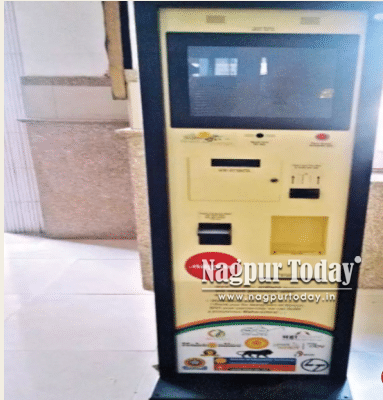
Nagpur: They were launched with grand promises. Branded as symbols of a “Smart Nagpur,” these digital kiosks were supposed to revolutionise public services, empower commuters, and showcase the city’s technological leap into the future. Instead, eight years later, they stand abandoned, dysfunctional, wrapped in cobwebs, coated in dust, and in several places, reduced to garbage dumping points.
An RTI reply obtained by Nagpur-based activist Abhay Kolarkar has now blown the lid off what appears to be yet another costly urban experiment executed without foresight, accountability, or long-term planning. The revelations have raised uncomfortable questions over how crores of taxpayers’ money were spent under the banner of the Smart City mission while the infrastructure created under it today lies dead and decaying across the city.
The 65 “smart kiosks” were installed at various bus stops in 2018 under the ambitious Rs 520 crore Smart and Safe City Project implemented by Nagpur Smart and Sustainable City Development Corporation Limited (NSSCDCL). The project was later handed over to Nagpur Municipal Corporation (NMC). At the time, these kiosks were promoted as futuristic public interfaces that would provide commuters access to bus route information, emergency services, civic facilities, and government schemes through touchscreen technology.
Today, however, most of those kiosks resemble neglected scrap structures rather than smart infrastructure.

At several locations across Nagpur, the kiosks now stand lifeless with blank screens, jammed doors, broken panels, scratched displays, and thick layers of dirt. Dust-covered glass, hanging cobwebs, clogged ventilation panels, and garbage accumulated around the structures paint a disturbing picture of neglect. In some places, the kiosks are so poorly positioned behind pillars or obstructed structures that commuters barely notice them anymore. Citizens waiting at bus stops often stand just a few feet away, completely unaware that these installations were once projected as a major public utility.
The situation at locations like Shraddhanandpeth bus stop and NIT Swimming Pool bus stop is particularly embarrassing. Printed notices hang crookedly on the kiosks, debris has gathered at the base, and the touchscreen panels are either damaged or buried under grime. The once-polished “smart” structures now look outdated, abandoned, and irrelevant.
What makes the issue even more alarming is the shocking lack of transparency surrounding the project.
When questioned about the failure of the kiosks, an NSSCDCL official reportedly claimed that the widespread adoption of smartphones made the kiosks redundant. According to the official, citizens began accessing services on their personal devices, reducing the utility of the kiosks.
The explanation, however, raises a far bigger question: if smartphone usage was already rapidly growing in 2018, something even a basic market assessment could have predicted, then why was such an expensive project conceptualised, approved, and implemented at all?
Was there no feasibility study? No future assessment? No accountability for planning public infrastructure that was destined to become obsolete within a few years?
The official also vaguely referred to “billing and metering issues” but reportedly failed to explain what exactly those issues were or how they crippled the project.
Even more shocking was the response regarding expenditure details.
When asked about the amount spent on these kiosks, officials admitted that they had no separate expenditure data available. The RTI response revealed that Maharashtra Information Technology Corporation Limited (Maha-IT) initiated the project while Larsen & Toubro (L&T) Construction executed the installation work. Yet, neither NSSCDCL nor NMC could provide a clear financial breakup or ownership of responsibility.
In a stunning display of bureaucratic disconnect, officials reportedly told the RTI applicant to approach L&T or Maha-IT for cost details. However, when Kolarkar sought contact information of the concerned officials or coordinators, NSSCDCL allegedly informed him that the person handling the project was no longer associated with the corporation and they no longer had contact details.
The result is deeply troubling, a publicly funded project with no clear audit trail, no operational outcome, no maintenance mechanism, and apparently no accountability.
Officials have also admitted that there is now no budget left under the Smart City project to revive, repair, or repurpose the kiosks. In other words, the structures will likely continue to rot in public spaces while authorities move on to the next “visionary” project.
The larger concern goes beyond just malfunctioning kiosks. The controversy strikes at the heart of how public money is prioritised and spent.
Urban experts and citizens alike are questioning whether “Smart City” initiatives are increasingly becoming exercises in optics rather than meaningful development. Fancy labels, expensive tenders, and technologically flashy installations may create headlines during inaugurations, but without sustainability, planning, and accountability, such projects risk becoming monuments to administrative failure.
The dead kiosks standing across Nagpur today are not merely broken machines. They symbolise a deeper systemic problem, poor planning, absence of foresight, lack of accountability, and a culture where failed projects quietly disappear without anyone being held responsible.
For citizens, the question remains painfully simple: Who approved the project, how much money was spent, who benefited, and why is nobody answerable for its collapse?