


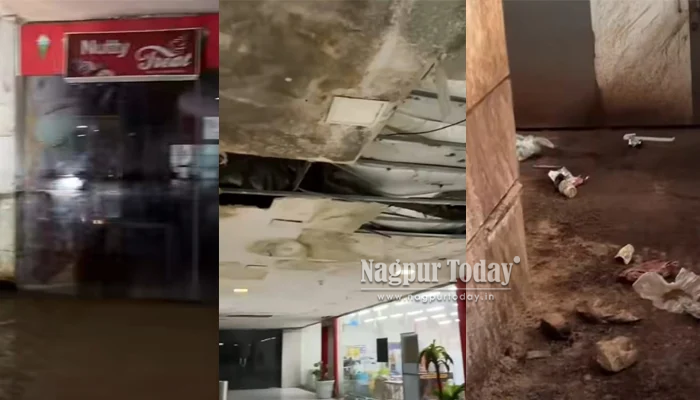
There was a time, somewhere around 2012 and 2013, when “let’s meet at Empress” could be heard commonly in Nagpur. You didn’t need to say why or for what. It was where the city went on a Sunday. Families, college groups, first dates, kids dragging parents towards the gaming zone. For a city that had never had a mall at that scale, it felt like arrival.
Walk in today and it feels like a building the city has quietly agreed to forget. Shutters down. Escalators still. Lights off in whole stretches. The kind of silence a big building become eerie ghost-haunts.
How does something go from that to this in a little over a decade?
A grand piece of land, and a grander promise
The land itself carries weight. This is where Empress Mills stood, the mill Jamsetji Tata started in 1877, named for Queen Victoria’s proclamation as Empress of India. It ran for well over a century. The mill finally shut in 2002 after years of financial trouble, and in 2005 the property was bought by KSL & Industries, a Mumbai-based textile company, for ₹35 crore, to be turned into “Empress City.”

And the plan was enormous. The developer’s own description promised an integrated township across 25 acres in the heart of the city: a nine-lakh-square-foot mall, an IT park, a corporate tower, luxury apartments, and a 300-room five-star hotel in collaboration with the Taj.
Almost none of it got built. The mall opened. PVR announced its first five-screen multiplex in Nagpur at Empress Mall in 2012. The rest stayed on paper.
That is the first clue. When only the cash-generating piece of a masterplan gets built and the rest never starts, the project usually stopped being about the project a long time ago.
Where the money actually went
Here is the part most Nagpurians never connected to the empty shops they were walking past.
In May 2019, the Enforcement Directorate attached properties worth ₹483 crore belonging to KSL & Industries, including the Nagpur mall and 2,70,374 sq ft of commercially diverted land, alleging that companies of the Tayal Group had fraudulently availed loans of ₹524 crore from Bank of India and Andhra Bank in 2008. The ED’s investigation followed three CBI FIRs against Tayal Group companies, and in November 2021 the agency took physical possession of Empress Mall. Counting an earlier attachment of ₹234 crore linked to a separate UCO Bank matter, total attachments against the group stood at ₹717 crore. These are allegations; the cases are still working their way through the system.
But you don’t need a verdict to understand the consequence. An asset under attachment is an asset nobody invests in. No owner is going to spend ₹20 crore refurbishing a building they may not own next year. So with zero investment, a mall doesn’t fade slowly; it falls.
Death by a thousand small failures
Shoppers don’t leave a mall because of a PMLA case. They leave because the escalator is dead and they’re carrying a toddler. Because the washroom is worse than the railway station’s. Because the AC is off in May. Because three of the four shops they came for have shut.
Visitor accounts from the last few years read like a post-mortem: outlets shut, lifts and escalators not working, broken floor tiles, unclean washrooms, more than half the mall empty. Occupancy is estimated to have slid to roughly 55 percent from around 85 percent in its better years. Big Bazaar, once an anchor, closed down.
Then the civic bills came due. In February 2025 the Nagpur Municipal Corporation sealed and took possession of the mall’s ground and first floors to recover ₹42.42 lakh in unpaid property tax.
Meanwhile the city moved on. VR Nagpur, acquired by Virtuous Retail in December 2019, gave Nagpur a clean, well-run, well-lit albeit a far smaller alternative. Once there’s a better option, a struggling mall doesn’t compete; it empties.
The lesson, if we want one
A mall is not a building, it is a promise the city renews every weekend. Come here, and your evening will be pleasant.
Empress had everything needed to keep that promise. The best-known name in the city. The biggest floor plate in central India. A first-mover advantage nobody else had. Crowds that showed up despite terrible traffic and worse parking.
What it didn’t have was an owner whose interest was the mall. When the building is a means to something else, a loan, a land parcel, a balance sheet entry; nobody wakes up worrying about the escalator on the second floor. And the escalator, in the end, is the whole business.
Nagpur didn’t lose a shopping centre, it lost a decade of what that land could have been, and it still has a 610,000-square-foot reminder standing opposite the railway station, visible to every visitor who arrives in this city.
The land has been reborn once before, from a mill to a mall. It can be reborn again. But not by whoever treated it as an asset to be extracted. Only by someone who treats it as a place to be run.