
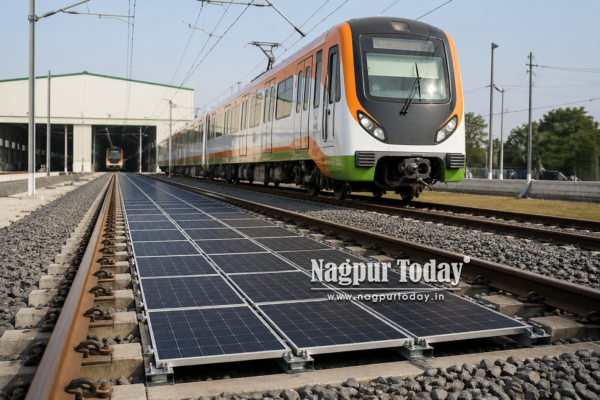
Nagpur: In a move that quietly redefines how urban transport infrastructure can double as a clean energy asset, the Nagpur Metro Rail Corporation Limited (NMRCL) has commissioned a first-of-its-kind solar power installation between railway tracks at its Hingna Depot, a model no metro system in India has operationalised so far.
Spread across a 200-metre pilot stretch, the project deploys monocrystalline solar panels with a capacity of 50 kilowatt peak. What sets it apart is not just its placement, but its engineering — designed to withstand and absorb the vibrations caused by trains passing overhead, while utilising inter-track space that had long remained redundant. The electricity generated is directly fed into the depot’s internal supply system, bypassing the city grid entirely.
Gold Rate
June 30,2026 - Time 10.30Hrs

Turning idle space into energy
The installation is expected to generate nearly 70,000 units of electricity annually, while reducing carbon dioxide emissions by an estimated 65 tonnes each year. According to a senior Metro official, while agencies like Indian Railways and the National Capital Region Transport Corporation have experimented with inter-track solar systems, no metro network in the country has brought such a concept into execution until now.

The project was conceptualised and researched by NMRCL’s Electrical Department under its Solar Energy division and implemented through a private vendor. Officials have indicated that the pilot will serve as a test case, with any future expansion contingent on its performance metrics.
Expansion meets sustainability push
The timing of the initiative is significant. As Nagpur Metro’s Phase II expansion advances toward Hingna, Kanhan, and Butibori, the corporation is actively evaluating additional track stretches for integrating renewable energy solutions.
Operational since 2019, the 38-kilometre, two-corridor Metro network has consistently positioned sustainability at the core of its infrastructure strategy. The inter-track solar model now adds a new dimension to that approach, one that leverages existing assets rather than demanding new land.
For now, the experiment remains confined to a 200-metre stretch. But its implications could extend far beyond. As the panels quietly generate power below, trains continue to glide above, a layered system where transit and sustainability run in parallel, awaiting the verdict of data before scaling up.


NMC Commissioner Pulls Up Officials Over Waterlogging

सोलर प्लांट के बावजूद भारी बिजली बिल #maharashtranews #smartmeter #electricity #bills #newsupdate

ट्यूशन फीस बढ़ोतरी के खिलाफ कांग्रेस आंदोलन #maharashtranews #tuitionfees #congress #andolan

महिला को एमडी ड्रग्स के झूठे केस में फंसाने की साजिश नाकाम...

एमआईडीसी में युवक की बेरहमी से हत्या #nagpurnews #crime #murdernews #newsupdate

सिर्फ एक धक्का... फिर चला चाकू #nagpurnews #crime #accusedarrested #murdernews