

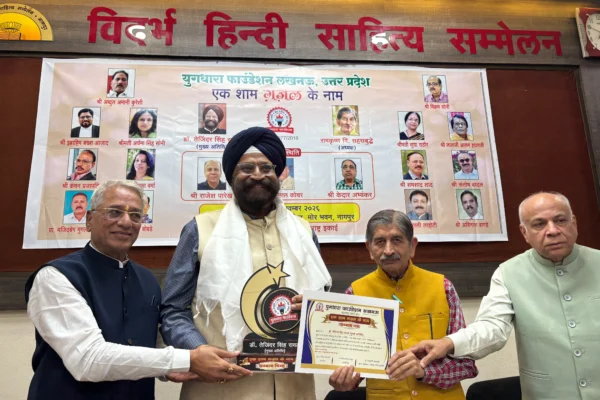
Nagpur, November 16: The Maharashtra unit of Yugdhara Foundation, Lucknow, organised a literary evening titled “Ek Shaam Ghazal Ke Naam” at Saket Auditorium, Mor Bhavan, Nagpur, on Sunday, November 15. The programme brought together prominent poets, writers and lovers of Urdu and Hindi literature, celebrating the richness of the Ghazal tradition and India’s composite cultural heritage.
Renowned linguist, scholar and poet CA Dr. Tejinder Singh Rawal, who graced the occasion as Chief Guest, delivered an insightful address on the history, evolution and literary significance of the Ghazal. Tracing its journey through Arabic, Persian and Urdu literary traditions, he explained how the Ghazal had evolved from an expression of romantic emotions into a powerful medium for philosophical reflection, social commentary and human values.
Dr. Rawal narrated an interesting historical anecdote about the eighth-century Arab scholar Al-Khalil ibn Ahmad Al-Farahidi, who is credited with systematising the science of poetic metre, known as Ilm-e-Arooz. According to a popular tradition, the rhythmic sounds of a blacksmith’s hammer inspired Al-Khalil to explore the underlying rhythmic patterns of poetry. Dr. Rawal explained that the beauty of the Ghazal lies in its unique combination of creative freedom and technical discipline, particularly its Behr (metre), Qafia (rhyme) and Radif (refrain).
Referring to legendary poets such as Mir Taqi Mir, Mirza Ghalib, Momin, Daagh Dehlvi, Faiz Ahmed Faiz and Dushyant Kumar, he illustrated how the Ghazal could convey profound philosophical ideas and human emotions in just two lines.

Emphasising the importance of Urdu as an integral part of India’s Ganga-Jamuni Tehzeeb, Dr. Rawal observed that languages should serve as bridges between communities rather than barriers dividing them. Drawing upon his experience of conducting free Urdu classes in Nagpur since 2013 through his initiative Aamozish-e-Urdu, he highlighted the contributions of writers belonging to different religious and cultural backgrounds to the development of Urdu literature.
He also spoke about the relevance of poetry in the age of artificial intelligence and rapid technological advancement. While technology has greatly enhanced communication, he observed, literature continues to play an indispensable role in developing empathy, sensitivity and an understanding of human emotions.
Dr. Rawal encouraged emerging poets to study classical literary traditions while developing their own distinctive voices. He also shared his personal journey as a student of Ghazal composition and explained the significance of his poetic pen name, Talib, meaning a seeker or learner. He congratulated Yugdhara Foundation for providing a platform to literary talent and preserving India’s rich cultural and linguistic heritage.
Guest of Honour Dr. Shantilal Kochar ‘Goldy’ spoke about the responsibility of writers and creative artists in strengthening national unity and social harmony.
The programme was presided over by Dr. Ramakrishna V. Sahasrabuddhe, Patron of Yugdhara Foundation, who outlined the organisation’s literary initiatives, particularly its efforts in publishing literary works and recognising the contributions of writers and poets.
Special guest Rajesh Parekh appreciated the initiative and assured his continued support for such literary activities.
The programme commenced with a Vagdevi Vandana, written by Avinash Bagde and melodiously rendered by musician and singer Kedar Abhyankar. Senior writer Avinash Bagde conducted the proceedings with grace and literary flair.
The highlight of the evening was the presentation of Ghazals by participating poets, including Rama Verma, Kanchan Prajapati, Lalji Alam Hathgavi, Madhav Bobde, Abdul Amani Qureshi, Santosh Badal, Abdul Majeed Beg, Ibrahim Bakhsh Azad, Vikram Soni, Dr. Shantilal Kochar Goldy, Shamshad Shad, Avinash Bagde and Raas. Their compositions reflected a wide range of emotions, experiences and contemporary concerns, drawing appreciation from the audience.
Several distinguished literary personalities and enthusiasts, including Hemlata Mishra Manvi, Vijaya Abhyankar, Mumtaz Sheikh and Aleem Sheikh, were present.
The evening concluded on a memorable note, reaffirming the continuing appeal of Ghazal as a literary form that transcends linguistic, religious and cultural boundaries and brings people together through the shared language of poetry.