

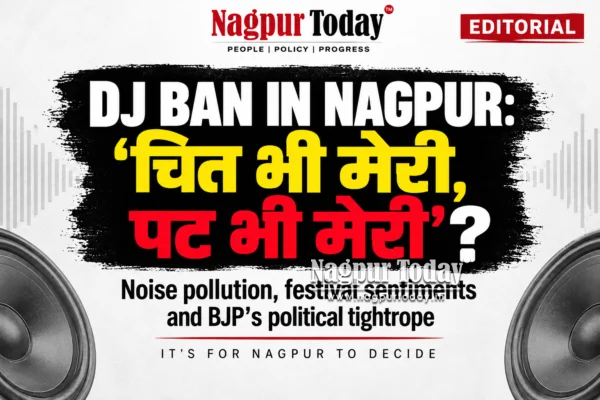
 Nagpur has a new political sound system-and this one is louder than any DJ.
The city’s police commissioner has put restrictions on DJs, DJ vehicles and laser/beam lights during the festive period. The stated objective is straightforward: control noise pollution, protect public safety and prevent high-intensity lights and sound systems from creating problems during crowded processions and celebrations.
Nothing controversial about that.
What is controversial is what happened politically immediately afterwards.
Because within the BJP, the DJ debate has suddenly produced something Nagpur does not see every day:

BJP leaders taking apparently different public positions on the same issue.
And that deserves a closer look.
First, Sandeep Joshi says: Enough is enough
Former mayor and former BJP MLA Sandeep Joshi had already launched a campaign against DJs and laser lights before the police order.
His argument was not limited to Ganeshotsav. He has repeatedly maintained that excessive DJ noise is a public-health and civic issue and that restrictions should ultimately apply across festivals and communities, not selectively. He has even announced a multi-stage public campaign seeking a permanent ban on DJs and laser lights.
Then, almost as if the administration had pressed the “confirm” button on his argument, the Police Commissioner announced restrictions.
Joshi welcomed the move.
Again, perfectly logical.
But then came the twist.
Enter Pravin Datke. Then Dayashankar Tiwari.
BJP MLA Pravin Datke questioned the timing and asked the obvious political question:
If DJs are the problem, why restrict them specifically around Hindu festivals?
His argument was essentially that restrictions should be universal and based on decibel levels—not on which festival happens to be taking place.
BJP city president Dayashankar Tiwari also called for reconsideration, arguing that instead of a blanket ban during selected months, authorities should consider year-round regulation with permissible decibel limits.
And suddenly, we have a rather unusual picture.
One BJP camp says: Good decision.
Another says: Wait. Not like this.
This is not the BJP disagreement we usually see playing out publicly in Nagpur.
So naturally, the Nagpurian question follows:
What exactly is going on?
The timing was politically explosive
Let’s forget politics for a moment.
Look at the calendar.
Dahi Handi celebrations are beginning. Ganeshotsav is around the corner. Major processions and programmes have already been planned.
The police order covers a long festive stretch, including Dahi Handi, Ganeshotsav and several other religious and civic occasions. Police have also said traditional lighting, music and decorations are not prohibited, while high-intensity beam and laser lights are restricted.
From an administrative point of view, the timing can be defended.
From a political point of view?
It was always going to be combustible.
And social media proved it.
The debate quickly moved from:
“Should there be noise control?”
to:
“Why now?”
Then:
“Why during Hindu festivals?”
And then the most politically dangerous question:
“Would the same rule be applied to everyone?”
That is the point at which a noise-pollution issue becomes a vote-bank issue.
Did BJP’s own voter base force the political reaction?
We don’t know.
And anyone claiming to know for certain is guessing.
But the sequence is worth examining.
A campaign against DJs gains momentum.
The administration announces restrictions.
Social media erupts with questions about timing and festivals.
Festival organisers express anger.
Some BJP-linked organisers and corporators publicly push back, with some even indicating they may proceed with DJs despite the restrictions.
And then BJP leaders begin raising objections.
Coincidence?
Possible.
Political damage control?
Also possible.
Genuine disagreement?
Absolutely possible.
But whichever explanation one chooses, there is one undeniable fact:
The BJP’s internal debate became public.
And once political differences become public, citizens have every right to ask why.
The ‘Hindutva trap’
This may also explain the peculiar silence from Nagpur Congress.
Where is Congress in this debate?
Where are the city-level Congress leaders?
Where are the sitting representatives, corporators and office-bearers?
Why aren’t they loudly supporting the ban?
Why aren’t they loudly opposing it?
Perhaps because this is precisely the political battlefield Congress does not want to enter.
Support the ban—and you can be accused of opposing traditional Hindu celebrations.
Oppose it—and you risk appearing to support excessive noise pollution.
Question the timing—and you enter the Hindu-festival-versus-government narrative.
So what is the safest political strategy?
Stay out of it.
Let the BJP fight the BJP.
From a purely political standpoint, that may be the smartest decision of all.
And here comes the ‘चित भी मेरी, पट भी मेरी’ theory
This is where things get really interesting.
Imagine the political outcomes.
Scenario 1: The ban works
Noise reduces.
Residents appreciate the quieter festivals.
The administration gets credit.
The leaders who demanded action can say:
“We told you so.”
Scenario 2: The public gets angry
Festival organisers revolt.
Social media turns against the decision.
Then other BJP leaders can say:
“We told the administration not to do it this way.”
Scenario 3: The government modifies the restrictions
Then both sides have something to celebrate.
Those supporting restrictions can claim victory:
“At least action was finally taken.”
Those opposing the manner of implementation can claim victory:
“We forced the administration to reconsider.”
And that brings us to the Nagpur version of an old political saying:
चित भी मेरी, पट भी मेरी.
If this is merely a genuine policy disagreement, fine.
But if different political voices are occupying different sides of the same controversy to protect different sections of the same voter base, then Nagpur deserves to know.
But let’s not miss the real issue
There is a danger in turning every noise-pollution debate into a Hindu-versus-somebody debate.
That would be a mistake.
Noise pollution is real.
High-powered DJs can disturb residents, patients, children, senior citizens and students. High-intensity laser and beam lights can create safety concerns, particularly around traffic and crowded processions. The administration has cited precisely these concerns in defending its restrictions.
At the same time, festival celebrations are also real.
And Nagpur’s citizens have demonstrated time and again that they are capable of celebrating responsibly.
So perhaps the answer isn’t:
DJ versus no DJ.
Perhaps the answer is:
Rules versus no rules.
Set the decibel limit.
Set the time limit.
Set clear conditions.
Apply them equally.
And enforce them equally.
One city. One rule. Every festival.
This is ultimately the only politically sustainable solution.
If loud music is dangerous on September 5, it is dangerous on October 5.
If excessive sound is harmful during Ganeshotsav, it is harmful during every other festival.
If laser beams can blind motorists during one procession, they can do the same during another.
Noise does not check religion before entering someone’s bedroom window.
That should be the guiding principle.
Not politics.
Not vote banks.
Not which festival is on the calendar.
Nagpur is watching
The most fascinating part of this controversy isn’t actually the DJ.
It is the politics surrounding the DJ.
A BJP leader pushes for a stronger crackdown.
The police act.
Other BJP leaders question the timing.
Festival organisers push back.
Social media explodes.
Congress largely watches from the sidelines.
And citizens are left asking:
Was this simply an administrative decision that accidentally became political?
Or did the political reaction become necessary because the decision touched a particularly sensitive part of the BJP’s own voter base?
We don’t have the answer.
But the question is legitimate.
And perhaps there is another question that is even more important:
Can Nagpur have a noise-pollution policy that is strict without being selective, secular without being insensitive to religious sentiment, and enforceable without becoming a political weapon?
The answer should be yes.
Because Nagpur doesn’t need a political DJ where one leader turns up the volume and another turns it down depending on who is listening.
We need one volume setting for everyone.
And if our political leaders genuinely believe in that principle, then the easiest test is also the simplest:
Apply the same rule to every festival.
Apply the same rule to every community.
Apply the same rule to every political procession.
Apply the same rule to everyone.
Let Nagpur celebrate.
Let Nagpur breathe.
Let Nagpur sleep.
And most importantly—
let the rules speak louder than the DJs.