

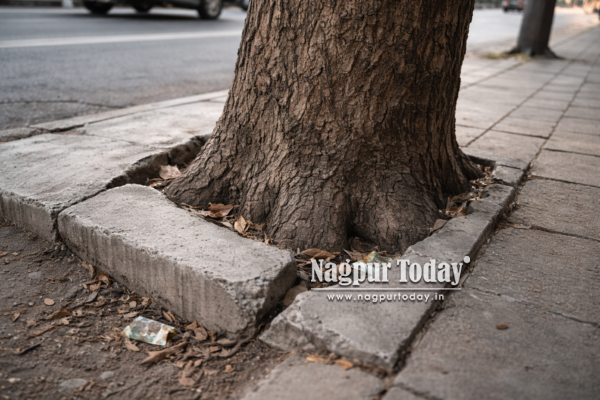
Nagpur: Beneath layers of concrete and civic apathy, hundreds of trees across Nagpur are silently suffocating, their roots locked in cement, their survival hanging by a thread. A damning report submitted before the Nagpur Bench of the Bombay High Court has revealed that at least 528 trees in the city are literally gasping for air, trapped by concrete in blatant violation of tree-protection norms meant to safeguard urban green lungs.
The revelation came from a three-member lawyers’ inspection committee appointed by the High Court, whose findings were placed before a division bench of Justice Anil Kilor and Justice Raj Wakode during hearings in an ongoing public interest litigation highlighting indiscriminate damage to trees in the name of development.
Gold Rate
Mar 12 2026 - Time 11.45Hrs

The issue traces back to 2018, when the High Court took suo motu cognisance of rampant tree cutting and damage across Nagpur. Subsequently, environmental activists Sharad Patil, Prachi Mahurkar, Yash Netke and Preeti Patel approached the court, demanding urgent directions to free city trees from suffocating concrete and restore their natural breathing space. Acting on the plea, the bench had earlier ordered the formation of a committee under the Divisional Commissioner to ensure large-scale deconcretisation.
However, what followed was silence, and cement.
Amicus curiae advocate Radhika Bajaj informed the court that although a committee was constituted in February 2025, it failed to submit mandatory monthly status reports or demonstrate visible action on the ground. Taking a stern view of this inertia, the court ordered a fresh, independent inspection by a new panel of lawyers, P.S. Gawai, R.V. Gehlot and Pushkar Ghare, with clear directions to physically survey cement roads and locations where trees were encased in concrete, and submit a report within one month.
The cost of the inspection was to be borne by the Nagpur Municipal Corporation (NMC).
The report submitted on Tuesday painted a grim picture. From residential colonies to arterial roads, trees across the city were found imprisoned in concrete collars, cutting off air, water and nutrients essential for survival. The violations spanned a vast stretch of Nagpur, including Bajaj Nagar, Shankar Nagar, Corporation Colony, Shivaji Nagar, Pratap Nagar, Laxmi Nagar, NEERI Colony, Abhyankar Nagar, Bharat Nagar, Ravi Nagar, Civil Lines, Itwari, Nandanvan, Central Avenue, Shukrawari Talav, Gandhi Sagar, Vayusena Nagar, Friends Colony, Jafar Nagar, Zingabai Takli, Dabha, Katol Bypass Road, Ajni, Medical Square, Ayodhya Nagar, Ridge Road, Rameshwari, Khamla, Surendra Nagar, Sahakar Nagar, Ring Road, Hingna Road, and Narendra Nagar.
What disturbed the court further was the apparent disconnect between official claims and ground reality.
Expressing displeasure over “incorrect information” earlier furnished regarding concretised trees, the bench directed the civic body to file a detailed explanation by February 6. The court also sought a comprehensive response after the amicus pointed out that no proper tree census has been conducted in Nagpur since 2011, raising serious doubts about the credibility of official data.
In sharp oral observations, the bench reprimanded the civic administration, warning that authorities must refrain from making unverified statements and instead focus on strict compliance with environmental norms. The message was unambiguous: development cannot come at the cost of choking the city’s trees to death.
As Nagpur expands outward in concrete and asphalt, the High Court’s intervention has once again spotlighted a troubling reality, that while the city grows taller and wider, its trees are being pushed into a slow, silent suffocation.