

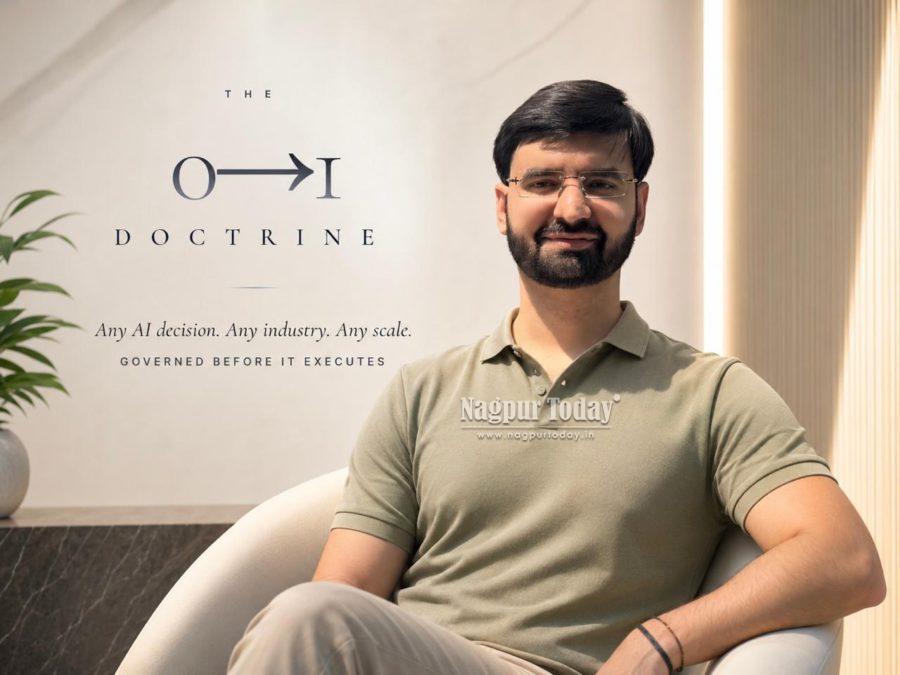
What frightens the world is not the technology arriving — it is the world’s own unreadiness for it, and that gap is what actually drives the headlines. The 0→1 Doctrine’s Authorized Intelligence closes it through governing Axioms, Theorems, and Pre-execution Governance — privacy intact, zettabytes spared exposure, every decision reduced to 0 and 1, proven now and ready ahead of quantum scale. Tested live, via API, governed against ungoverned, side by side.
Gold Rate
Sept 12,2026 - Time 10.30Hrs

Singularity is not a small problem, and nothing here treats it as one. The check itself simply does not get bigger for a bigger decision. A civilisation-scale choice and a routine one go through the same test. Same architecture. Same rule, no matter the stakes.

Fear of scale assumes the check has to grow with the thing it checks. It does not.
One technology leader says the industry has entered the singularity. Others call it premature. Neither side is wrong to disagree — they are reading the same evidence and reaching different conclusions, which is what a genuinely open question looks like.
That kind of open, good-faith disagreement between credentialed people is exactly what should happen before anyone claims certainty about a threshold this significant.
Multiple theorems and several governance layers do not treat a routine decision and a civilisation-scale one as different problems requiring different proof. Every decision is the identical question: does the request’s band overlap the authorized band, yes or no.
A modest decision and one made by a system some call far more advanced pass through that identical question, worded the identical way, proved the identical way.
Three constitutional axioms carry the actual weight here: A1, Delete-Before-Share, ensures the raw record never travels. A2, the Human Oversight Pathway, keeps a person in authority by structure, not courtesy. A3, Decision Closure, ensures every action resolves — approved, blocked, or held — nothing left ambiguous.
TWO CAMPS, ONE BLIND SPOT
The people declaring singularity and the people denying it agree on more than either side admits.
Both camps are debating capability. Neither is arguing that oversight should shrink as capability grows. That quiet agreement, buried under the louder disagreement, is where a governed answer actually fits — it does not ask either camp to concede the argument they are having.
LAYERS, NAMED PRECISELY
Sensing stress early, advising risk before commitment, recovering what fails, verifying what was delivered — none of these functions need to multiply just because the decision got bigger.
EMERGE — the Emergent Meta-Environmental Response and Governance Envelope — senses systemic stress early, across individuals, enterprises, or nations, before it compounds. PRAT — the Predictive Risk Advisory Token — delivers signed, advisory-only risk predictions before a commitment becomes irreversible.
PARR — Post-Actuation Remediation and Recovery — governs what happens after an action executes.
RECAP — the Regenerative Evaluation and Civic Accountability Protocol — verifies what was promised was actually delivered. Together: sense, advise, recover, verify. None scales up separately when the decision does.
FIVE FIELDS, ONE IDENTICAL TEST
The band does not know or care which field submitted it.
Every product, service, and asset runs the same test.
- A biological-age estimate, versus calendar age, normalizes to [0.71, 0.76], falling short of the target band [0.78, 0.85] that would confirm aging slower than calendar time. Held for review — the shortfall caught early enough to add real life years through intervention, not just flagged after the fact.
- A satellite maneuver’s band [0.76, 0.83] overlaps its slot [0.74, 0.85]. Accepted. Cleared, executed, no conflict.
- A coastal accelerometer’s band [0.76, 0.82] approaches the earthquake and tsunami ceiling [0.00, 0.80]. PRAT advises, before commitment. Hours more forewarning, while it is still a warning.
- An ecommerce return clears policy at [0.60, 0.71], but its window is full. ATRP reroutes. Honored, no conflict forced.
- An energy load-shift’s band [0.85, 0.93] has no intersection with grid stability [0.60, 0.80]. Vetoed, absolute. Stopped outright.
WHAT HAPPENS AFTER, NOT JUST BEFORE
A theorem that only governs the moment of approval leaves the moment after ungoverned.
When a cleared action still produces an unexpected outcome, PARR coordinates recovery and produces the same cryptographic proof that governed the original decision. RECAP then verifies the recovery delivered what it claimed. A decision governed only at approval, with nothing watching afterward, was never fully governed.
Neither step is optional, and neither is unique to any one field — a factory line and a sovereign transaction both close through the identical two-stage loop.
That closure is not decorative. It is the difference between a governance claim that ends at approval and one that follows the decision all the way to its actual outcome.
WHAT THE MARKET IS PRICING RIGHT NOW
Capital does not usually panic over capability. It panics when nobody can say who was checking.
Every dollar committed to autonomous systems today is exposed to the same question the singularity debate keeps circling: not whether the system is powerful, but whether anything reviews what it decides. That exposure exists regardless of which side of the debate turns out correct.
A portfolio built on the assumption that oversight can be added once the debate resolves is a portfolio pricing a bet that may never actually settle in time to matter.
QUANTUM CHANGES THE HARDWARE, NOT THE ARCHITECTURE
A theorem proved once does not need proving again because the computer running it changed.
Every sealed receipt already uses signature standards built for a future where today’s encryption no longer holds. The multiple-token chain runs unchanged whether the hardware is classical or quantum. Nothing about reaching quantum scale requires reopening the proof.
A theorem that needed re-proving every time hardware advanced would never have been a theorem to begin with — just a temporary convenience mistaken for a permanent law.
WHAT THIS DOES NOT CLAIM
This does not claim singularity is easy, small, or fully understood. It claims the check does not need it to be.
This does not claim to know when, or whether, singularity in the fullest sense arrives. What it claims is narrower and already filed: the mathematics governing a routine decision today does not require redesign to keep governing a much larger one.
Every organization deploying autonomous systems today inherits this same exposure, whether or not the debate above them resolves this year or the next decade.
Capital rarely waits for readiness before it moves — and neither did this architecture. Unready for Singularity or not, the axioms and theorems built to govern it were filed and standing ready before the fear demanding them was even news.
This can be tested, live, via API, governed against ungoverned, side by side.
The Inventor
Vatsal Soin is a serial inventor, systems theorist, and entrepreneur. An alumnus of Nanyang Technological University, Singapore — ranked second globally for artificial intelligence in the latest U.S. News Best Global Universities rankings — his earlier inventions converged toward one destination — the 0→1 Doctrine.
Selected References
Granted: US Patent 12,446,652 B2 · Japan Patent No. 7560909 · India Patent No. 454081 · Filed: PCT/IN2025/051943 · US 19/489,595 · India 202511115781 · Australia AU2022450649
DISCLAIMER: Informational only. Not certified. No endorsement implied. Not investment advice. Expert validation required before deployment. Vatsal Soin · © 2026 All Rights Reserved