

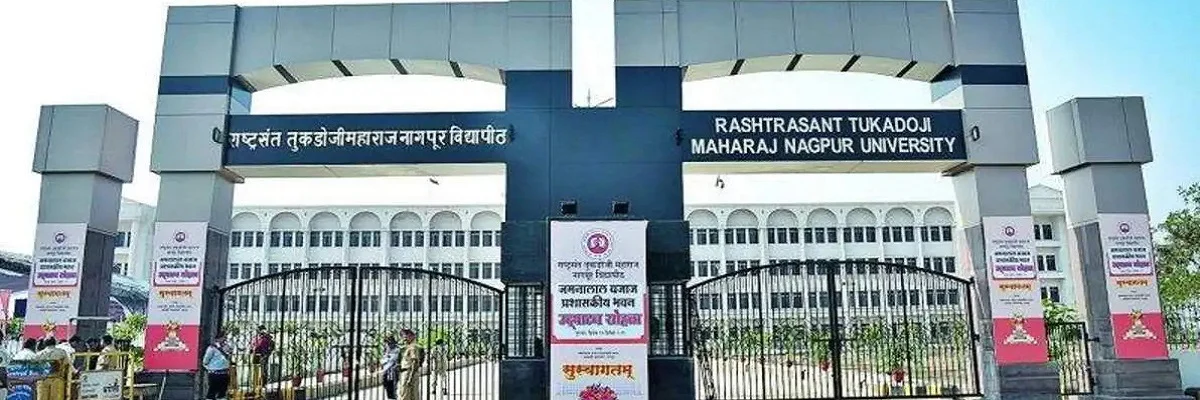
Nagpur: In a glaring examination fiasco, Rashtrasant Tukadoji Maharaj Nagpur University (RTMNU) has exposed students to a bizarre academic ordeal by setting a Labour Law-I question paper based on an obsolete law when they had been instructed to prepare under a revised syllabus. The blunder has forced the university to cancel the examination and announce a fresh test, leaving students paying the price for what appears to be a serious failure in question-paper setting and scrutiny.
The controversy erupted during the LL.B (NEP-CBS three-year course), Third Semester examination on November 18, when students discovered that questions were based on the old Industrial Disputes Act instead of the Industrial Relations Code (IR Code) 2020 prescribed under the revised syllabus. The confusion was compounded by another glaring discrepancy: the question paper itself carried the heading of LL.B (five-year course), Seventh Semester, rather than the course for which the students were appearing.
The mismatch left candidates bewildered even as the examination clock continued ticking. One student, speaking on condition of anonymity, said the discrepancy was immediately brought to the examiner’s notice, with a specific query about whether the correct question paper had been distributed.
“The examiner took around 15 to 20 minutes to verify the matter with the university and subsequently told us that we had to appear for the examination,” the student said.

With no clear resolution forthcoming, students were left with little choice but to sit through the entire three-hour examination, attempting to answer questions largely on the basis of whatever they had studied. The experience was frustrating, with several candidates believing that their performance had been seriously compromised by the university’s mistake.
“None of us fared well,” the student said, describing the helplessness of candidates who had prepared for one syllabus but were confronted with questions from another.
Earlier warning signs ignored
The controversy was not entirely new. A similar discrepancy had surfaced during the BA LL.B (five-year course), Seventh Semester Labour Law-I examination on November 16. However, only a handful of students reportedly raised objections at that stage, and the matter did not trigger immediate corrective action.
It was the larger number of complaints from three-year LL.B students on November 18 that brought the issue into sharp focus.
A senior university official confirmed that around 45 to 50 students had submitted representations alleging that questions were outside the prescribed syllabus. Following these complaints, the concerned committee decided to cancel both examinations and conduct them afresh.
The official maintained that the subject was common to both courses. Explaining the delay in identifying the problem after the November 16 examination, the official said the university’s examination mechanism does not allow authorities to access question papers before they are distributed to candidates.
Re-examination on November 28
According to an RTMNU circular issued on November 18, both examinations have been rescheduled for November 28.
The LL.B (three-year course), Third Semester examination will be conducted from 9.30 am to 12.30 pm, while the BA LL.B (five-year course), Seventh Semester examination will take place from 2 pm to 5 pm.
Who will answer for the blunder?
Beyond the cancellation, the episode has raised uncomfortable questions about the university’s examination machinery, particularly the competence and accountability of those entrusted with preparing and scrutinising question papers.
How could a paper based on an old law pass through the examination-setting process despite a revised syllabus? Why was the course heading incorrect? And why did the discrepancy reported after the November 16 examination not trigger an immediate review before the next batch of students faced the same subject?
The repercussions extend beyond the embarrassment of cancelling an examination. Students must rearrange their schedules, bear additional inconvenience and prepare for another test despite having already spent three hours attempting a paper that allegedly did not conform to their syllabus.
A re-examination also entails additional administrative and financial expenditure, ultimately burdening the university.
The senior official acknowledged the financial implications and said the committee would decide the further course of action, including whether the question-paper setters were responsible for the lapse.
For students, however, the bigger question is whether anyone will actually be held accountable. Cancelling an examination may correct the immediate academic injustice, but it cannot absolve the university of responsibility for allowing such a glaring lapse to occur in the first place.