

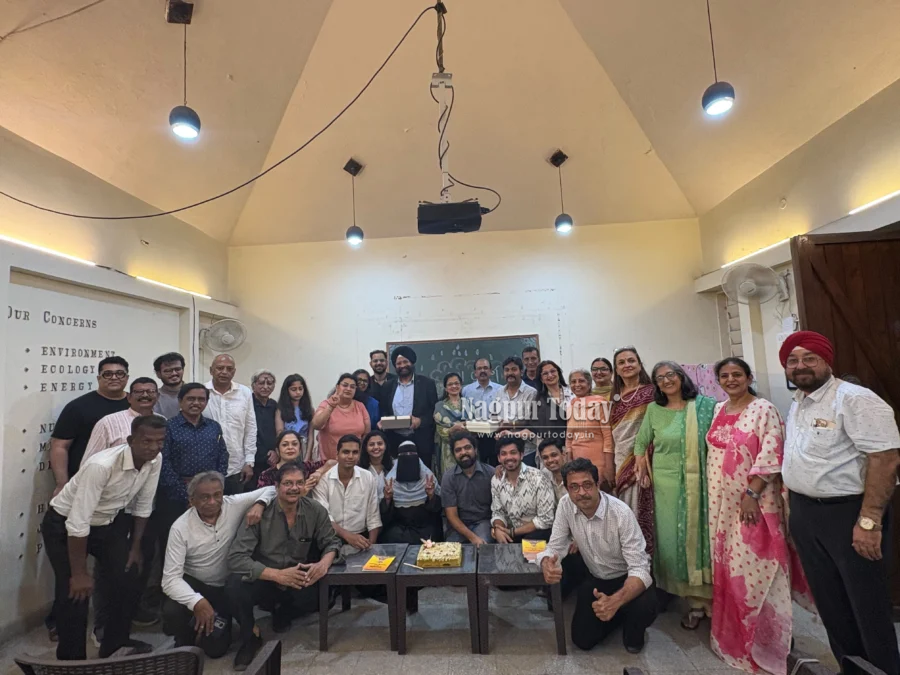
 The 13th batch of Aamozish-e-Urdu concluded on October 9 with a graduation ceremony at the India Peace Centre, Civil Lines, Nagpur, marking the culmination of a 30-day learning journey that brought together participants from diverse professional backgrounds to discover the Urdu language, its script and its rich literary heritage.
Organised annually at the India Peace Centre, Aamozish-e-Urdu aims to introduce learners to Urdu while fostering an appreciation for its literature, poetry and cultural traditions. The concluding ceremony featured certificate distribution, participant performances, personal reflections and a dinner, celebrating both the learners’ progress and the bonds developed during the programme.
Dr. Tejinder Singh Rawal: A Chartered Accountant with a Passion for Urdu
The classes were conducted by Dr. Tejinder Singh Rawal, a chartered accountant, academic and author whose professional expertise extends across taxation, economics, information systems auditing and cyber law. His qualifications include master’s degrees in Economics, Public Administration and Urdu, a law degree, professional accountancy and information systems certifications, and a PhD in taxation. His professional and academic work reflects interests spanning education, writing and social service.
Despite his demanding professional commitments, Rawal took the time to introduce participants to the fundamentals of reading and writing Urdu. His approach went beyond the mechanics of the script, encouraging learners to appreciate the language’s literary traditions and the values of adab, tehzeeb and respectful communication.
Reflecting on the concluding ceremony, Rawal shared a heartfelt message with the batch, describing the evening as a blend of happiness, laughter, affection and the bittersweet feeling of parting. He wrote that a teacher’s success lies not merely in having students listen attentively, but also in seeing them gain the confidence to express their thoughts, showcase their talents and share their experiences.

Recalling the early lessons, when participants struggled to recognise letters and join them into words, he expressed happiness at seeing them gradually develop their reading and writing skills. He invoked Dagh Dehlvi’s famous couplet to describe the process:
“Nahin khel, Dagh, yaaron se keh do,
Ki aati hai Urdu zubaan aate-aate.”
The couplet captures the patience and perseverance required to learn Urdu, with progress coming gradually through practice and continued effort.
Ms. Alefia Master’s Commitment Beyond the Classroom
A key contributor to the programme was Ms. Alefia Master, a teacher at a CBSE school in Nagpur, whose dedication played an important role in ensuring that participants understood the lessons.
After fulfilling her responsibilities at school and at home, Ms. Master made time every day to conduct revision sessions before Rawal’s classes. Her efforts helped participants reinforce their basics, revisit difficult concepts and keep pace with the lessons. Her commitment ensured that learning remained inclusive, with attention given to the understanding and progress of every participant.
Describing the spirit of the initiative, Ms. Master said, “Aamozish-e-Urdu is a markaz of ilm, adab aur mohabbat” — a centre of knowledge, literature and love. Her contribution reflected the collaborative spirit behind the programme, with teaching and revision working together to make the learning experience meaningful.
From Urdu Script to India’s Shared Cultural Heritage
The programme introduced participants to the fundamentals of Urdu script, including its letters, joining patterns, pronunciation and diacritical marks. Along the way, learners explored the works of celebrated poets such as Mir, Ghalib, Momin, Dagh, Faiz and Parveen Shakir, among others.
For many, the experience extended beyond learning to read and write. It opened a door to Urdu’s literary world and encouraged a deeper appreciation of the language’s expressive beauty.
The graduation ceremony reflected this cultural diversity through speeches, ghazals accompanied by guitar, Punjabi compositions, Marathi writing and Hindi songs. Participants presented a range of performances, including Bulleh Shah’s Punjabi composition Nukta, while other contributions celebrated music and literature across languages. The gathering demonstrated how Urdu could serve as a common platform for people with different linguistic and cultural backgrounds.
Rawal expressed particular happiness at seeing Hindi, Marathi, Punjabi and Urdu come together during the event, noting how different languages enrich a shared cultural experience. The ceremony also gave participants an opportunity to speak about their personal journeys and the friendships they had formed during the classes.
More Than a Language Course
In his message, Rawal reflected that the programme had also offered participants an opportunity to rediscover their inner student. Professionals with years of experience had returned to the classroom, asking questions, making mistakes, learning new skills and experiencing the joy of understanding something unfamiliar.
He encouraged the learners to carry that curiosity beyond the course by reading regularly, writing, exploring literature and remaining open to new knowledge throughout their lives. He also acknowledged the support of the India Peace Centre and Nagpur Book Club in nurturing the educational and literary initiative.
The venue held particular significance in the context of the programme’s wider message. At the India Peace Centre, participants from different backgrounds came together to learn, respect one another’s identities and celebrate a shared cultural inheritance.
As the 13th batch concluded, the graduation ceremony marked both an ending and a beginning. The formal classes may have come to an end, but the participants’ engagement with Urdu literature, poetry and calligraphy is set to continue.
Aamozish-e-Urdu’s larger message remained at the heart of the celebration: language can be a bridge between people, while learning together can nurture friendship, mutual respect and brotherhood. For the participants, the certificate was not simply a record of completing a course. It was a reminder of the first steps taken into a new literary world, the teachers who guided them and the community they found along the way.
Written by Mayank Sharma