
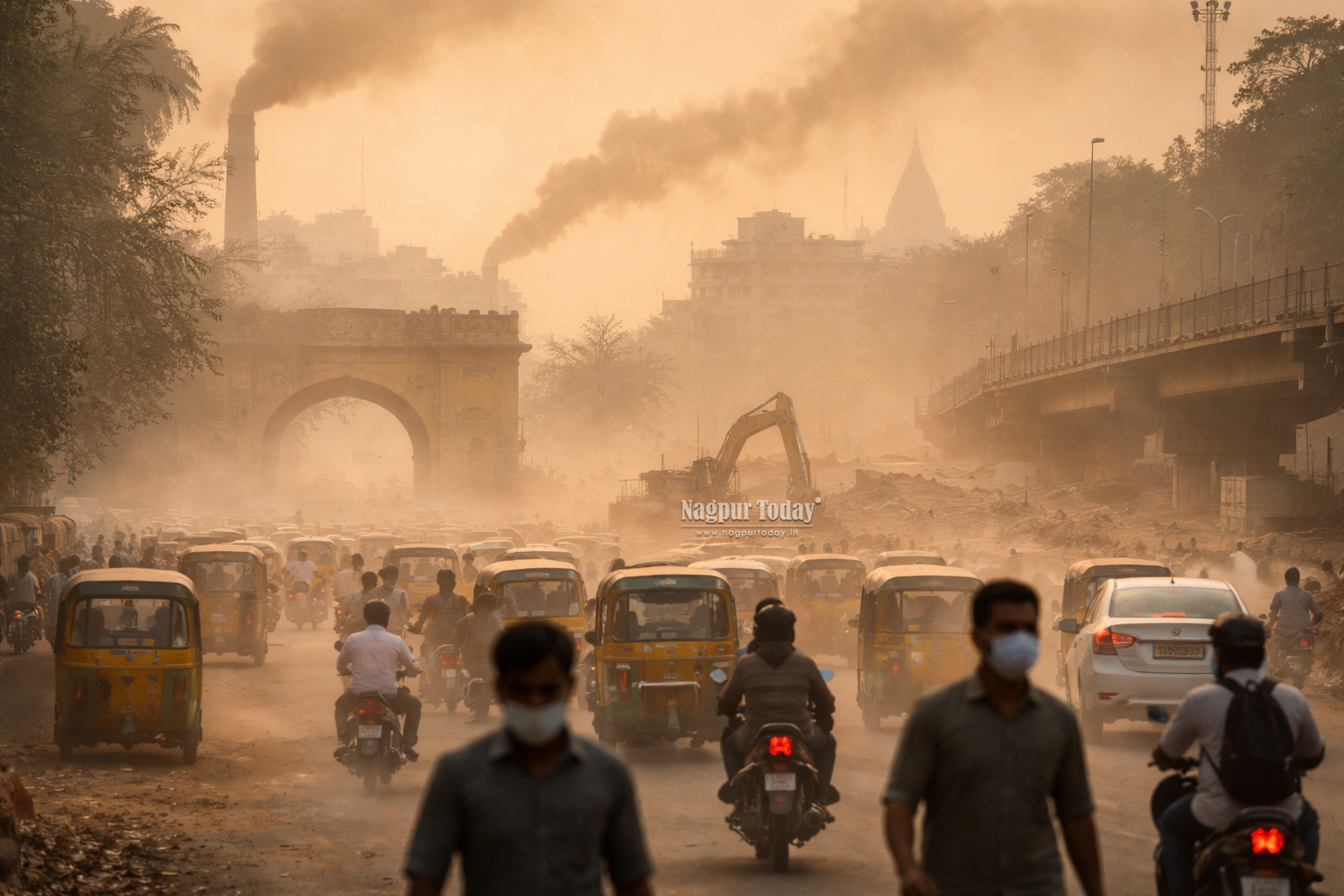
Nagpur: The air over Nagpur is growing heavier, and more dangerous. Fresh data released by the Maharashtra Pollution Control Board (MPCB) paints a grim picture of a city steadily sliding into a pollution crisis, with Mahal once again emerging as the most contaminated pocket.
Shockingly, environmental assessments now indicate that Nagpur has overtaken Chandrapur, once listed among India’s critically polluted cities, in terms of deteriorating air quality trends over the past four years.
Gold Rate
Mar 2nd, 2026 - Time 11.45Hrs

Mahal worst-hit; fine particles rule the air
In February alone, Mahal recorded “moderate” air quality for 22 out of 28 days, while six days slipped into the “poor” category. More alarming is the dominance of PM2.5, the ultra-fine particulate matter that penetrates deep into the lungs and bloodstream, which remained prevalent for 24 days. PM10 levels were recorded on only four days.
Health experts caution that sustained exposure to PM2.5 significantly increases the risk of asthma, chronic respiratory illness, heart disease, and other life-threatening conditions.
Pollution spreads across city
The Ramnagar monitoring centre reported 25 moderate days, two poor days, and just one satisfactory day. Here, PM2.5 was recorded on 15 days, while PM10 was observed on 13 days, indicating persistent particulate pollution.
Ambazari fared marginally better, with three satisfactory days, 23 moderate days, and two poor days. However, PM2.5 still dominated 18 days of the month. Environmental observers noted that the few “satisfactory” readings were largely due to favourable weather conditions and intermittent rainfall that temporarily suppressed airborne dust, a seasonal respite rather than a structural improvement.
At the GPO monitoring centre in the city’s core, air quality remained moderate for 25 days, poor for two days, and satisfactory for just one day. PM2.5 levels were recorded on 19 days, underlining the sustained presence of fine-particle pollution even in central Nagpur.
Vehicles and construction fuel the crisis
Environmental expert Prof. Suresh Chopane warned that Nagpur’s pollution curve has shown a steady upward trend over the past four years.
“The surge in vehicles on city roads, combined with aggressive infrastructure expansion and weak dust-control enforcement, is intensifying particulate pollution,” he said.
Nagpur’s rapid urban sprawl, marked by road widening, flyover construction, residential projects, and commercial development, has unleashed massive dust emissions. Simultaneously, the steady rise in private vehicle ownership has compounded exhaust emissions, particularly fine particulates that linger in the air long after traffic clears.
A warning for Vidarbha’s largest city
As Vidarbha’s biggest urban centre, Nagpur’s deteriorating air quality signals a serious environmental and public health red flag. Experts are calling for urgent structural reforms, including:
• Strict dust-control compliance at construction sites
• Stronger vehicle emission monitoring
• Expansion of public transport
• Increased urban green cover
• Long-term pollution mitigation policies
Without decisive and sustained intervention, temporary weather-induced relief will remain cosmetic, doing little to reverse the city’s deepening pollution burden.
For now, the message is stark: Nagpur is choking, and the clock is ticking.