
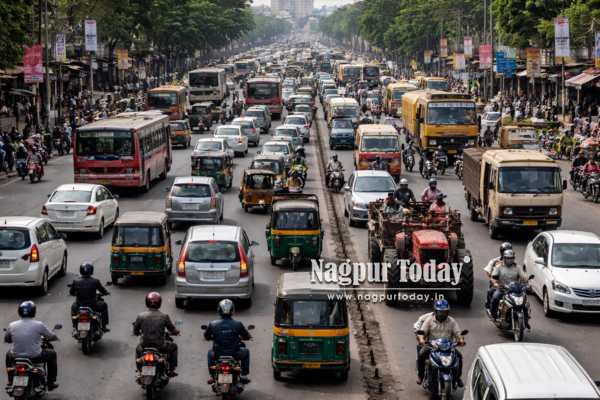
Nagpur: Maharashtra’s roads are groaning under the weight of an ever-growing fleet of vehicles, with the State adding 40 lakh new motor vehicles in 2025, pushing the total to a staggering 5.28 crore as of January 1, 2026. The figures, revealed in the Economic Survey of Maharashtra 2025-26 tabled in the Maharashtra Legislative Assembly ahead of the State Budget, paint a worrying picture of rising traffic congestion and escalating air and noise pollution across urban centres.
According to the survey, the number of registered vehicles jumped 8.2% within a year, up from 4.88 crore at the beginning of 2025. With the State now recording nearly 41,000 vehicles for every one lakh people, the rapid motorisation is placing unprecedented pressure on already strained road infrastructure.
Gold Rate
Mar 25,2026 - Time 11.05Hrs

Two-wheelers continue to dominate the State’s vehicle landscape. Motorcycles, scooters and mopeds account for 3.78 crore vehicles, forming the largest share of registrations. Light motor vehicles, including cars, jeeps, station wagons and taxis, number 77.10 lakh, reflecting the steady rise in private car ownership.
Apart from these, the State has 12.96 lakh auto-rickshaws, 15.93 lakh tractors, 5.20 lakh trailers, 2.01 lakh buses, and 26,002 ambulances as of January 2026.
The survey also highlighted the growing pressure on road infrastructure, noting that 153 vehicles are now competing for every kilometre of road length in the State, a density that continues to worsen traffic bottlenecks, particularly in major cities.
The explosive growth in vehicle numbers is also emerging as a major environmental concern. Urban centres such as Nagpur, Mumbai, and Pune are witnessing a sharp rise in air pollution levels, largely driven by vehicular emissions including carbon monoxide, nitrogen oxides and fine particulate matter.
Environmental experts warn that the surge in vehicles is significantly contributing to deteriorating air quality, increasing the risk of respiratory illnesses, especially among children and the elderly.
Equally alarming is the spike in noise pollution caused by relentless traffic movement, frequent honking and poorly maintained vehicle silencers. Major arterial roads and commercial zones in cities are regularly recording noise levels far above the permissible limits prescribed by pollution control authorities.
With traffic volumes increasing far faster than road capacity, experts say the State urgently needs stronger public transport networks, stricter emission checks and effective traffic management measures to prevent the situation from spiralling into a full-blown environmental and public health crisis.